Yacht Broker Reviews and Testimonials, Asked of Every Client.
The closing is when a buyer or seller is most likely to say how it went. Ask all of them, not just the ones who are smiling: that is both what reads as honest and what the FTC’s 2024 rule on reviews and testimonials expects. Then put their words on your website and their broker’s profile.
- The rule
- 16 CFR Part 465
- In force since
- Oct 21, 2024
- Testimonials
- Every plan, from $350/mo
Six lines a brokerage shouldn’t cross.
The Trade Regulation Rule on the Use of Consumer Reviews and Testimonials took effect on October 21, 2024, and lets courts impose civil penalties for knowing violations. The Endorsement Guides sit beside it. Here is each part in brokerage terms.
| Section | What it prohibits | At a brokerage |
|---|---|---|
| 16 CFR 465.2Fake reviews and testimonials | Writing, buying or publishing a review or testimonial that misrepresents who wrote it, whether they used the business, or what their experience was. | Every quote on your site is a real buyer or seller, in their own words. Nothing drafted for them to sign off. |
| 16 CFR 465.4Paying for a positive review | Offering money or another incentive conditioned, openly or by implication, on the review saying something positive or negative. | No “thank-you gift for five stars”. Google goes further and bans incentives for reviews altogether. |
| 16 CFR 465.5Insider reviews | Officers and managers reviewing their own business without disclosing it, and testimonials from staff or agents put out without the connection made clear. | Brokers, the office manager and their families don't review the brokerage as if they were clients. |
| 16 CFR 465.7Review suppression | Unfounded legal threats, intimidation or knowingly false accusations to stop or remove a review, and presenting displayed reviews as all of them while hiding the negative ones. | Answer a bad review in public, factually. Never threaten a client over one, and don't call a curated page “all our reviews”. |
| 16 CFR 255.2(d), Example 11Review gating (Endorsement Guides) | Inviting only customers who gave very positive feedback to post reviews may be unfair or deceptive if it makes the posted reviews more positive than they would otherwise be. | Ask everyone who closed, buyer and seller, with the same link. Asking everyone while hoping for good reviews is fine. |
| 16 CFR 255.2(b)Results that look typical | A testimonial about a key result is read as what customers generally achieve, unless that is substantiated or the generally expected result is disclosed. | “Sold in nine days at asking” needs your real numbers behind it, or a plain note on what usually happens. |
Summarised from 16 CFR Part 465, the FTC’s Questions and Answers on the rule, and the Endorsement Guides (16 CFR Part 255). The rule itself has no clause on asking only happy clients; the FTC’s Q&A points to the Endorsement Guides for that. Google’s own review policy separately forbids selectively soliciting positive reviews and offering incentives. This is a plain-language summary, not legal advice.
Ask the buyer and the seller, every time.
- 1
One link, every client
Your Google review link, or the reviews page on your site that carries it. The same link goes to every buyer and every seller.
- 2
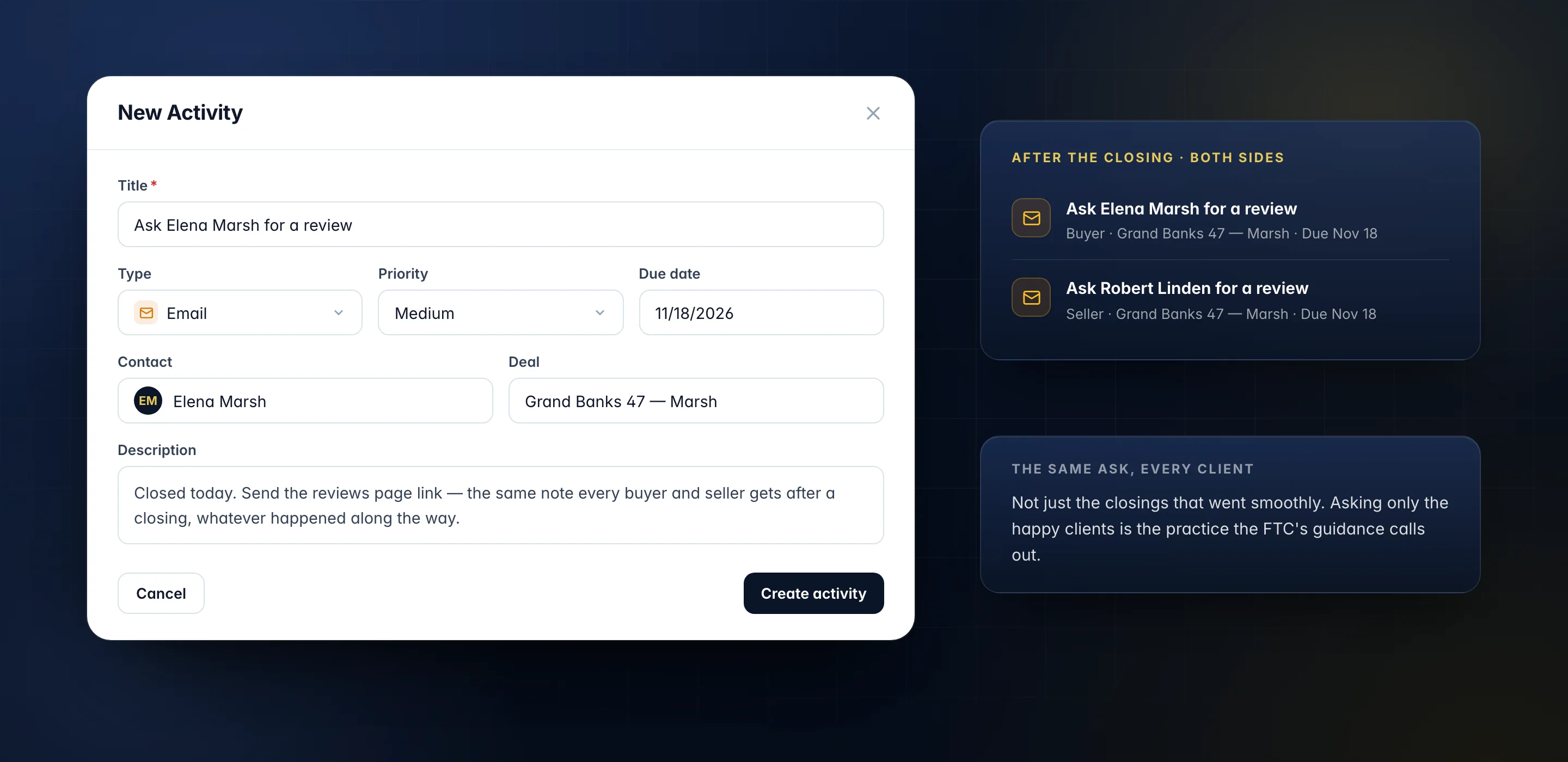
A reminder on the closed deal
Add an activity for each side of the closing, linked to the deal and the contact. It sits on the broker's morning task email until it's done.
- 3
The same words, whatever happened
The closing where the survey turned up a soft deck gets the same ask as the one that went perfectly. That is the whole rule, in practice.
Their words on your site, the full list on Google.
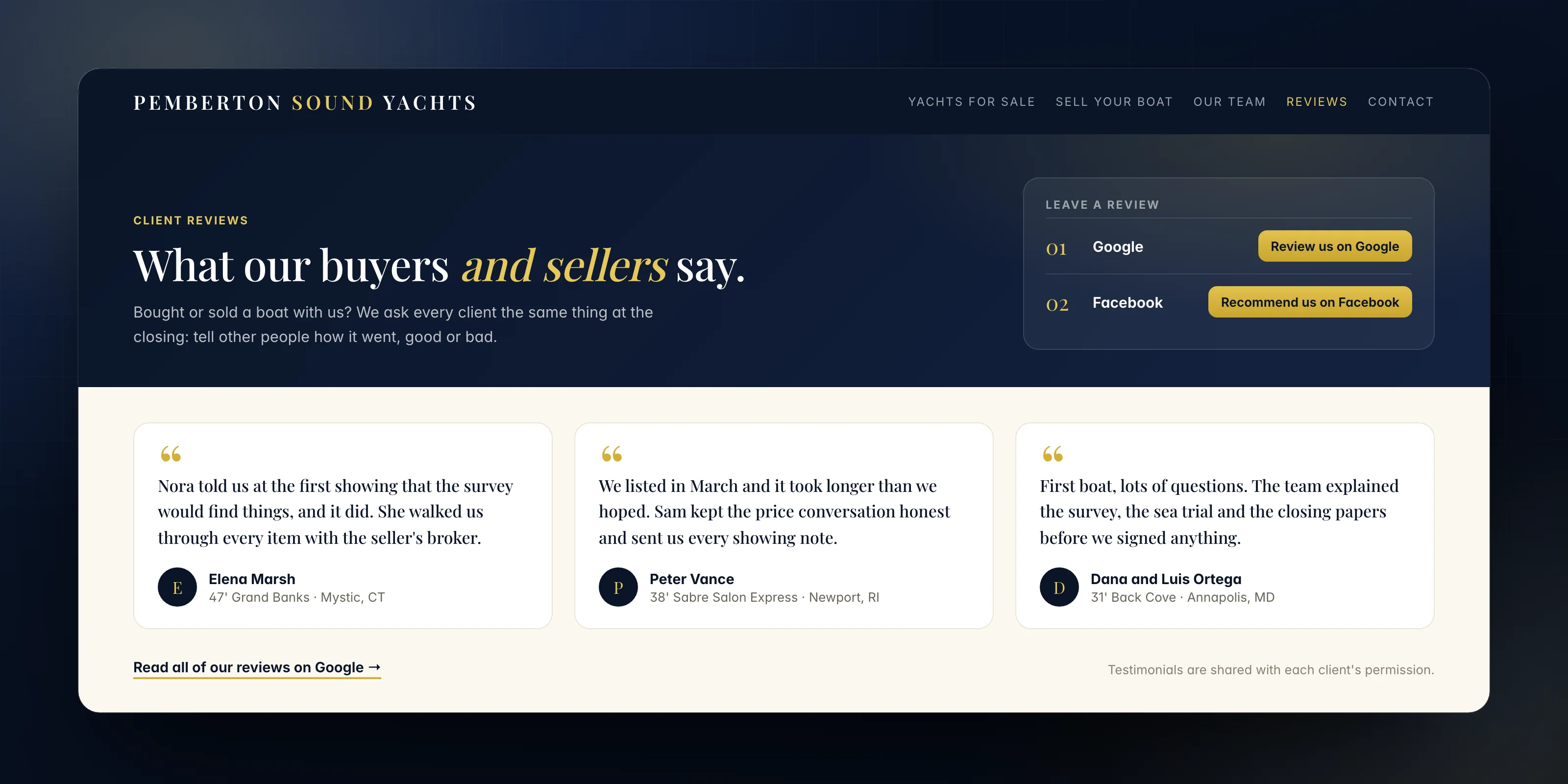
A reviews page that asks every client to review you, shows the testimonials they agreed to share, and sends anyone who wants the whole picture to your Google page.
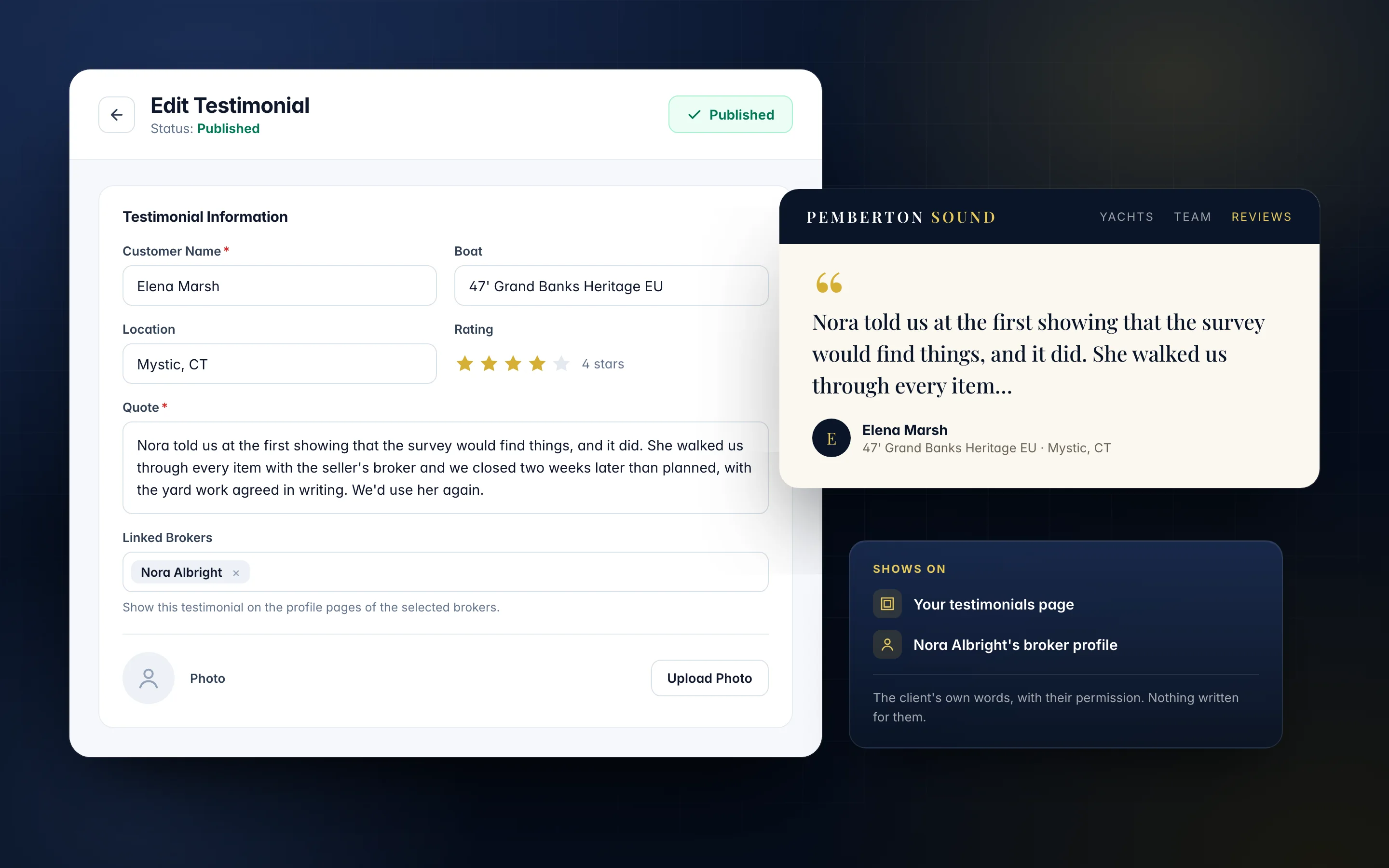
Testimonials you publish
Typed into your admin with the client's name, boat and town, saved as a draft, published when the client has said yes. Drag them into the order you want.
On the broker's profile
Link a testimonial to the broker it's about, and we can show it on that broker's profile page beside their listings.
Your Google page, linked
A Review us on Google button for clients, and a link to read every review on Google for everyone else. The full picture is one click away.
Four things YachtOne deliberately doesn’t do.
Review tools that decide who gets asked, or quietly keep the low scores off the page, are the ones the rules are written about. Here is exactly where the line sits in YachtOne.
It doesn't email review requests for you.
The ask stays a person's job: an activity on the deal, the same link for everyone.
It doesn't pull your Google reviews in live.
We add a Google review link to the site, and any Google reviews you want shown are added by hand, with a link to the full list.
It doesn't hide low ratings.
Nothing in YachtOne filters testimonials by stars. What you publish is your decision, and your responsibility.
It doesn't promise review stars for your site in Google.
Google doesn't give stars to reviews a business controls about itself. Your star rating lives on your Google Business Profile.
Everything Else You Might Ask.
Is it legal to ask only our happy clients for a review?
The FTC's 2024 rule on reviews and testimonials does not ban it in so many words, and the FTC's own Q&A says so. But the FTC's Endorsement Guides describe exactly this, inviting only the customers who gave very positive feedback to post reviews, as a practice that may be unfair or deceptive under Section 5 of the FTC Act when it makes the posted reviews more positive than they would otherwise be (16 CFR 255.2(d) and Example 11).
Asking every buyer and seller is fine, even while you hope for good reviews. Google's own policy is blunter: businesses must not selectively solicit positive reviews.
Can we give a client a gift card or a discount for leaving a review?
Not one that depends on the review being positive. Section 465.4 of the rule makes it unlawful to offer compensation or an incentive conditioned, openly or by implication, on a review saying something good (or something bad).
An incentive that does not depend on what the review says is not barred by the rule, but the FTC expects it to be disclosed, and Google forbids incentives for reviews on Google altogether. The simplest policy for a brokerage is to ask, and not to pay.
Can our brokers, our office manager or their families review the brokerage?
Not without saying who they are. Under section 465.5, an officer or manager who writes a review of their own business must clearly disclose that relationship, and a business may not put out a testimonial from an officer, manager, employee or agent without disclosing the connection when it isn't already obvious.
Managers also shouldn't ask staff or relatives for reviews that end up posted without that disclosure. A general request to everyone who bought from you is exempt. Google treats reviews from current or former employees as a conflict of interest.
Can we choose which testimonials go on our own website?
Testimonials on your own site are your advertising, so the question is honesty rather than completeness. Each one has to be a real client describing their real experience (section 465.2). If a testimonial says the boat sold in nine days or at asking price, the Endorsement Guides treat that as a claim that it is typical, so either you can back it up or you say what generally happens (16 CFR 255.2(b)).
What you must not do is present a hand-picked selection as all your reviews. The FTC's Q&A warns that using non-representative reviews in marketing can be deceptive, which is why a reviews page should link to your full Google page.
A buyer left an unfair review. Can we ask them to take it down?
You can reply and you can talk to them. What section 465.7 forbids is using an unfounded legal threat, intimidation or a public accusation you know is false to stop a review being written or get it removed.
Reply publicly and factually, without the client's private details, and report a review to the platform only if it breaks that platform's rules, for example because it is fake.
Does YachtOne send review requests automatically after a closing?
No. There is no automated review-request email. The ask is a person's job, which is also what keeps it honest: the same link and the same words to every buyer and seller.
What YachtOne gives you is the reminder. Add an activity for the buyer and one for the seller, linked to the closed deal, and each shows up in the broker's morning email of tasks due.
Does YachtOne pull our Google reviews onto the website?
Not as a live feed. We put your own Google review link on the site, usually as a Review us on Google button on a reviews page, so it is one tap for a client after the closing.
If you want Google reviews shown on the site as well, we add them as testimonials and link to your Google page for the full list. They change when you or we change them, not automatically.
Will testimonials on our site give us review stars in Google search?
No, and nothing should try to. Google's review snippet guidelines say that when a business controls the reviews about itself, pages using LocalBusiness or Organization markup are not eligible for star results.
So testimonials on your site do their work on the people reading them, and your Google Business Profile carries your star rating.
Can a testimonial appear on the broker's own profile page?
Yes, where your site's broker pages show testimonials. Each testimonial has a Linked Brokers field, and we set the profile pages up to show the ones linked to that broker, so a client's words about their broker sit next to that broker's listings.
Which YachtOne plan includes testimonials?
Testimonials and the Google review link come with every plan, starting with the $350 a month Website plan. Activities, for the reminder to ask, come with the $500 Website + CRM plan, and deal pipelines with the $850 Full Platform.
More problems we solve
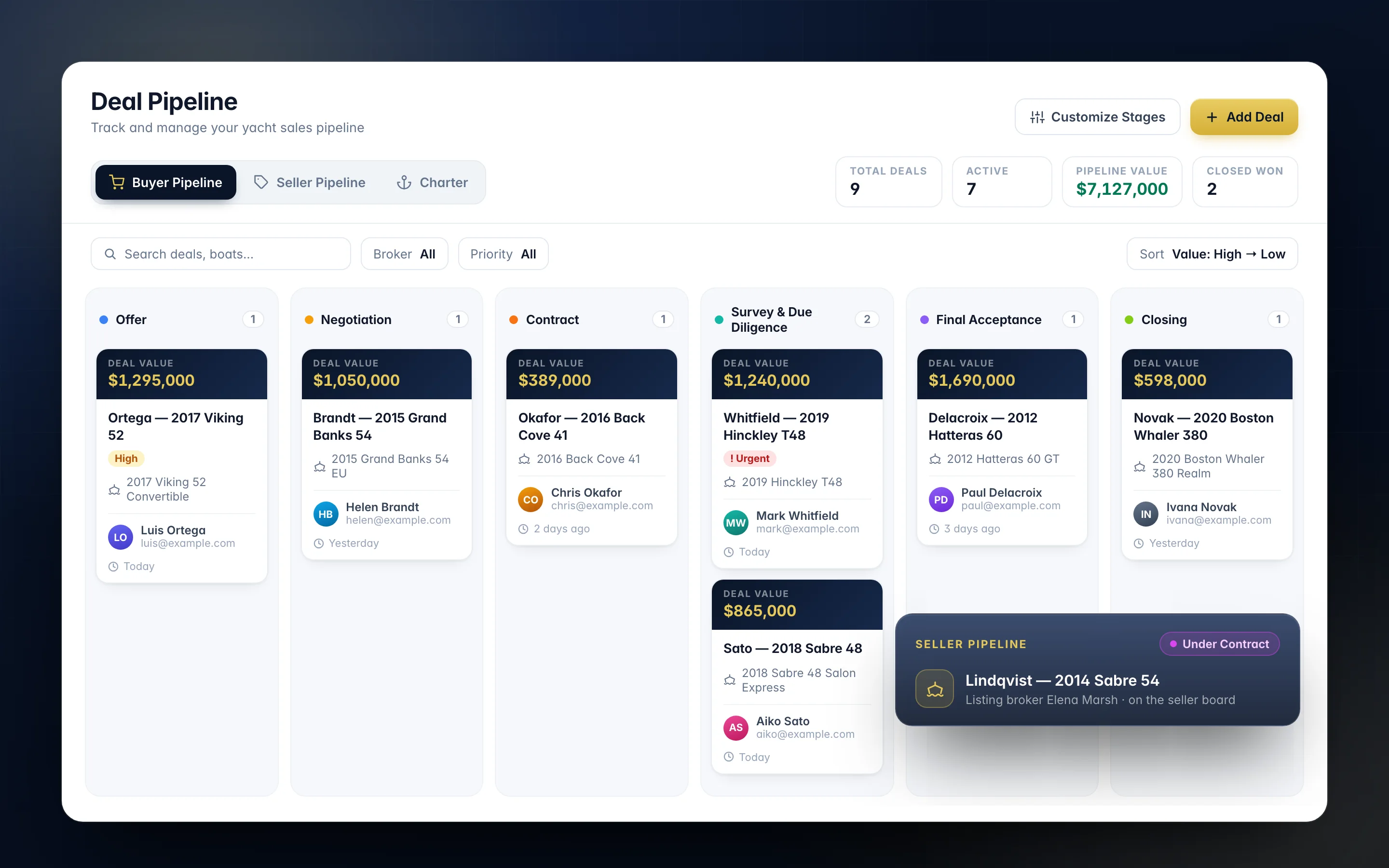
Welcome to the First End-to-End Yacht Sales Operating System
We've built the only platform designed specifically for how yacht sales actually happen. From the moment a visitor lands on your site—they never leave your ecosystem.