CRM for Superyacht Brokers Where an Owner’s Name Stays Need-to-Know.
An owner who won’t be named. A yacht that is for sale but not advertised. A central agency only one broker holds. YachtOne shows each principal to the broker who handles them and to your admins, keeps off-market yachts in your inventory and off your website, and keeps the notes, email and documents of a sale on one record.
- Broker logins see only their own clients
- Off-market yachts stay off the website
- Full Platform · $850 a month
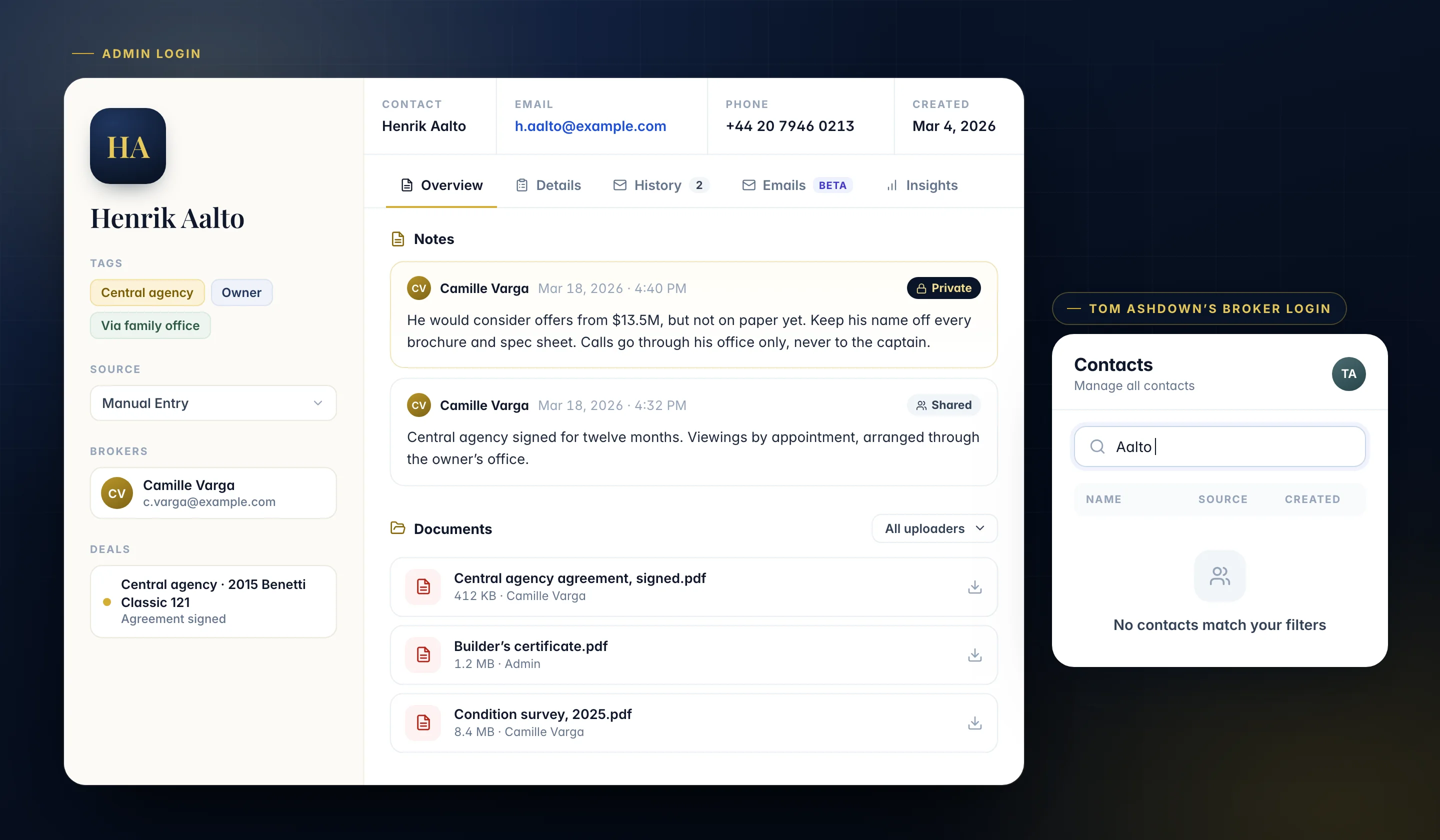
One owner, four ways in.
The owner of a 37-metre motor yacht signs a central agency with your brokerage. Here is what each kind of login, and your website, can see of that sale.
| Record | Admin login | The listing broker | Another broker | Your website |
|---|---|---|---|---|
| The owner's contact record | Yes | Yes | No. Searching the name finds nothing | Never |
| A Private note | Yes | Yes, if they wrote it | No | Never |
| A Shared note | Yes | Yes | Only once added to the contact | Never |
| The deal for the sale | Yes | Yes, as the assigned broker | No | Never |
| The listing broker's Outlook email with the owner | Yes | Yes, it's their own | No | Never |
| Files on the owner's contact | All of them, labelled by who uploaded each | Their own uploads and the admin's | No | Never |
| The yacht, set to Inactive | Yes | Yes, as its broker | No | No page, not in the sitemap |
With broker roles on (Full Platform). “Admin” and “Broker” are levels of access, not job titles, and the broker rules are enforced by the database. How these logins work when someone leaves the firm is on When a Broker Leaves, the Clients Stay.
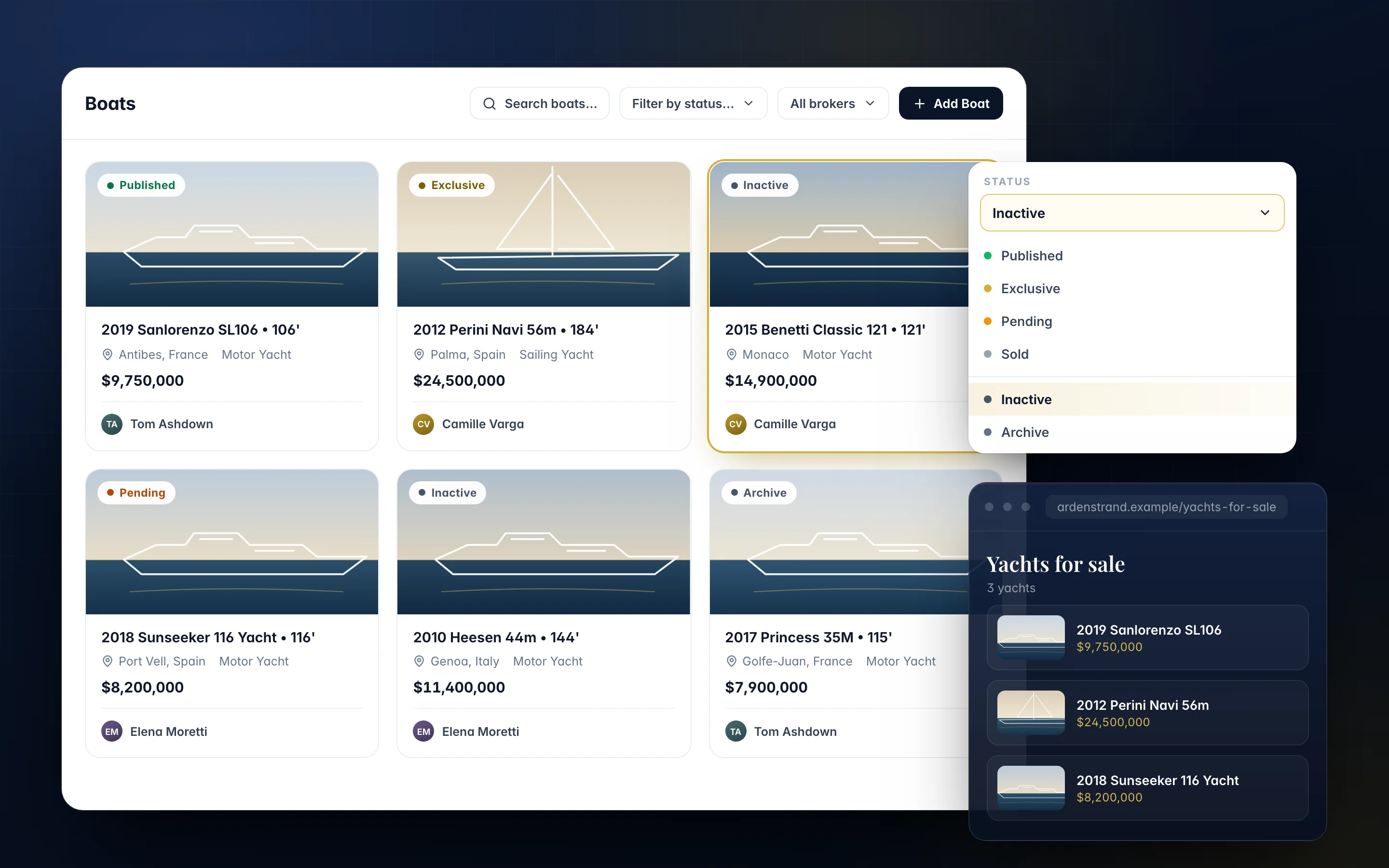
Off the website. Not off your books.
A yacht’s status decides whether the public ever sees it. Set an owner’s yacht to Inactive and it keeps its broker, photos and specification in your admin, with no page on your site and nothing in your sitemap. The AI chat concierge only ever offers Published and Exclusive yachts.
On your website
- Published
- Listed for sale.
- Exclusive
- Listed for sale, as a separate status.
- Pending
- Under contract, keeps its page.
- Sold
- Keeps its page.
Admin only
- Inactive
- Hidden, and back on the site the day you publish it.
- Archive
- Retired, kept as a record.
- Draft
- A new boat, until its first publish.
Not in your inventory at all? A deal can carry a yacht typed in by hand (builder, model, year, length and price) without a listing behind it. More on deals in the yacht deal pipeline.
Two kinds of listing, kept apart.
There’s no central-agency switch in YachtOne. This is how brokerages set it up with the pipelines, tags and fields that are there.
The owner appoints one brokerage to run the sale, and other brokers come through it.
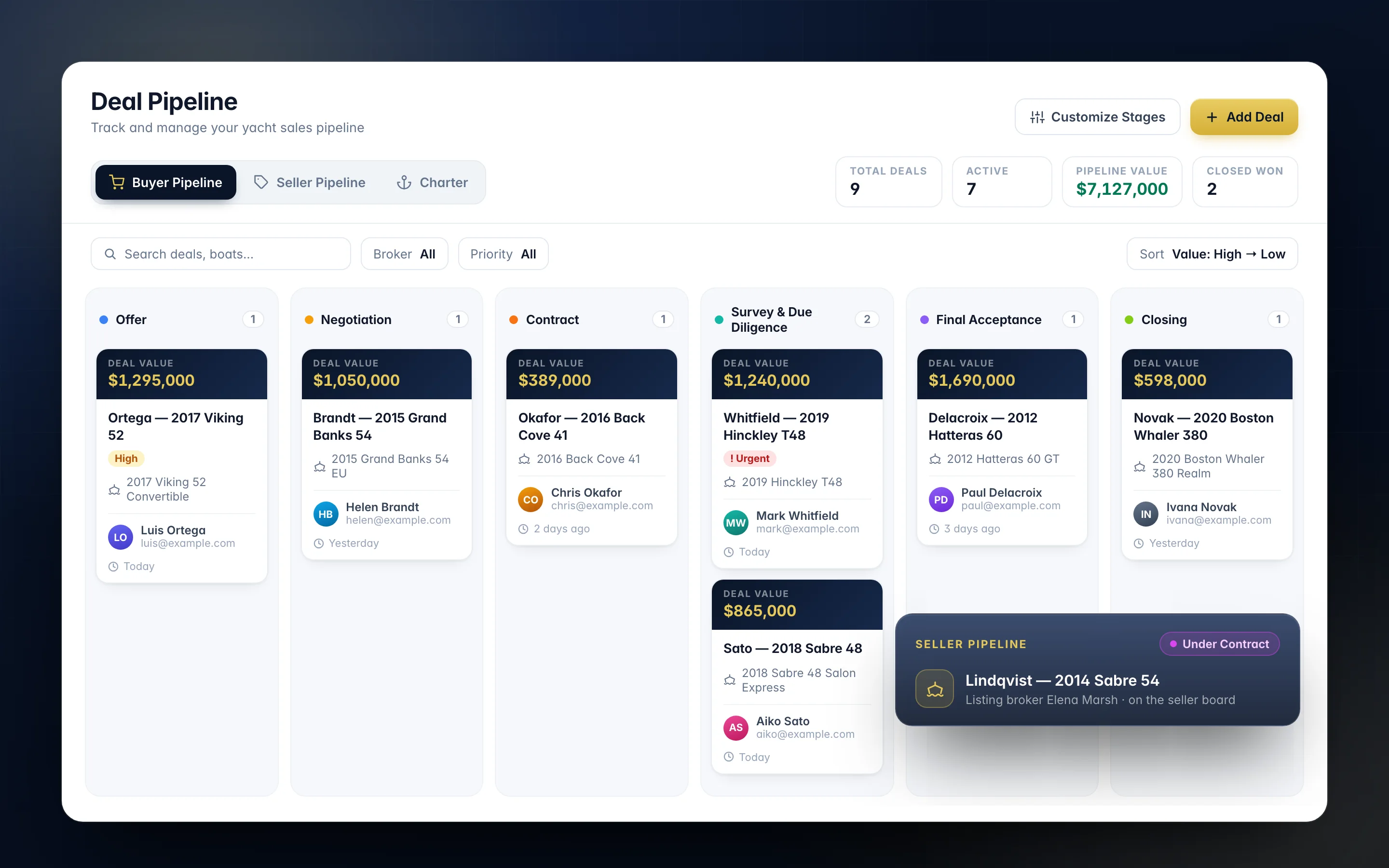
- An admin renames a spare deal pipeline “Central agencies” and names its stages: agreement signed, offer in, under contract, closed.
- The signed agreement, inventory list and certificates go on the deal’s Documents tab.
- The owner’s contact carries a “Central agency” tag, so the record says it at a glance.
The owner lets more than one broker offer the yacht.
- The deal sits in the Seller Pipeline like any other listing.
- A dropdown custom field on the deal can record the listing type, if you want it written down.
- Published on your website, or Inactive while the owner decides.
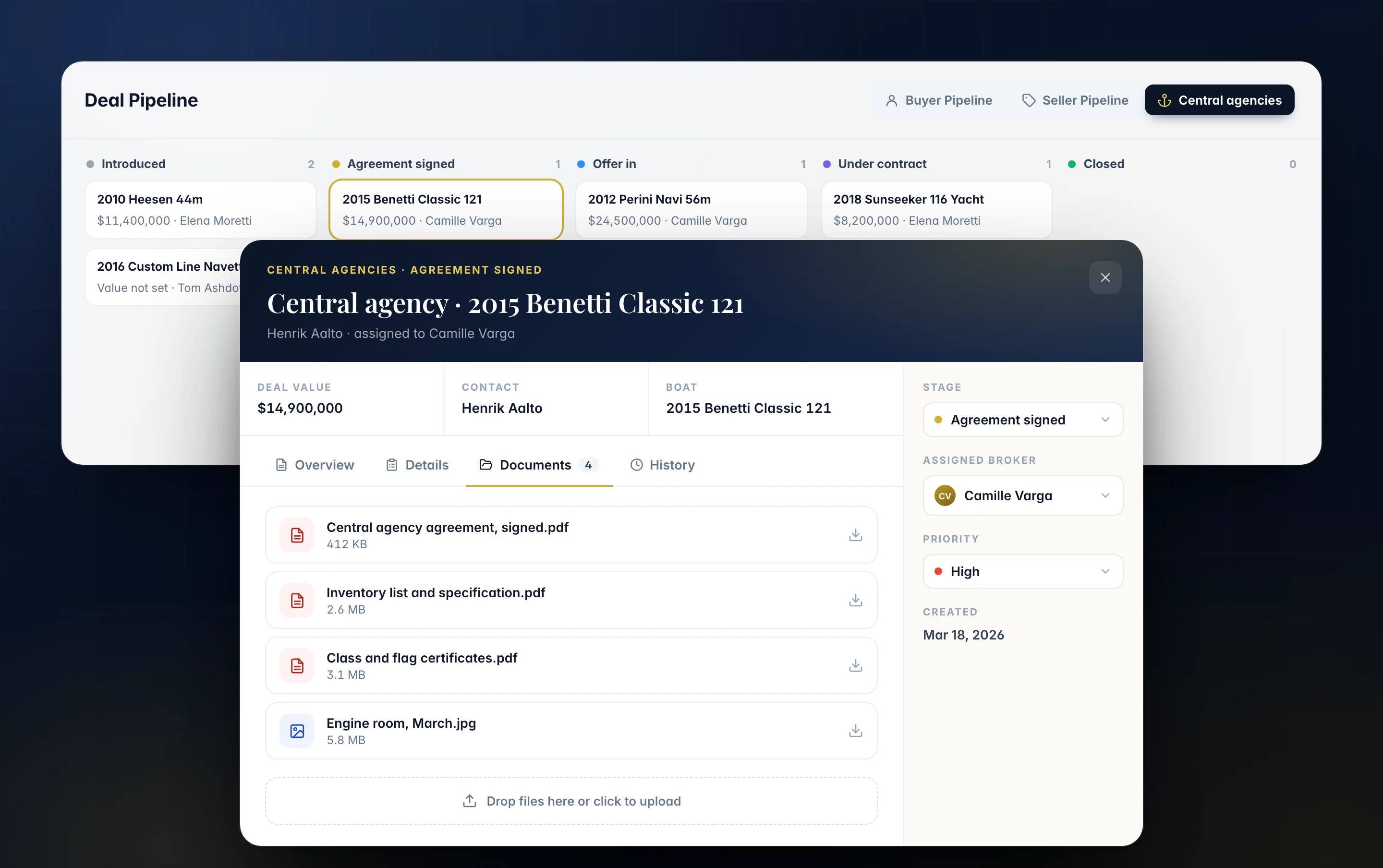
A deal opens for admins and the broker it is assigned to. Its files are kept in private storage and open through links that expire after an hour.
From 10 July 2027, €7.5 million is a line in EU law.
Regulation (EU) 2024/1624 of 31 May 2024 brings the sale of large private yachts under the EU’s anti-money-laundering rulebook. What it says, in its own words:
- Article 3, point (3)(f)
- Obliged entities include “persons trading, as a regular or principal professional activity, in high-value goods”.
- Annex IV, point (5)
- High-value goods include “watercraft of a price exceeding EUR 7 500 000 or the equivalent in national currency”.
- Article 74(1)(b)
- Persons trading in high-value goods report to the Financial Intelligence Unit every sale of watercraft “for a price of at least EUR 7 500 000” bought for non-commercial purposes.
- Article 19(1)
- Customer due diligence applies when a business relationship starts and on an occasional transaction of at least €10,000, among other triggers.
- Article 77(3)
- Due-diligence records are kept for 5 years from the end of the relationship or the date of the transaction.
- Article 80(1)
- Cash payments for goods are capped at €10,000.
Whether a broker who arranges a sale, rather than trading the yacht, is one of those “persons trading” depends on how the rule is read and enforced where you work. Ask your lawyer or your national supervisor. This is general information, not legal advice.
What YachtOne keeps
- Who the client is, and which broker handles them
- Every deal, with its stage, value and assigned broker
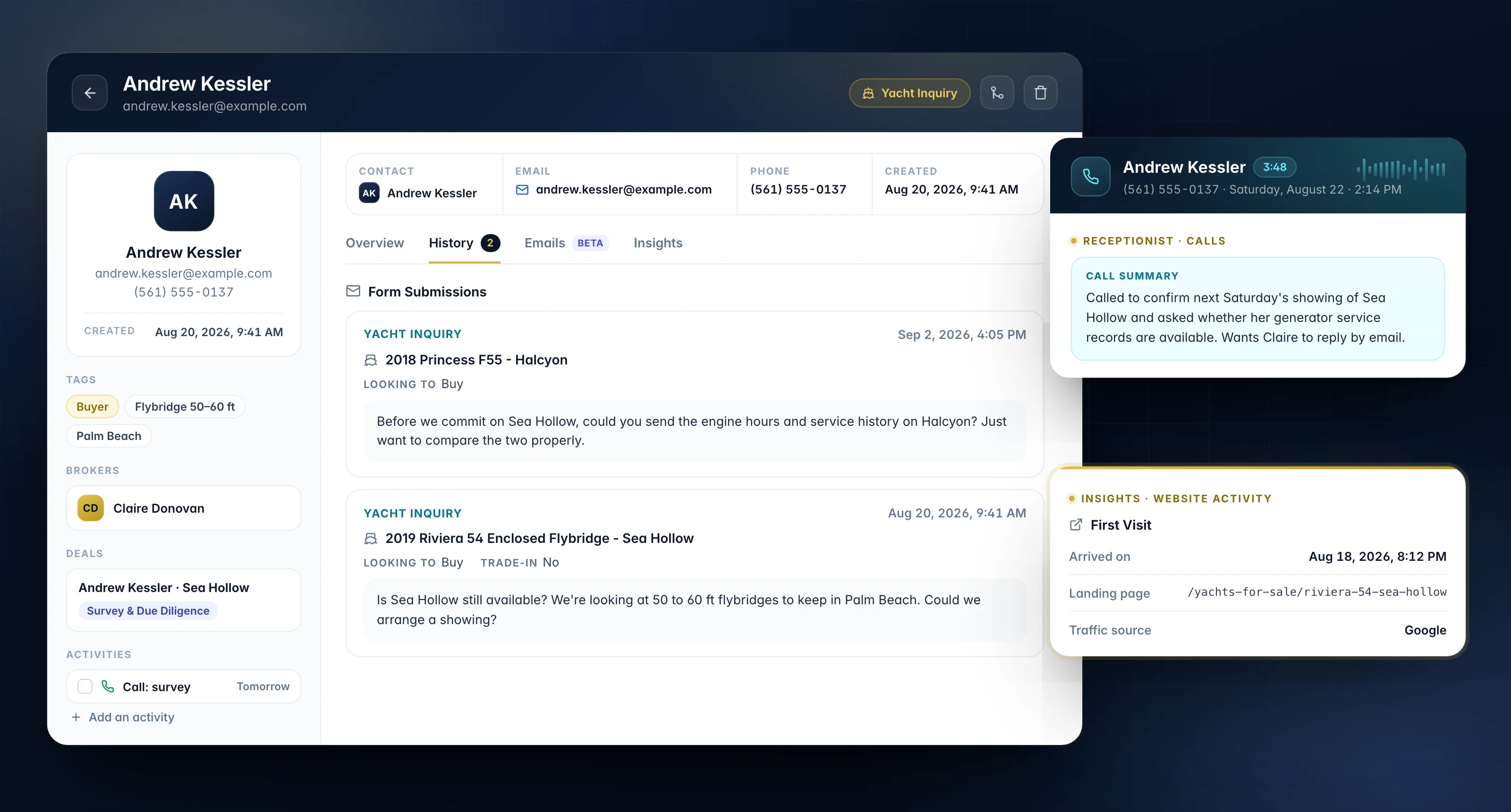
- Private and shared notes, each with its author and time
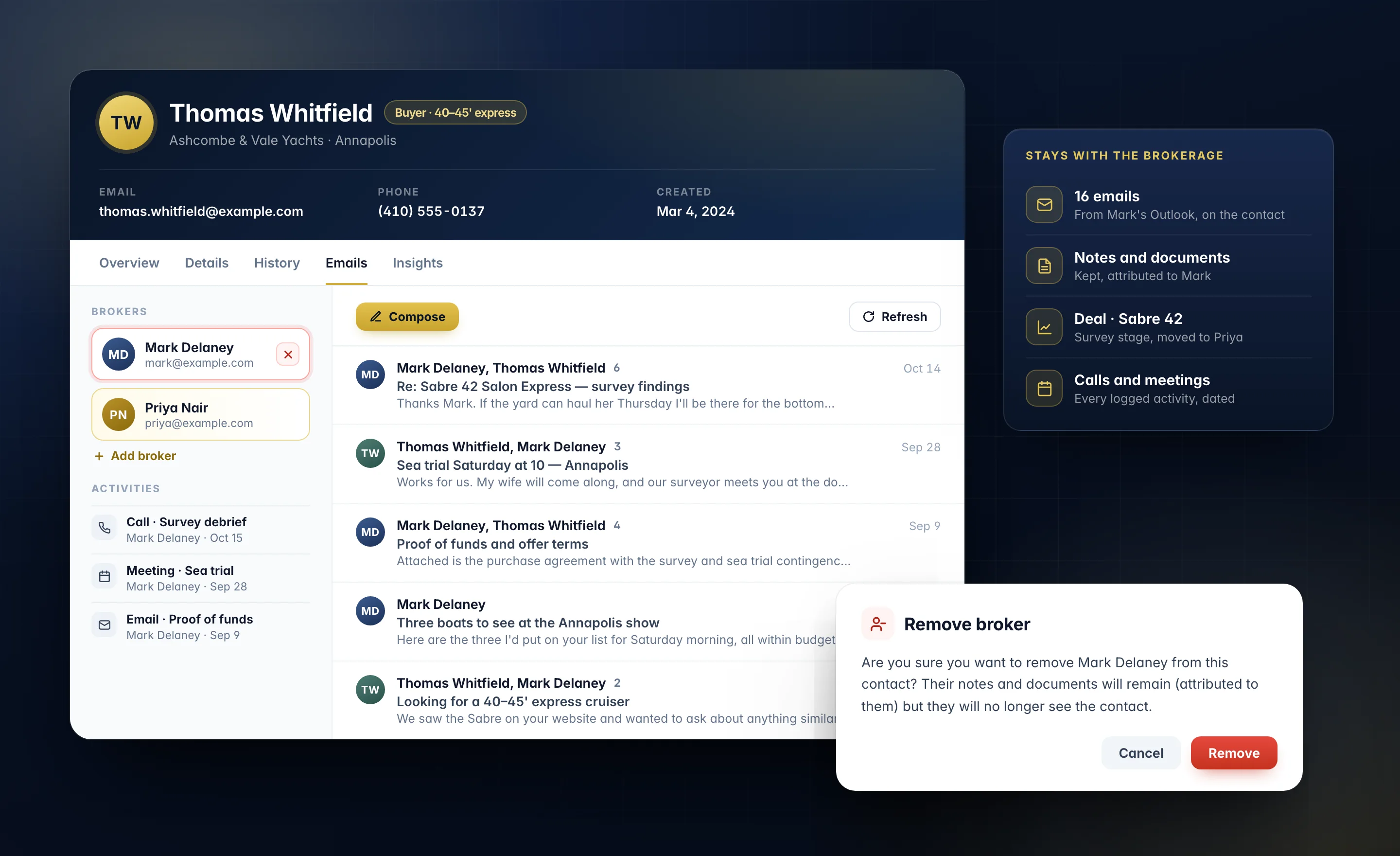
- Outlook email with the client, from the day a mailbox is connected
- The files you upload to the contact and the deal
What it doesn’t do
- Verify passports or other identity documents
- Screen for sanctions or politically exposed persons
- Check beneficial ownership
- File reports with an FIU
- Lock records: people with access can edit or delete them
A CRM holds the sales record around a client. It isn’t a KYC tool or an AML archive; use one built for that.
Five things to know first.
Better to hear them here than after you have moved your book across. Everything else on this page is in the product today.
Everything in the YachtOne CRM- 01
Prices in euros
A listing is priced in US or Canadian dollars, and deal values are kept in US dollars.
- 02
MYBA forms, NDAs and e-signature
Upload the signed copy to the contact or the deal. YachtOne doesn’t generate, send or sign contracts.
- 03
A central-agency field
There isn’t one. A renamed pipeline, a tag and a custom field do the job.
- 04
Yachts from a listing feed
They take their status from the feed. An off-market yacht is one you add in the admin.
- 05
Admin logins see everything
That is what full access means. Give admin logins to the people who need them, and broker logins to everyone else.
Everything Else You Might Ask.
Can I keep a yacht owner's identity from the rest of my team?
From the other brokers, yes. With broker roles on, a broker login only loads the contacts they are attached to, so a colleague who searches for the owner's name gets no result. That rule is enforced by the database, not just hidden in the screen.
Admins see every contact, so anyone you give an admin login can see the owner. Keep admin logins to the people who need them, and write the sensitive part of a note as Private: only its author and admins can read it.
How do I keep a yacht off the market but still in our system?
Add the boat in the admin and set its status to Inactive. An Inactive boat has no page on your website, isn't in your sitemap, and the AI chat concierge won't offer it. It stays in your inventory, with its broker, photos and specification, and you can publish it the day the owner agrees.
If the owner doesn't want it in your inventory at all, leave it out: a deal can carry a vessel typed in by hand (builder, model, year, length, price) without linking a listing.
Does YachtOne track central agency and open listings separately?
There's no central-agency field built in. Brokerages set it up with what's there: an admin renames one of the spare deal pipelines to “Central agencies” and names its stages, a dropdown custom field on the deal can record the listing type, and the owner's contact gets a tag.
On the website side, Published and Exclusive are separate statuses, and both show on your site.
Do the EU anti-money-laundering rules apply to superyacht brokers?
Regulation (EU) 2024/1624 applies from 10 July 2027. It makes “persons trading, as a regular or principal professional activity, in high-value goods” obliged entities (Article 3, point (3)(f)), and its Annex IV lists “watercraft of a price exceeding EUR 7 500 000”. Under Article 74 they must report to their Financial Intelligence Unit every sale of watercraft for at least €7,500,000 bought for non-commercial purposes.
Whether a broker who arranges a sale, rather than trading the yacht, counts as one of those persons depends on how the rule is read and enforced where you work. Ask your lawyer or your national supervisor. This is general information, not legal advice.
Can YachtOne do KYC checks or AML reporting?
No. YachtOne doesn't verify identity documents, screen against sanctions or politically-exposed-person lists, check beneficial ownership, or file reports with an FIU. Use a tool or service built for that.
What it does keep is the sales record around the client: who they are, which boat, which broker, the notes, the email (from the day an Outlook mailbox is connected) and the files you upload to the contact and the deal. Records in a CRM can be edited and deleted by people with the right access, so don't treat it as your AML archive.
Can I price a yacht in euros in YachtOne?
Not yet. A listing's price is entered in US or Canadian dollars, and deal values are kept in US dollars. If you sell in euros, that is the gap to know about before you start.
Does YachtOne handle NDAs or MYBA forms?
It stores them, it doesn't produce them. Upload a signed NDA or memorandum of agreement to the contact or the deal and it stays there with the rest of the record. YachtOne doesn't generate, send or e-sign contracts today.
What does a superyacht brokerage need from YachtOne, and what does it cost?
Broker roles, with a private login for each broker, and the deal pipelines are on the Full Platform plan at $850 a month. That plan also includes the website, the contacts CRM with private notes and documents, and Outlook email and calendar sync.
The Website + CRM plan at $500 a month has one admin login and no pipelines, so it doesn't give you the broker-by-broker separation this page is about.
More problems we solve
Welcome to the First End-to-End Yacht Sales Operating System
We've built the only platform designed specifically for how yacht sales actually happen. From the moment a visitor lands on your site—they never leave your ecosystem.