Get Your Yacht Brokerage Into ChatGPT, and Your Listings With It.
YachtWorld, Boat Trader and Rightboat now have apps inside ChatGPT. You don’t need one. When a buyer asks ChatGPT about a boat with search on, it runs web searches, reads the pages it finds and cites them. Whether one of those pages is yours comes down to a short technical list.
- Open to OAI-SearchBot
- Structured data on every boat
- Website plan $350 a month
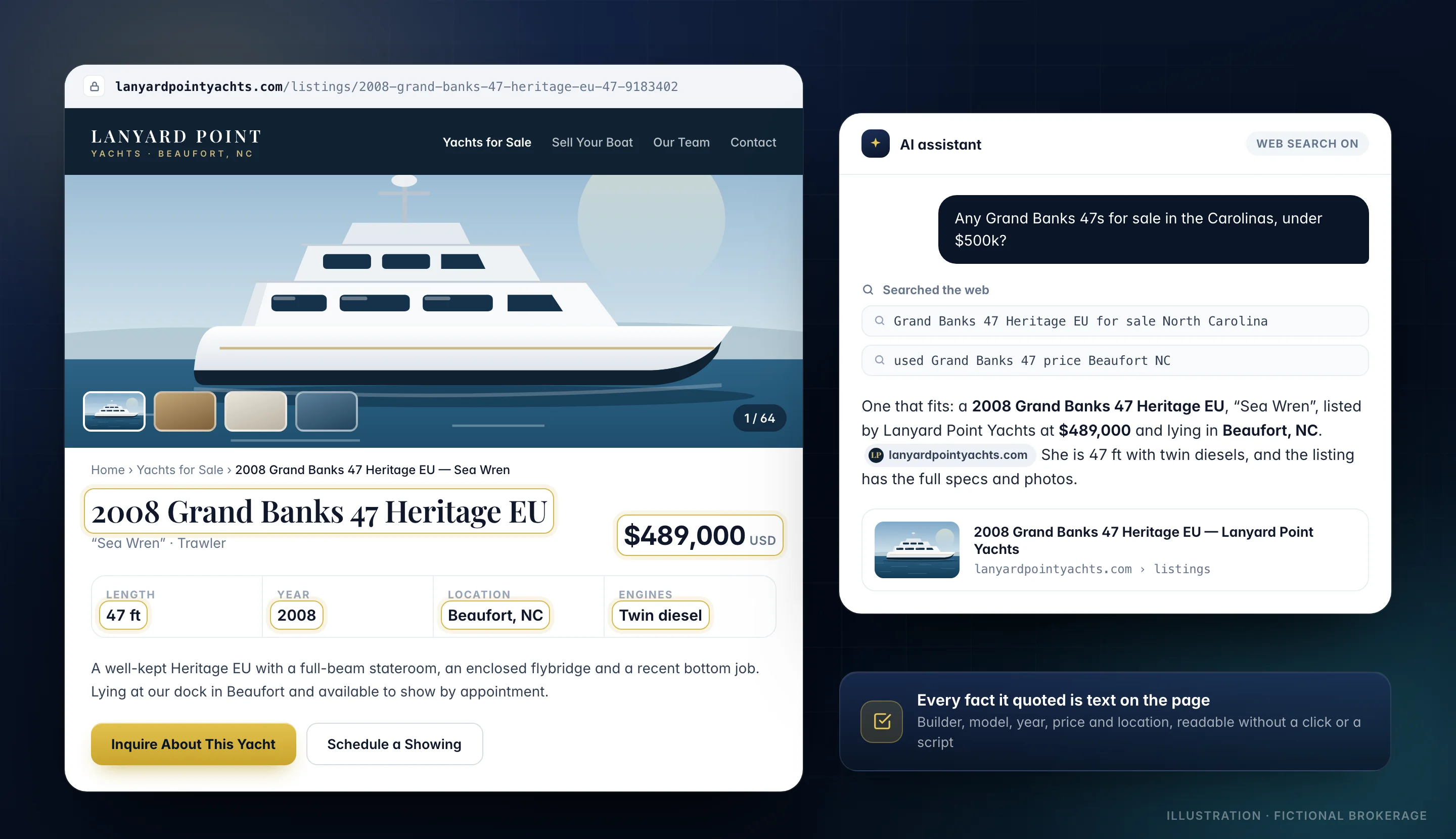
The marketplaces built an app. You need a readable website.
- 5 Aug 2026YachtWorld launches inside ChatGPT
- 12 Aug 2026Boat Trader launches inside ChatGPT
- 26 Oct 2026Rightboat launches inside ChatGPT
An app inside ChatGPT
The buyer chooses to use it, and it searches that company’s own inventory. It makes sense for a marketplace. For a single brokerage it means building and maintaining an app that buyers have to know to pick.
ChatGPT search reading your site
No app. ChatGPT turns the buyer’s question into searches, reads the pages that come back and links the ones it uses. OpenAI says it ranks results on multiple factors and that placement is not guaranteed, so the job is to be the clearest, most complete page about your own boats.
Nine things ChatGPT’s search depends on.
When we put brokers’ questions about AI search to ChatGPT, these are the things it went looking for in OpenAI’s and Google’s own documentation. Each one below has what that source says, and what a YachtOne website already does about it.
Let OAI-SearchBot in
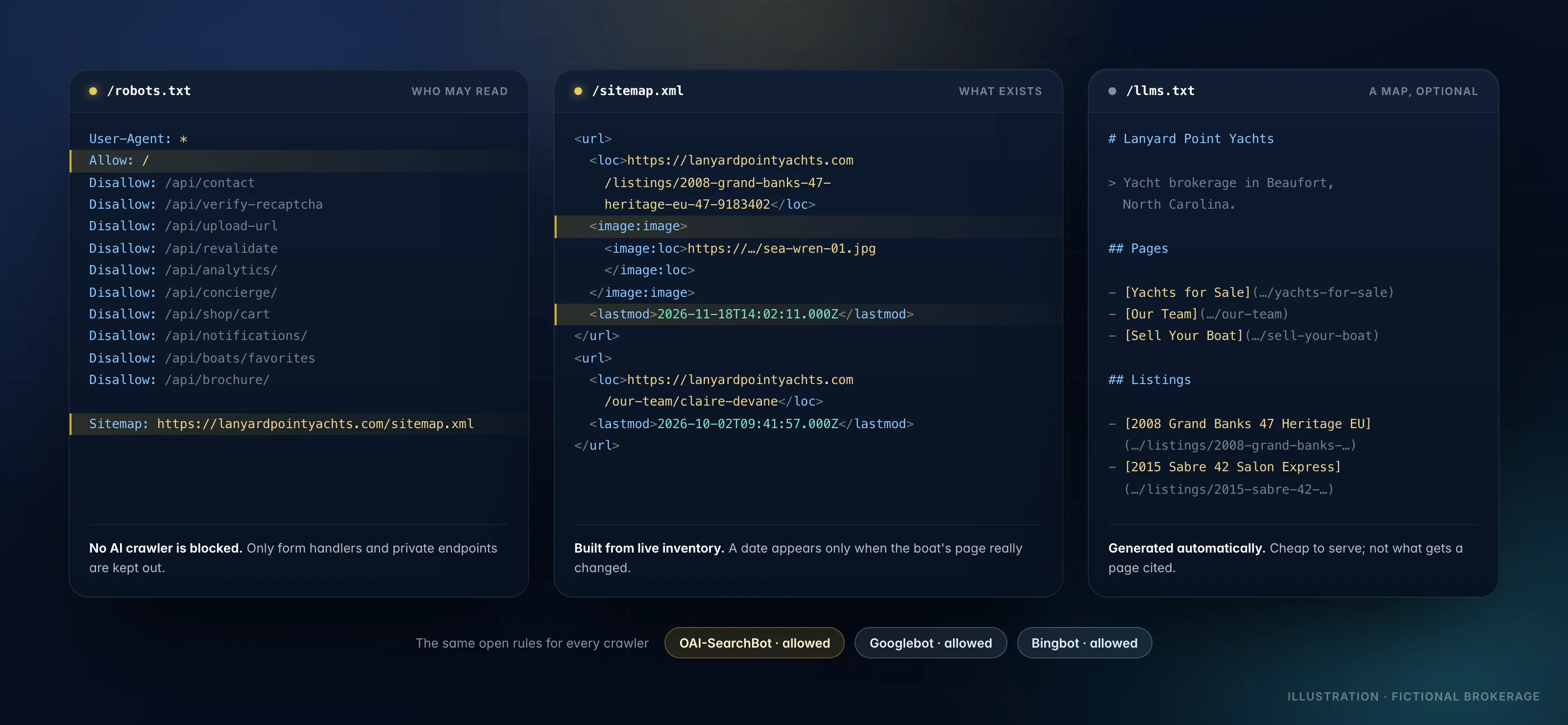
OpenAI crawler documentationOAI-SearchBot is the crawler that decides whether a site can appear in ChatGPT search answers; sites that opt out are not shown in them. GPTBot, which gathers training data, is separate, so you can block one and allow the other. A robots.txt change takes about 24 hours to register. OpenAI's help page adds that your host or CDN must also let its crawler's published IP addresses through.
On a YachtOne siterobots.txt allows every crawler on every public page, AI crawlers included. Only form handlers and private endpoints are kept out.
Give every boat its own page, in the HTML
Google Search CentralGoogle can only index what is in the rendered HTML, can only follow links that are ordinary <a href> links, and recommends server-side rendering because “not all bots can run JavaScript.” A boat that only appears after a search button is pressed may never be seen.
On a YachtOne siteEach boat has its own address under /listings/, rendered on the server with its specs, and the first page of every listings grid is rendered on the server too, so a crawler sees the boats without running a search.
Put the facts in text, near the top
Google Search CentralGoogle lists “making sure that important content is available in textual form” among the basics for its AI features. Year, builder, model, length, price and where she is lying belong in the page as words, not only in a photo caption, a brochure PDF or a gallery overlay.
On a YachtOne siteEach listing's page title and search description are written from that boat's own facts, its length and location, so no two listings share a snippet.
Add structured data to every boat
Google Search CentralGoogle says there is no special schema needed for its AI features, but that structured data must match the visible text on the page. For a listing that means the boat, its price and currency, and whether it is available.
On a YachtOne siteBoat pages carry Product data (builder, model, year, photos, price, availability, condition, seller, length, location) and a breadcrumb. It is built into the listing page every site shares, not left to each site's template.
Keep one subject per page
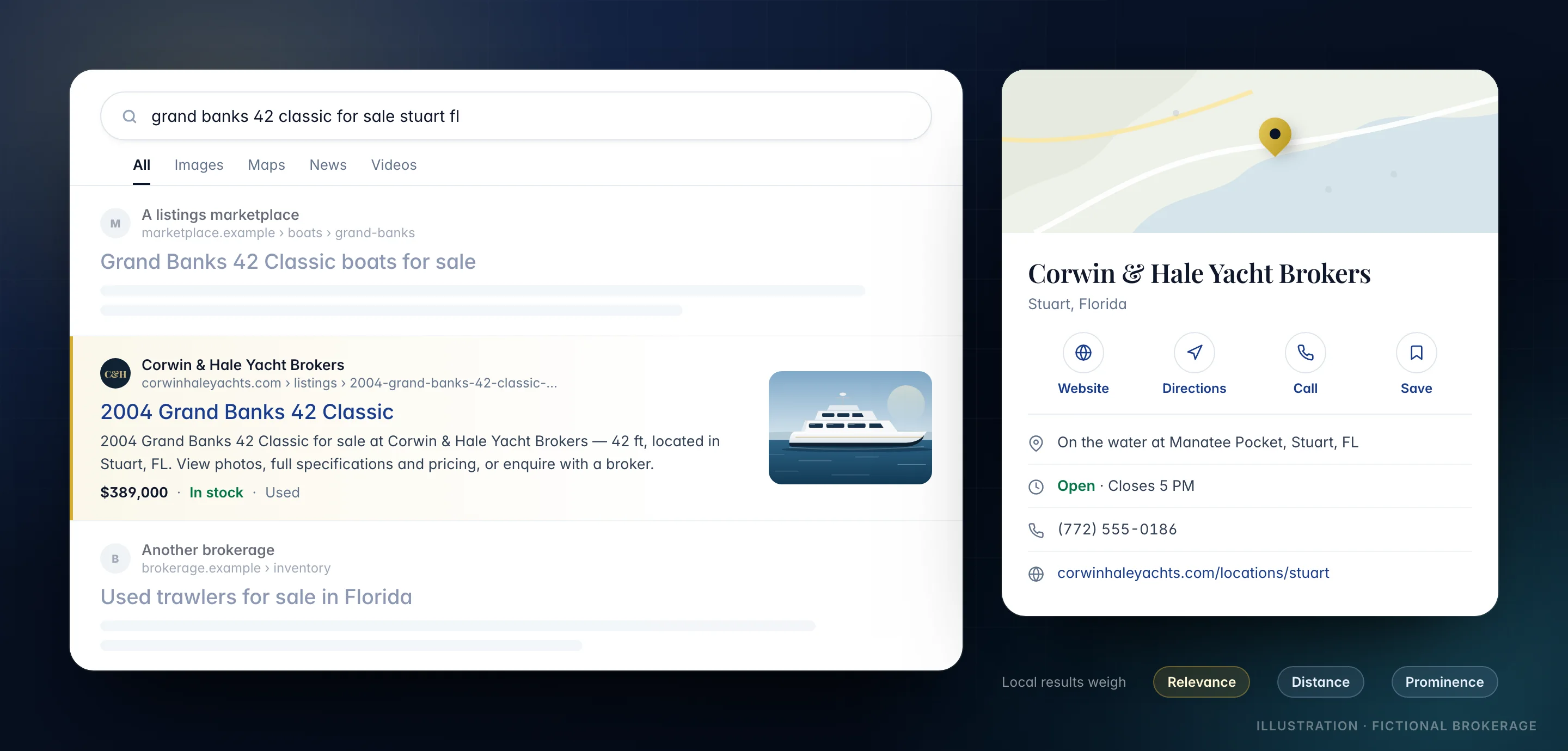
How answers get quotedAn answer engine quotes the page that is clearly about the thing asked. One page that tries to be about every boat, every broker and every office is about none of them.
On a YachtOne siteBoats, broker bios, news articles and, for brokerages with several offices, each office get their own pages, and those pages are listed in the sitemap.
Publish a sitemap that tells the truth
Google Search CentralGoogle uses a sitemap's <lastmod> date only when it is consistently and verifiably accurate, and ignores the priority and change-frequency fields.
On a YachtOne siteThe sitemap is built from live inventory, each boat listed with its photo. A date appears only when the boat's page content really changed, never the time the file was generated.
Be indexed in Bing too
OpenAI help centreChatGPT search sometimes sends rewritten searches to third-party search providers; OpenAI's help page points to Microsoft's privacy policy for how they are handled, and Microsoft runs Bing. Check your site in Bing Webmaster Tools, not only Google Search Console.
On a YachtOne siteThe sitemap's address is in robots.txt, where Bing and Google both look for it.
Make pages fast
Google Search CentralGoogle recommends good Core Web Vitals: the main content painted within 2.5 seconds, a response to taps in under 200 milliseconds, and a layout shift score under 0.1. A slow listing page loses buyers on a phone first.
On a YachtOne sitePages are prerendered and cached, open near-instantly as buyers move from boat to boat, and refresh when you publish a change.
Treat llms.txt as optional
Google Search Central · llmstxt.orgllms.txt is a proposal for giving AI tools a short map of a site. Google says you don't need new machine-readable files or AI text files to appear in its AI features, and OpenAI doesn't document using it. Do it if it is free; don't expect it to do the work.
On a YachtOne siteEvery site serves one, generated from its pages, current listings and recent news, so it never needs editing.
What the buyer sees, and what the crawler reads.
Every boat page on a YachtOne site carries its facts twice: once as the page a buyer reads, once as structured data in the HTML. Each number on the left matches the line it becomes on the right.
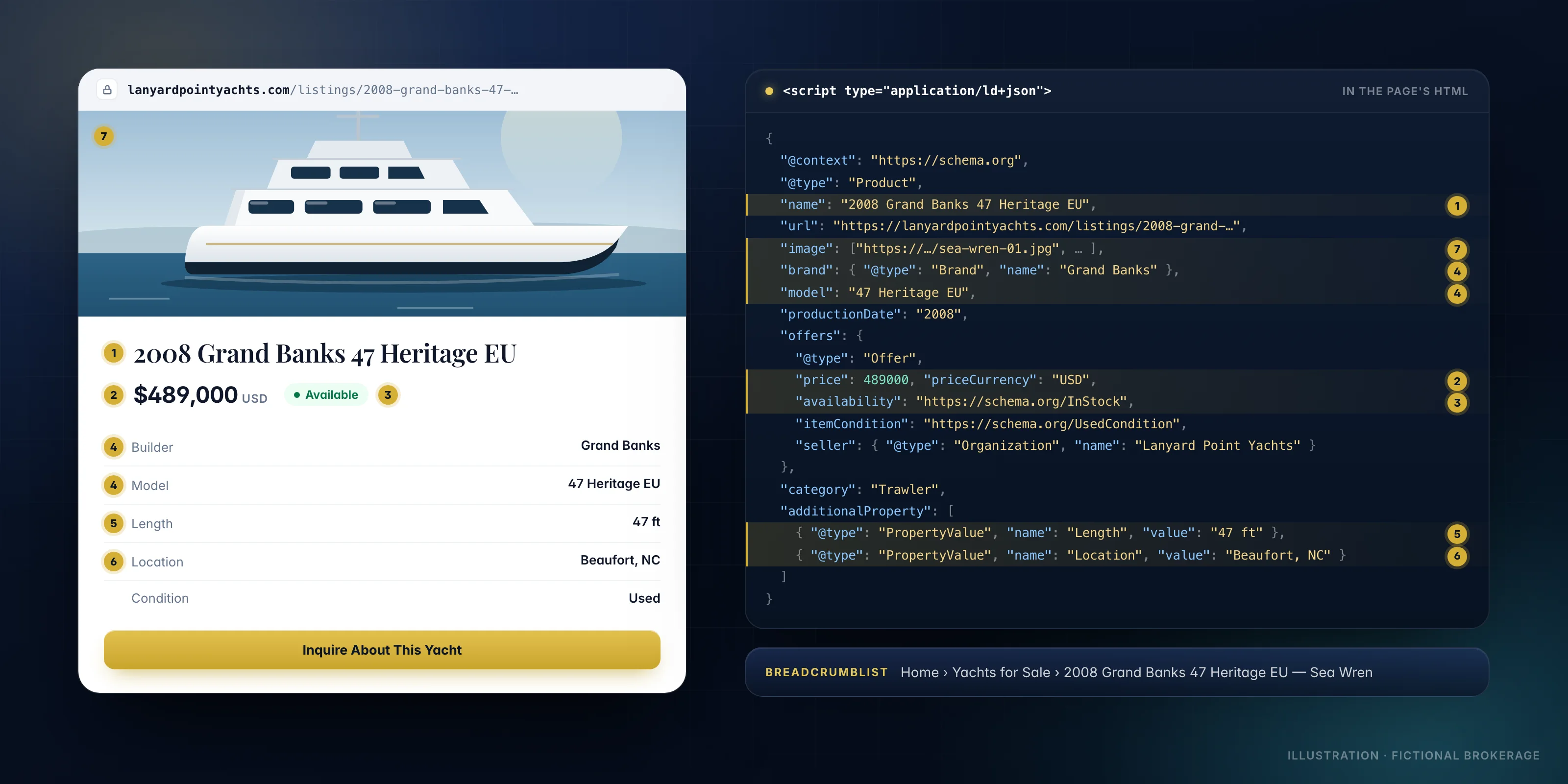
Written once, published twice
The visible spec table and the structured data come from the same boat record, so they can't disagree: Google's own rule for structured data.
Status kept honest
Availability follows the listing: in stock, pending or sold. A sold boat is never marked available in the markup.
No placeholder prices
When a price is hidden or missing, the Offer is left out entirely rather than filled with a zero or “call for price”.
Check your own site today.
Five checks you can run on whatever website you have now.
- 1
Open yoursite.com/robots.txt
Look for Disallow: / under User-agent: * or under OAI-SearchBot. Either one keeps you out of ChatGPT search.
- 2
View the source of one listing
Search the raw HTML for the boat's price. If it isn't there, a crawler that doesn't run JavaScript can't see it either.
- 3
Run that listing through Google's Rich Results Test
It shows whether the page carries Product data, and whether the price and availability in it match the page.
- 4
Search Bing for site:yourdomain.com
If your listings aren't in Bing's index, verify the site in Bing Webmaster Tools and submit your sitemap.
- 5
Ask ChatGPT about one of your boats
With search on, ask for the year, builder and model in your region. See which pages it cites, and whether yours is one.
Everything Else You Might Ask.
Can ChatGPT see my yacht listings?
If they are on public pages it can reach, yes. When ChatGPT searches the web it reads public pages and cites the ones it uses. OpenAI's own help page says a site has to allow its search crawler, OAI-SearchBot, to be eligible, and that placement is not guaranteed.
What stops a listing being read is usually one of three things: robots.txt blocks the crawler, the boat's details only appear after a script runs or a button is clicked, or the facts are in photos and PDFs rather than text on the page.
YachtWorld and Boat Trader have apps in ChatGPT. Do I need one?
No. An app inside ChatGPT is something a buyer chooses to use, and it searches that company's own inventory. It makes sense for a marketplace that carries many brokerages' boats.
A brokerage is found a different way: when a buyer asks ChatGPT a question with search on, it runs web searches, reads pages and cites them. Your own site can be one of those pages without any app at all, as long as it is open to the crawler and says plainly what you have.
If I block GPTBot, am I blocking ChatGPT search?
No. OpenAI runs separate crawlers and documents them separately. GPTBot collects content that may be used to train its models. OAI-SearchBot is the one that decides whether a site can appear in ChatGPT search answers.
OpenAI says each setting is independent, so a site can block GPTBot and still allow OAI-SearchBot. It also says a robots.txt change can take about 24 hours to be reflected in search.
Does ChatGPT search use Bing?
OpenAI's help page says ChatGPT search sometimes partners with other search providers, rewriting the question into searches that it sends to them, and it points to Microsoft's and Shopify's privacy policies for how those providers handle the queries. Microsoft runs Bing.
OpenAI does not say how much each provider contributes, so the safe course is simple: make sure your site is indexed in Bing as well as Google. Bing Webmaster Tools shows which of your pages it has.
Is llms.txt worth having?
It does no harm, but it is not what gets a page cited. llms.txt is a proposed file that gives AI tools a short map of a site. Google's guidance on its AI features says you do not need to create new machine-readable files or AI text files to appear in them, and OpenAI does not document using llms.txt for ChatGPT search.
Every YachtOne website serves one anyway, because it is generated automatically from the site's own pages, current listings and recent news, and costs nothing to keep up to date. The work that matters is the rest of the checklist on this page.
What structured data should a boat listing have?
A Product (or Vehicle) node naming the boat, with its builder as the brand, the model, the year, photos and the page's address, and an Offer carrying the price, the currency, whether the boat is available, under offer or sold, whether it is new or used, and who is selling it. Length and location can be added as properties, and a BreadcrumbList shows where the page sits on the site.
Google's rule is that structured data has to match what the page visibly shows. On a YachtOne site both come from the same boat record, and when you hide a price the Offer is left out rather than filled with a placeholder.
Does this help with Google's AI Overviews too?
Mostly, yes. Google says there are no extra requirements for AI Overviews or AI Mode beyond ordinary search best practice: let Googlebot crawl, put the important content in text, keep structured data matching the visible page, and give people a good page experience. The same checklist covers both.
Can you do this on our existing website?
The checklist works on any website, and you can hand it to whoever runs yours. Most of it is settings and templates rather than new content.
What this page describes as already done is how YachtOne websites are built. The Website plan is $350 a month, and there is no build fee: your first month covers the build.
More problems we solve
Welcome to the First End-to-End Yacht Sales Operating System
We've built the only platform designed specifically for how yacht sales actually happen. From the moment a visitor lands on your site—they never leave your ecosystem.