SEO for Yacht Brokerages: When the Portal Outranks Your Own Listing.
Search for a boat you list and a portal’s copy often comes first. Here is how Google decides, which parts you can’t change, and the parts you can: your Business Profile, your office pages, the listing page itself, its speed, and what happens to your old addresses when you rebuild.
Three things Google does with the same boat on two sites.
- 01
It ranks pages, not listing owners
Nothing in how Google ranks results gives the listing broker's own page priority over a portal's copy of the same boat.
- 02
It shows one copy of a duplicate
Pages that look the same are grouped, and Google picks the one it judges “most complete and useful for search users.” Your canonical tag is a hint, not a rule.
- 03
It doesn't penalise the duplicate
Google says some duplicate content is normal and not a spam violation. There's no penalty to fear, and no tie-breaker in your favour either.
Out of your hands
- How strong the portal's whole site is
- That the portal carries the same feed text and photos
- Which copy Google decides to show
In your hands
- A description written for the boat, not pasted from the feed
- The details only the listing broker knows
- A Business Profile that points at the right office
- How fast your pages load, and how cleanly they are marked up
- Keeping your old addresses alive when you rebuild
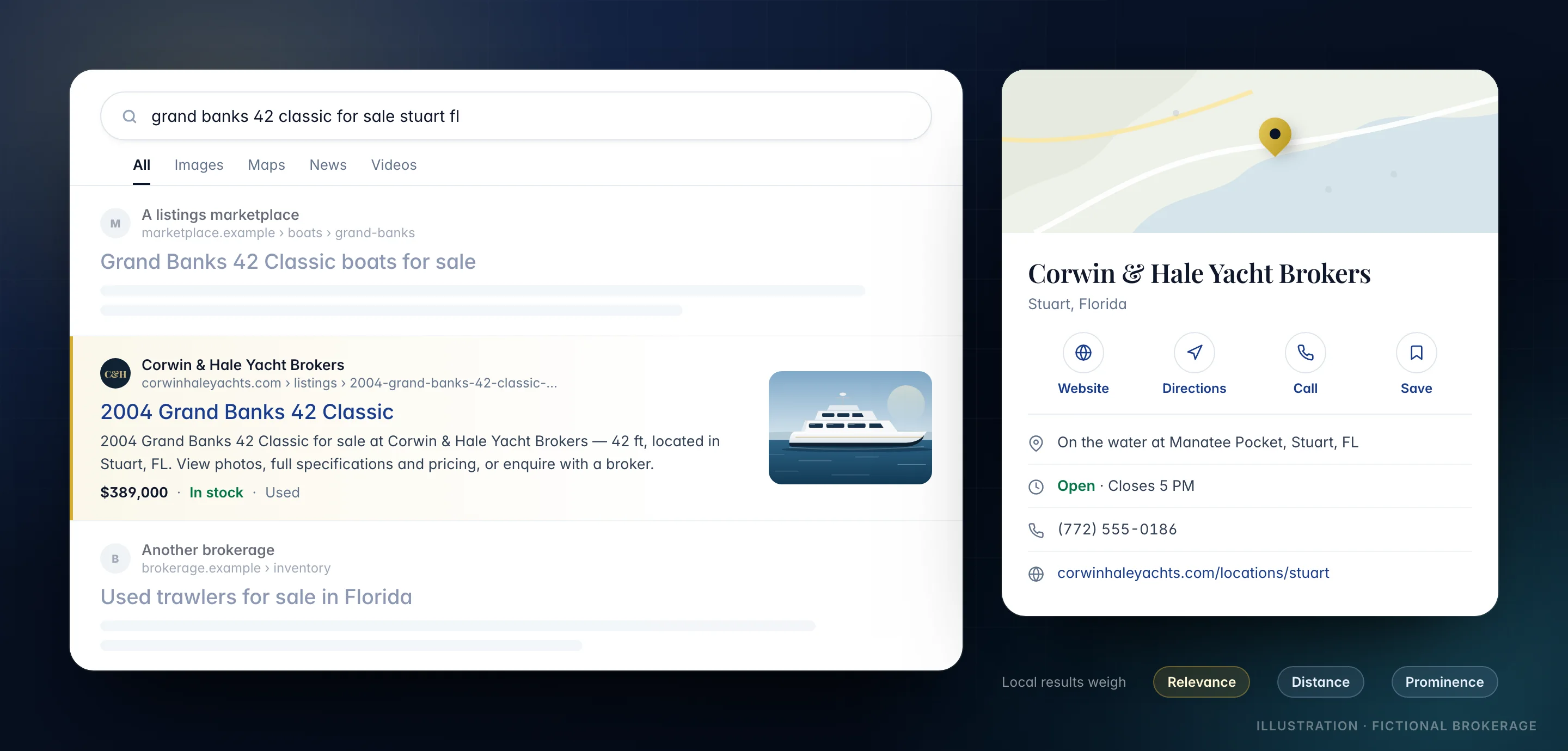
Your office, in the local results.
When someone searches for a yacht broker near them, Google answers from Business Profiles. It says it weighs three things, and that there is no way to pay for a better local ranking.
Relevance
How well your profile matches what was searched. Category, description and services do the work here.
Distance
How far your office is from the person searching. You can't move it, so each real office needs its own profile.
Prominence
How well known the business is. Google says more reviews and positive ratings can help.
Getting the Business Profile right
- 1
Choose the most specific category for the business as a whole: “this business is a…”, not “has a…”. Type “yacht” into the picker and take the closest true match.
- 2
One profile per office that is staffed during its stated hours. No virtual offices, and no profile for a marina where nobody works.
- 3
Use your real-world business name. No towns, boat types or taglines added to it.
- 4
Ask for reviews and reply to them. Google says replying shows customers you value their feedback.
- 5
Point each profile's website link at that office's page, not the home page.
Your business details (name, address and phone, plus opening hours and the areas you cover where you give them) are published as LocalBusiness structured data across the site. A brokerage with several offices can have a page for each one, built from the office record in the admin, for that office’s profile to link to.
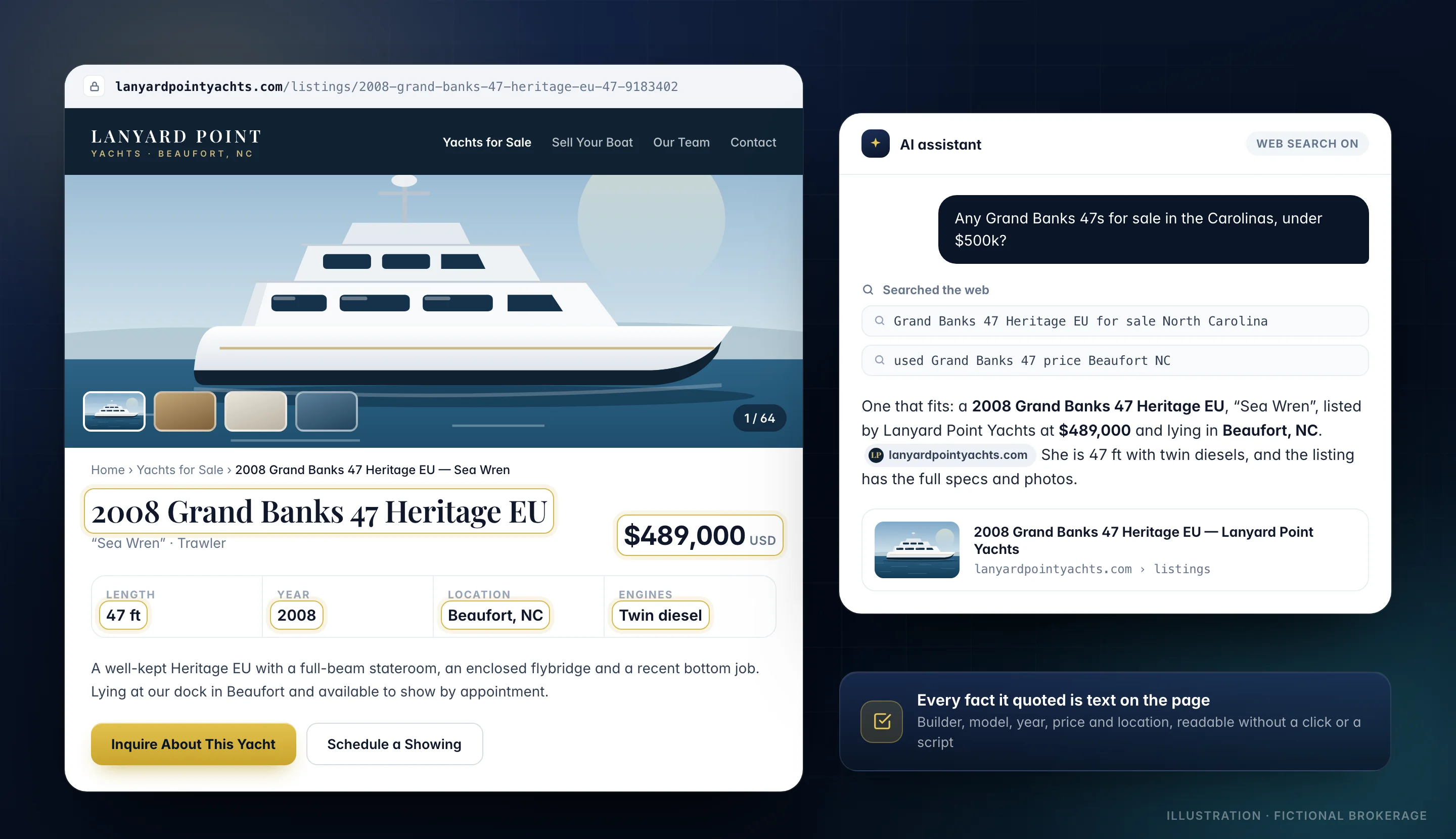
What a listing page needs to compete with the portal’s copy.
The parts every boat page on a YachtOne site already has, and the one part only you can add.
| Part of the page | On a YachtOne site |
|---|---|
| Its own address | Every boat lives at /listings/ followed by its year, builder, model and length, so the address itself describes the boat. |
| Title and description | Written from the boat's own facts: “2004 Grand Banks 42 Classic for sale at … — 42 ft, located in Stuart, FL.” No two listings share a snippet. |
| Canonical | Each boat page names itself as the canonical address, so it never inherits the home page's. |
| Structured data | Product data with builder, model, year, photos, price, currency, availability and condition, plus a breadcrumb back to the page the boat is listed on. |
| Photos in the sitemap | Each boat's entry in the sitemap carries its main photo, with a last-modified date only when the page really changed. |
| When she sells | The description says sold, the structured data stops calling her available, and the page stays live where the site has a sold-boats page. |
| The description | Yours to write. The portal carries the feed text; your page can carry what the listing broker knows: the refit, the service history, why the owner is selling, where she has cruised. That is what makes your copy the more useful one. |
Pages for each boat type and builder, built from live stock, are a separate subject. For being quoted in AI answers rather than ranked on Google, see getting your brokerage into ChatGPT search.
Google’s bar for a “good” page.
Google recommends meeting these Core Web Vitals and says they align with what its ranking systems reward. YachtOne pages are prerendered and cached, open near-instantly as a buyer moves from boat to boat, and refresh when you publish a change.
- Largest Contentful Paint
- < 2.5 sMain content shown
- Interaction to Next Paint
- < 200 msResponse to a tap
- Cumulative Layout Shift
- < 0.1Nothing jumps around
A new website shouldn’t cost you the rankings of the old one.
Every address Google already knows needs somewhere to go. Miss them and years of indexed boat and broker pages turn into errors on launch day.
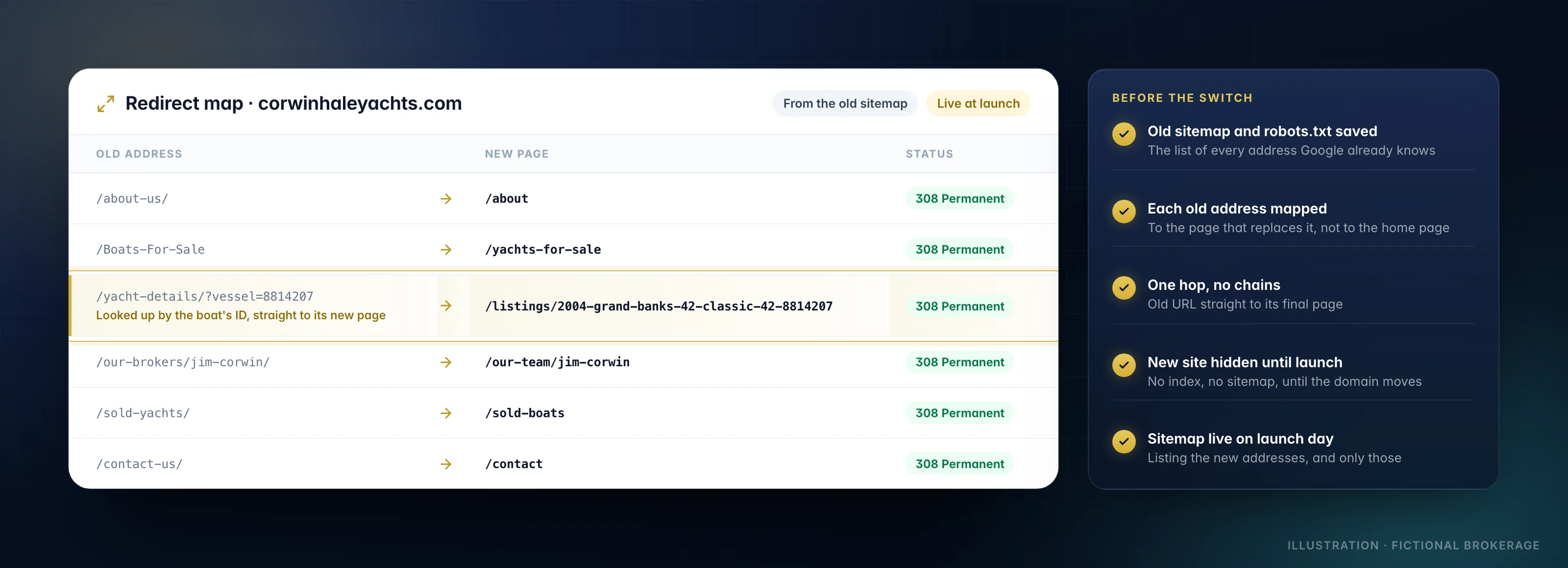
What Google asks for
- Permanent, server-side redirects (301 or 308) from each old address
- Each old page to the page that replaces it, never everything to the home page
- Straight to the final page, with no chains
- Kept for at least a year
Google also says to expect some movement in rankings while it recrawls a moved site, and that it settles.
What we do on every YachtOne build
- A copy of the old sitemap and robots.txt is kept before anything changes
- Each indexed address is mapped to its new page, including mixed-case and trailing-slash variants
- Old boat pages that carry the boat's feed ID go straight to that boat's new page
- The new site stays out of search, with no sitemap, until the domain moves
Everything Else You Might Ask.
Why does YachtWorld outrank my own listing on Google?
Google ranks pages, not the broker who holds the listing. When the same boat appears on several sites with the same feed description and photos, Google groups the copies and picks the one it judges most complete and useful to show. Being the listing broker is not one of the things it weighs, and a canonical tag only counts as a hint.
A portal also brings a lot of site-wide strength to every page it publishes. What you can change is your own page: a description written for that boat rather than the feed text, the details only you know, fast pages, clean structured data, and a site Google can crawl easily.
Is having the same boat on my site and the portals a duplicate-content penalty?
No. Google says some duplicate content is normal and is not a violation of its spam policies. The cost is simply that Google shows one copy, and it may not be yours. Making your page the more useful one is the only lever.
Which Google Business Profile category should a yacht brokerage use?
Google's guidance is to pick the most specific category that describes the business as a whole, using as few as possible, and to choose categories that finish the sentence “this business is a…” rather than “has a…”. Type “yacht” into the category picker and choose the closest match for what you actually do.
Don't add charter, rental or dealer categories unless you run those services, and don't use categories as keywords: Google's guidelines say not to.
Should each of our offices have its own Google Business Profile?
Each real office can, if it is staffed by your team and able to receive customers during its stated hours. Google allows one profile per location and does not allow profiles for virtual offices or addresses where nobody works.
Link each profile to the page for that office rather than to your home page, so the profile and the page describe the same place.
Can I rank in a town where we don't have an office?
Not in the map results the way you would with an office there: Google's local ranking weighs relevance, distance and prominence, and distance is from the searcher to your business. You can still rank in ordinary results with pages about the boats you actually have lying there.
What to avoid is a stack of near-identical town pages that all lead to the same contact form. Google's spam policies name pages targeted at specific regions or cities that funnel visitors to one page as doorway abuse.
What should happen to a sold boat's page?
Keep it live and say clearly that it is sold, if your site has a sold-boats page to hold it. A sold boat is still a page people search for, and it shows buyers and sellers what you have closed.
On a YachtOne site a sold boat's search description says it was sold, its structured data no longer marks it available, and it is listed in the sitemap only where the site has a sold-boats page.
Will we lose our Google rankings when we move to a new website?
Not if every old address is redirected to the page that replaces it. Google recommends permanent server-side redirects from each old URL to its new one, straight to the final page rather than through a chain, kept for at least a year. It also says to expect some fluctuation while it recrawls the site, and that it settles.
When we build a YachtOne site we keep a copy of the old sitemap, map each old address to its new page, keep the new site out of search until launch, and serve the redirects as permanent 308s the moment the domain moves. Old WordPress boat pages that carry the boat's feed ID in the address go straight to that boat's new page.
Does the keywords meta tag or FAQ markup still help?
No to both. Google says it does not use the keywords meta tag at all, for indexing or ranking. FAQ rich results stopped appearing in Google Search in May 2026, so FAQ markup no longer earns a special result; the questions and answers still help when they are written plainly on the page.
What does SEO cost with YachtOne?
It is part of the website rather than a separate retainer. The Website plan is $350 a month with hosting, updates and fixes included, and there is no build fee: your first month covers the build, including the redirect map.
More problems we solve
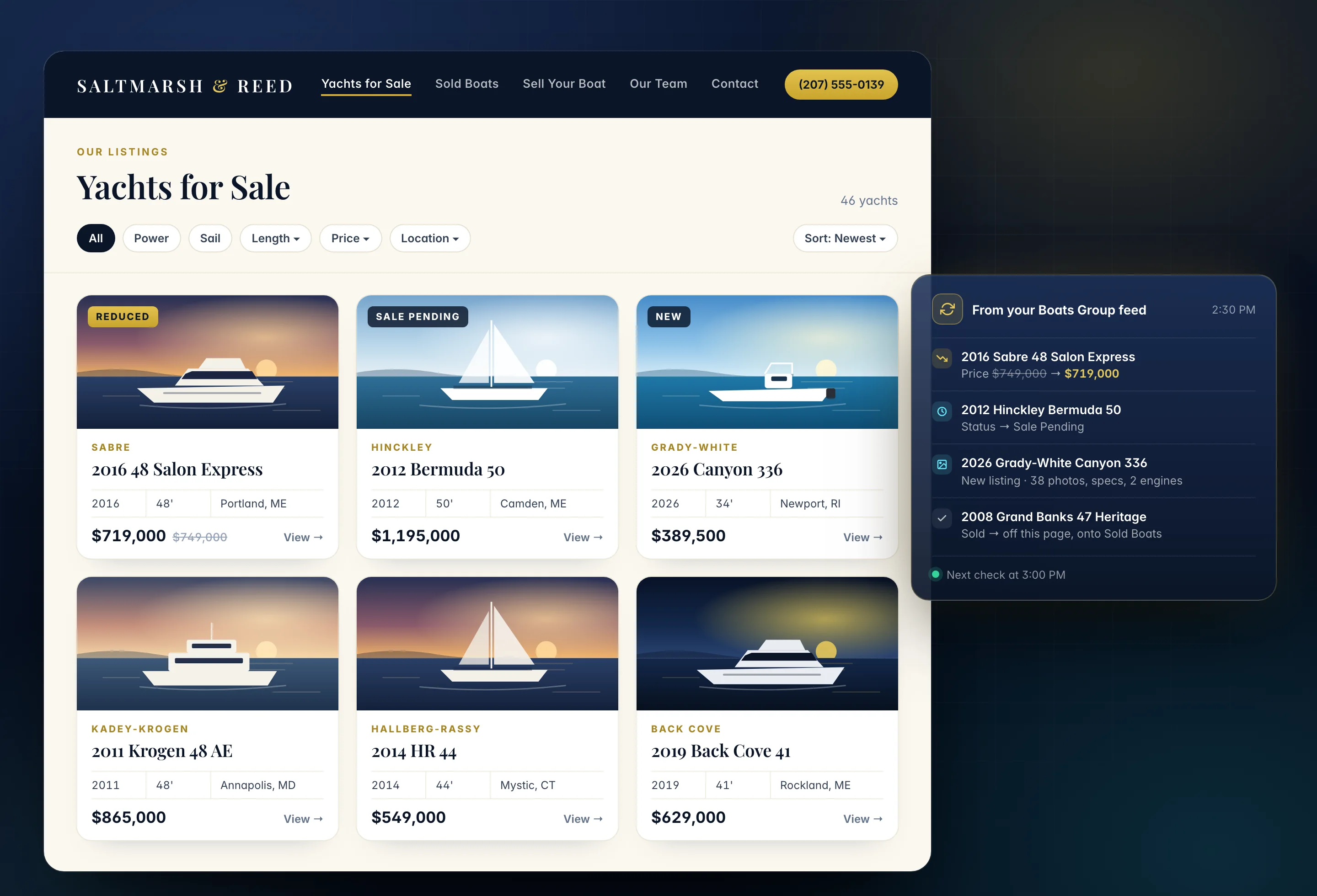
Welcome to the First End-to-End Yacht Sales Operating System
We've built the only platform designed specifically for how yacht sales actually happen. From the moment a visitor lands on your site—they never leave your ecosystem.