Prove You Introduced the Buyer, Date by Date.
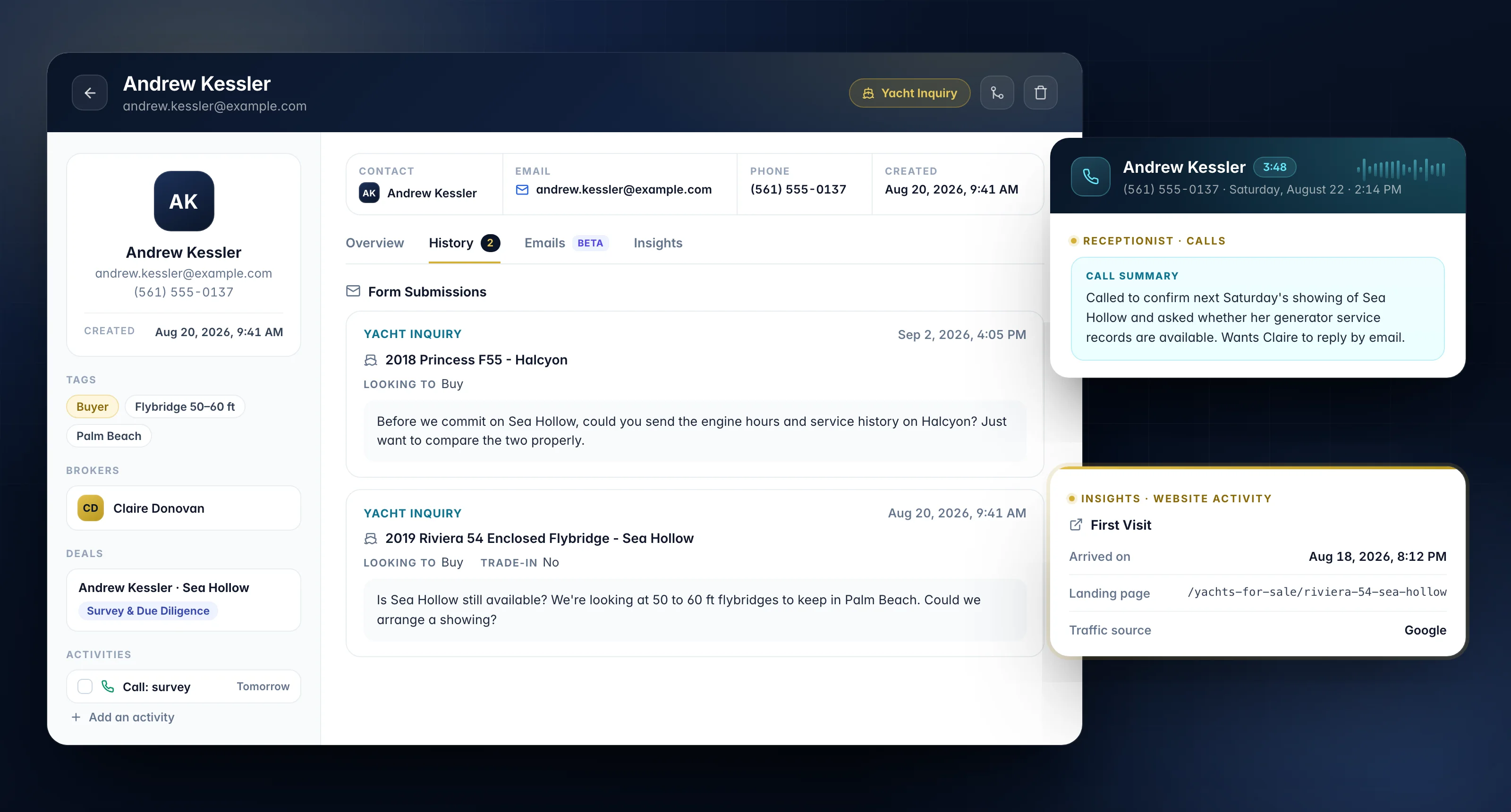
Another broker says the buyer was theirs. Your answer is the record: the night the buyer first landed on your website, the inquiry with its time stamp, the calls, the email and the showing. All on one contact in YachtOne, kept by the brokerage rather than in one broker’s inbox.
- Inquiry times set when they arrive
- Kept on the contact, not in an inbox
- Records, not legal advice
“…buyers are shopping brokers as much as boats.”
At a boat show, a yacht’s sign-in log “feels like objective evidence”. But “a sign-in sheet tells you who walked someone onboard”, not who built the relationship. That leaves the question “to be resolved by conduct, correspondence, and (ideally) written agreement.”
Stephenson Harwood, on commission questions at the Monaco Yacht Show, 24 September 2026Conduct and correspondence are things you can keep.
Another firm's broker
A co-broker says they introduced your buyer at the show, weeks after the buyer first wrote to you about the same boat.
Two brokers in your office
One took the first inquiry, the other ran the showing. Both say the buyer is theirs, and the owner has to decide.
The buyer who went quiet
Months later the buyer comes back through someone else. What happened in between is the whole question.
The questions in a procuring-cause dispute, and where the answer lives.
Yacht sales have no single rulebook for this. The most-quoted written list comes from US real estate: the National Association of REALTORS® arbitration guidelines define procuring cause as “the uninterrupted series of causal events which results in the successful transaction” and tell panels that “rules of thumb” are to be disregarded. Their questions make a good test of what a record should show.
| The question | What the record shows | Where |
|---|---|---|
01Who first introduced the purchaser or tenant to the property? | The first inquiry, with the date and time it arrived, the boat, the page it was sent from and the broker it went to. Before that, the buyer's first visit to your website. | History · Insights |
| 02Did that introduction start an unbroken series of events? | Every later inquiry, receptionist call and synced email on the same contact, each with its own date, so the chain can be read in order. | History · Emails · Calls |
| 03Was there a break, and who caused it? | The date of the last email each way and the last time the buyer was on your website. A long silence shows up as a gap. | Emails · Insights |
| 04Did the broker make reasonable efforts to develop and maintain an ongoing relationship with the purchaser? | Showings, calls and follow-ups logged as activities against the buyer and the boat, and the email the broker actually sent. | Activities · Emails |
| 05What was the buyer actually after? | Every boat they opened on your site, how many times, and which ones they asked about. | Insights |
Those guidelines govern disputes between US real estate agents, not yacht brokers; question 01 is quoted from them, the rest are summarised. Whether a yacht broker is owed a commission depends on the listing or central agency agreement, any co-brokerage agreement, the law where the sale happens and the rules of any association involved. Source: NAR Code of Ethics and Arbitration Manual, Appendix II to Part Ten. This is not legal advice.
One buyer. Every date that matters.
Each piece lives where you already work on the contact, the call log and the activity list, and each carries its own time. Put together, they read as the story of how the buyer came to you.
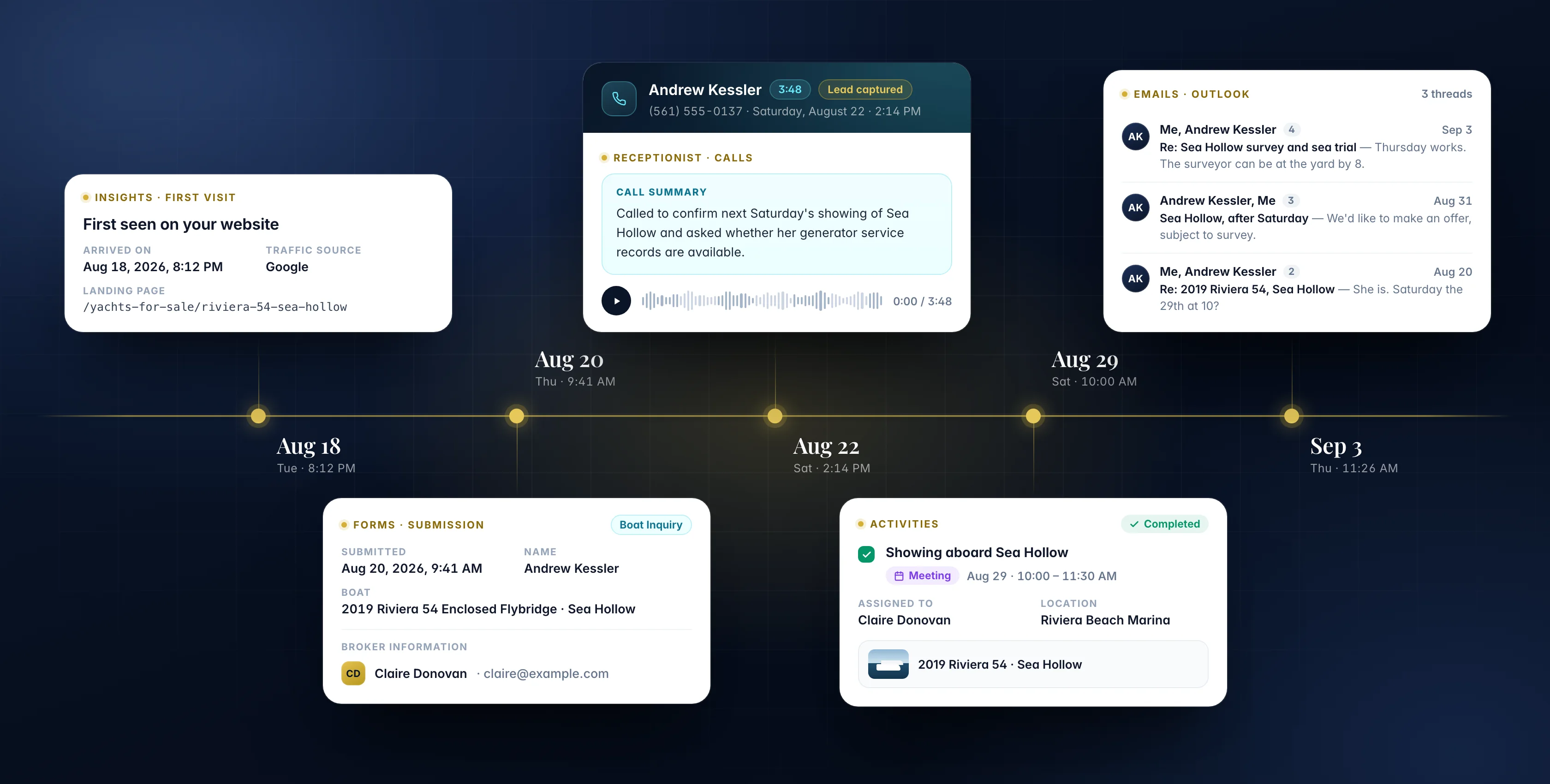
First visit
Date and time, landing page and traffic source. Joins the contact when the buyer fills in a form.
Set by the websiteInquiry
Submitted time, boat, page and the broker it went to. Portal leads from YachtWorld, Boat Trader and Rightboat land the same way.
Set when it arrivesCall
Calls the AI receptionist answers: start time, length, recording, transcript and summary.
Set by the callThe answering serviceEmail
With a broker's Outlook connected, email with the buyer both ways, from the day it was connected.
Set by the mailboxShowing
A Meeting activity with the date, time, place, boat and broker. Log it on the day.
Typed by your team
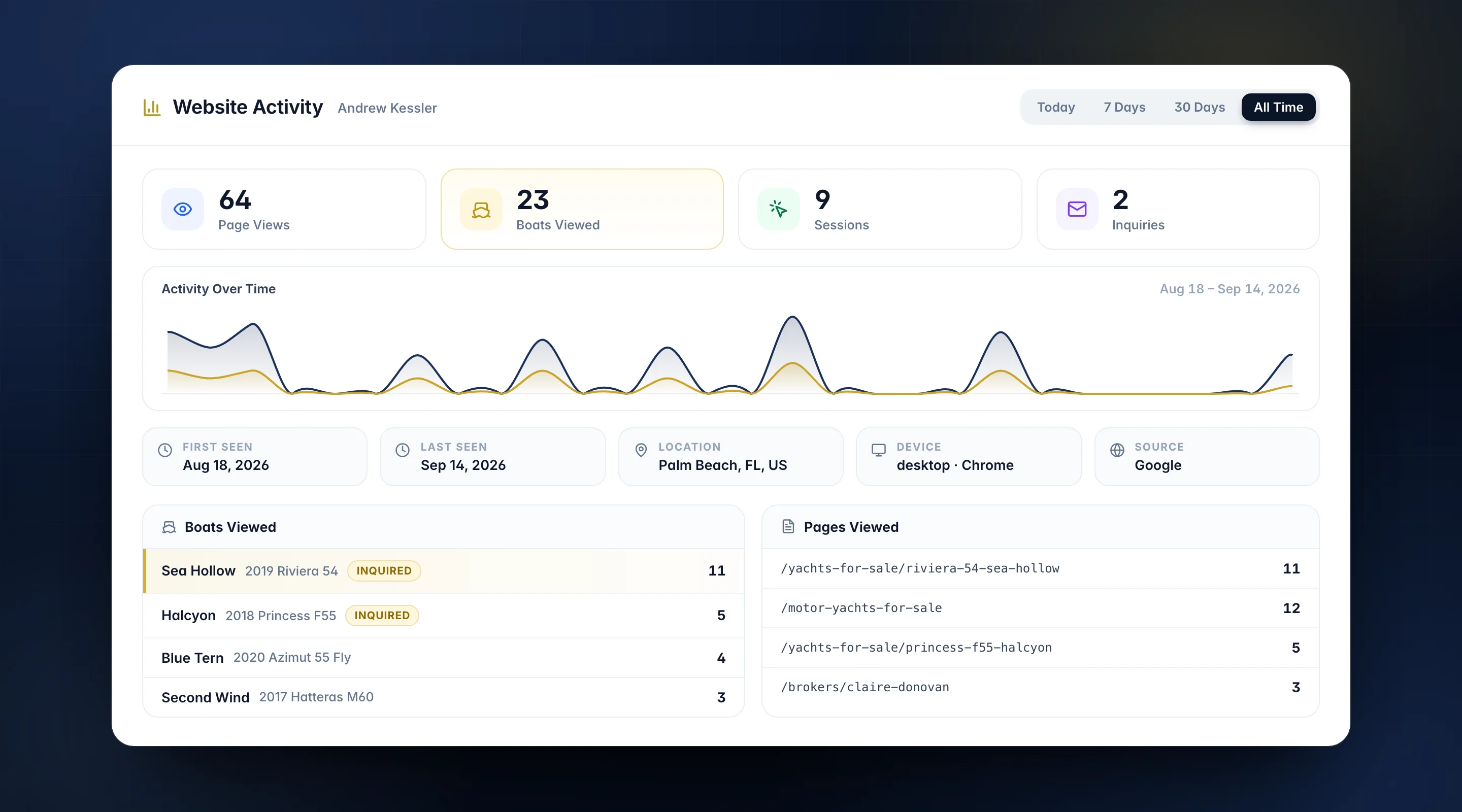
What they looked at, and how many times.
Lead Analytics follows each visitor to your website anonymously. The moment they fill in a form, the browsing they did before joins their contact.
- The first visit: date, time, the page they landed on and how they found you
- Each boat they opened, how many times, and an Inquired tag on the ones they asked about
- Sessions, page views, when they were last on the site, location and device
It sees the browser the buyer used on your site. Browsing on another device, or on a portal, isn’t part of it.
What the record is, and what it isn’t.
Times nobody typed in
- When each inquiry arrived, and the contact was created
- When the buyer first and last visited your website
- When each receptionist call started, with its recording
- When each synced email was sent
Your own account of it
- Notes, with their author and the time they were written
- Activities: showings, sea trials, the calls you made yourself
- Editable by their author or an admin, so write them on the day
Records, not legal advice
YachtOne keeps the record. It doesn’t decide who is owed a commission, and it is no substitute for a written co-brokerage agreement. Disputes often turn out to involve “no written co-brokerage agreement in the first place”, as Stephenson Harwood puts it. Agree the split in writing before a showing; what counts in a dispute is your agreements and the law and association rules where you work.
A record only covers the time it was being kept: email from the day a mailbox is connected, visits from the day tracking is on. Start before the argument does.
Everything Else You Might Ask.
What is procuring cause in a yacht sale?
It is the term used when two brokers both claim a commission on the same sale: which one's work actually brought the buyer to the deal. The phrase comes from US real estate, where the National Association of REALTORS® arbitration guidelines describe it as “the uninterrupted series of causal events which results in the successful transaction”.
In yacht sales there is no single rulebook. Whether a broker is owed a commission, and how much, depends on the listing or central agency agreement, any co-brokerage agreement, the law where the sale takes place and the rules of any association the brokers belong to. This is general information, not legal advice.
Does being first to introduce the buyer guarantee the commission?
Not on its own. The NAR guidelines tell arbitration panels that “rules of thumb” are to be disregarded. Who first introduced the buyer is one question among several: whether that introduction started an unbroken chain of events, whether there was a break and who caused it, and whether the broker kept working the relationship.
That is why a dated record of everything after the first inquiry matters as much as the first inquiry itself. It shows the continuity, or the gap.
What does YachtOne record about a buyer's first contact with us?
When a buyer fills in a form on your website, the inquiry is saved with the date and time it arrived, the boat it was about, the page it was sent from, the lead source and the broker it went to. The contact is created at the same moment, and that date is shown on the contact. Leads from YachtWorld, Boat Trader, boats.com and Rightboat are saved the same way.
With Lead Analytics on, the contact also shows the buyer's first visit to your website: the date and time, the page they landed on and where they came from, such as Google.
Can I see which boats a buyer looked at before they got in touch?
Yes, on your own website. Lead Analytics follows each visitor anonymously, and when they fill in a form their earlier browsing joins their contact: every boat they opened, how many times, and an Inquired tag on the boats they asked about, along with sessions, page views and the last time they were on the site.
It sees the browser they used on your site. Browsing on another device, or on a portal, is not part of it.
Are phone calls part of the record?
Calls answered by the YachtOne AI receptionist are: each one is in the call log with the time, the length, the recording, a transcript and a summary, and the caller's inquiry is saved on their contact.
Calls you make or take on your own phone are not recorded by YachtOne. Log them as Call activities on the contact, with the date, so they sit in the record with everything else.
Is our email with the buyer kept on the contact?
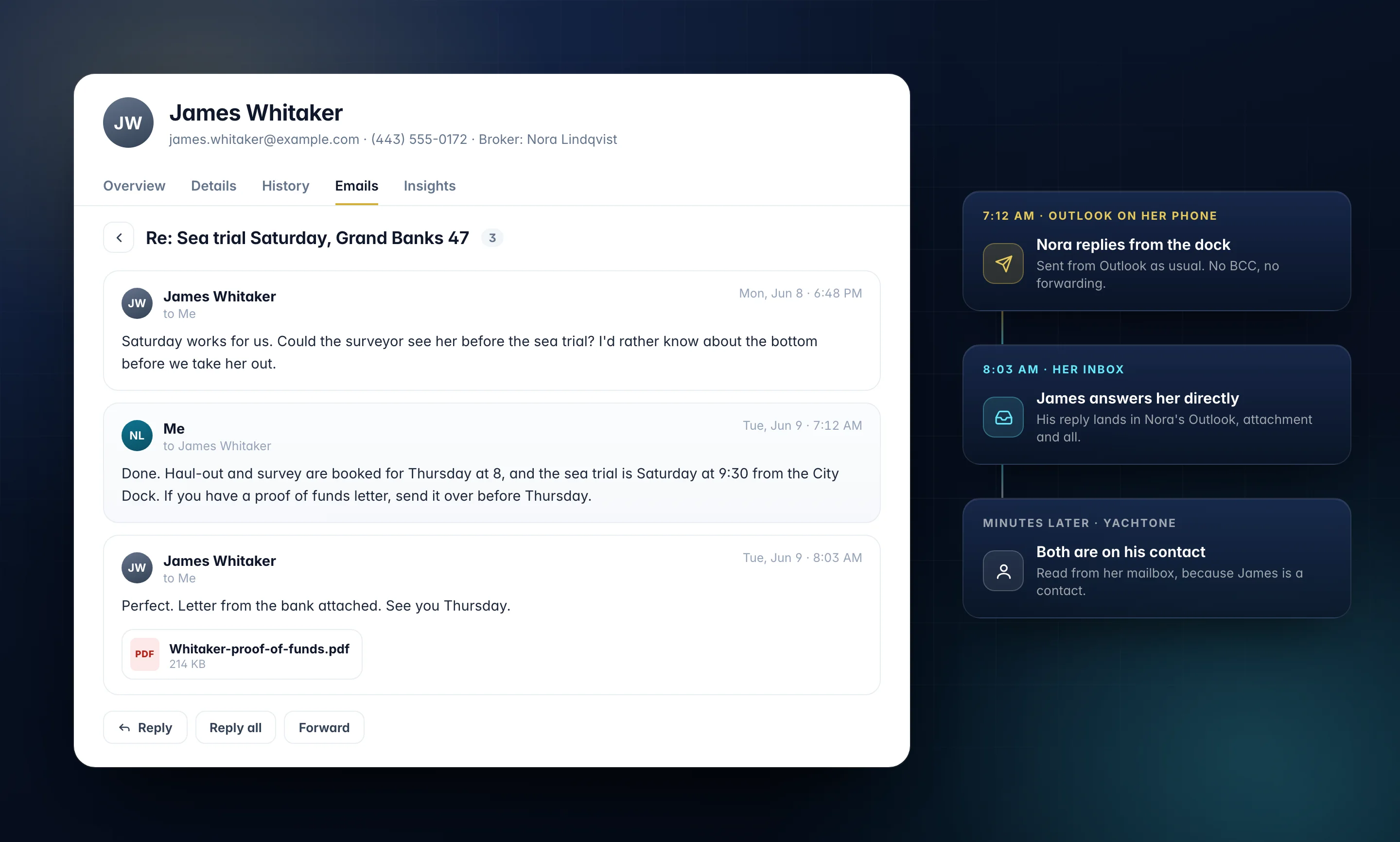
Yes, once a broker connects their Outlook mailbox. From that day on, email with existing contacts is logged on the contact in both directions, at the time it was sent, whether the broker wrote it in YachtOne or in Outlook. Mail from before the mailbox was connected is not read.
Logged email is visible to the broker whose mailbox it came from and to your admins. Other brokers can't read it.
Can anyone change the record?
The times on inquiries, website visits, receptionist calls and synced email are set by the system when they happen. Nobody types them in.
Notes and activities are written by your team. A note shows its author and the time it was written, and it can be edited or deleted by its author or an admin. So log showings and calls on the day they happen, while the details are fresh.
Two brokers in our office both say the buyer is theirs. How does this help?
An admin can open the one contact and see everything on it: which broker the first inquiry went to and when, the activities each broker logged, and the email each of them exchanged with the buyer. Brokers see their own contacts and leads; admins see the whole brokerage.
How you split the commission is still your office's decision. The record means it is made on dates rather than on memory.
Can we get the record out of YachtOne if we need it?
Form submissions export to a CSV file from the Forms page, with the date and time each one was submitted, the boat, the page it came from and the broker it went to. And if you ever leave YachtOne, we export all of your data for you.
Does this replace a co-brokerage agreement?
No. A record shows what happened. An agreement says what each broker is owed. A Stephenson Harwood commentary on commission disputes at the 2026 Monaco Yacht Show notes that they often reveal “no written co-brokerage agreement in the first place”.
Agree the split in writing before you show another firm's boat or let another firm show yours, and keep the record from the first inquiry onwards.
What does it cost?
The contacts CRM, the inquiry history, activities, Lead Analytics and Outlook email sync come with the Website + CRM plan at $500 a month. Private logins for every broker, each with their own mailbox connected, come with the Full Platform at $850 a month. There is no build cost and no minimum term.
The AI receptionist is an add-on for any plan at $150 a month, with 750 minutes included.
More problems we solve
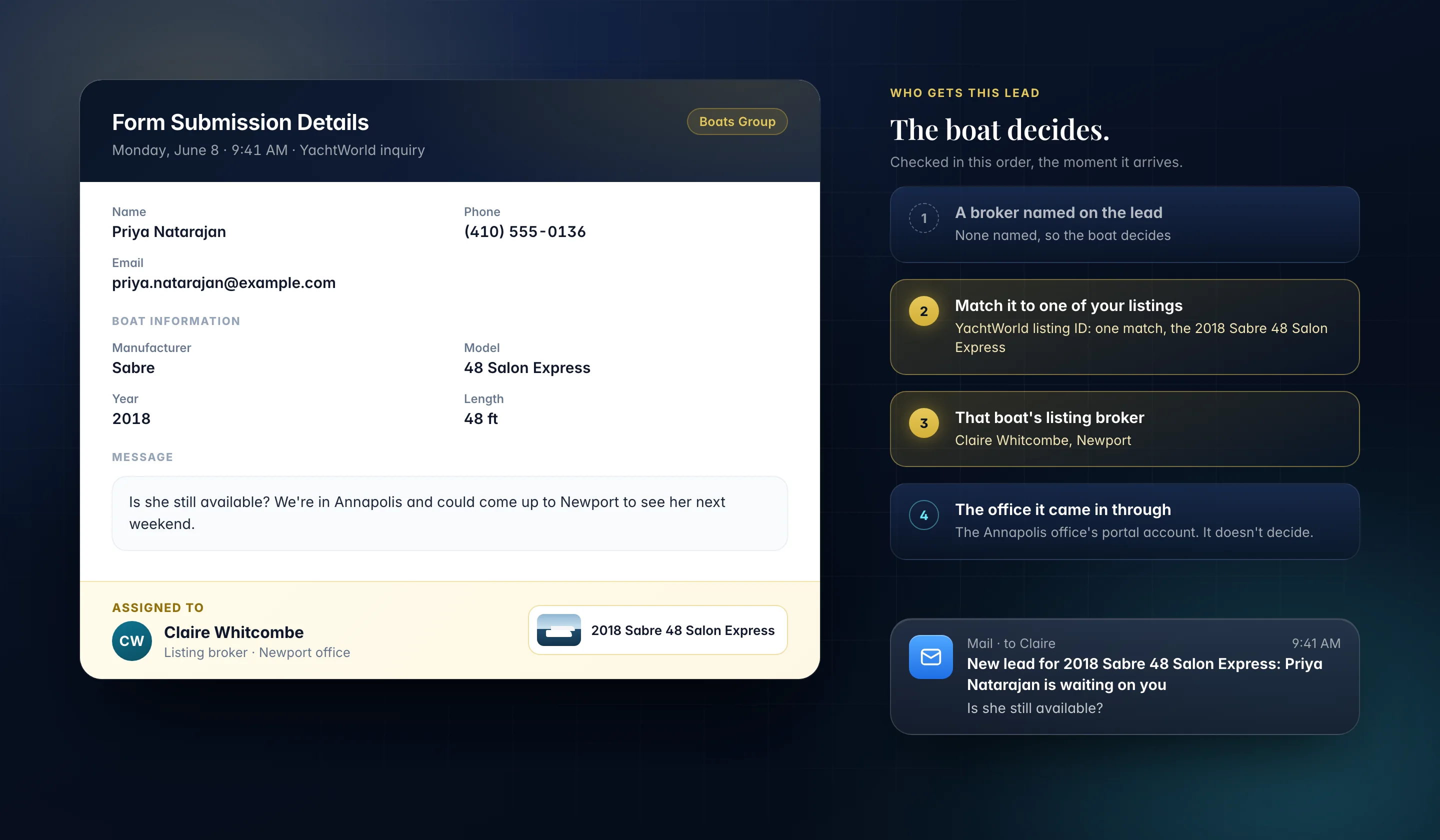
Welcome to the First End-to-End Yacht Sales Operating System
We've built the only platform designed specifically for how yacht sales actually happen. From the moment a visitor lands on your site—they never leave your ecosystem.