Lead Routing for Yacht Brokerages. Every Inquiry Goes to the Listing Broker.
A buyer asks about a boat. YachtOne matches the inquiry to your listing and hands it to the broker who holds it, whether it came from your website, YachtWorld, Boat Trader or Rightboat, and whichever office’s account it arrived on. When nothing matches cleanly, it doesn’t guess: an admin decides.
- The listing broker, in any office
- One contact per buyer
- No match means a person decides
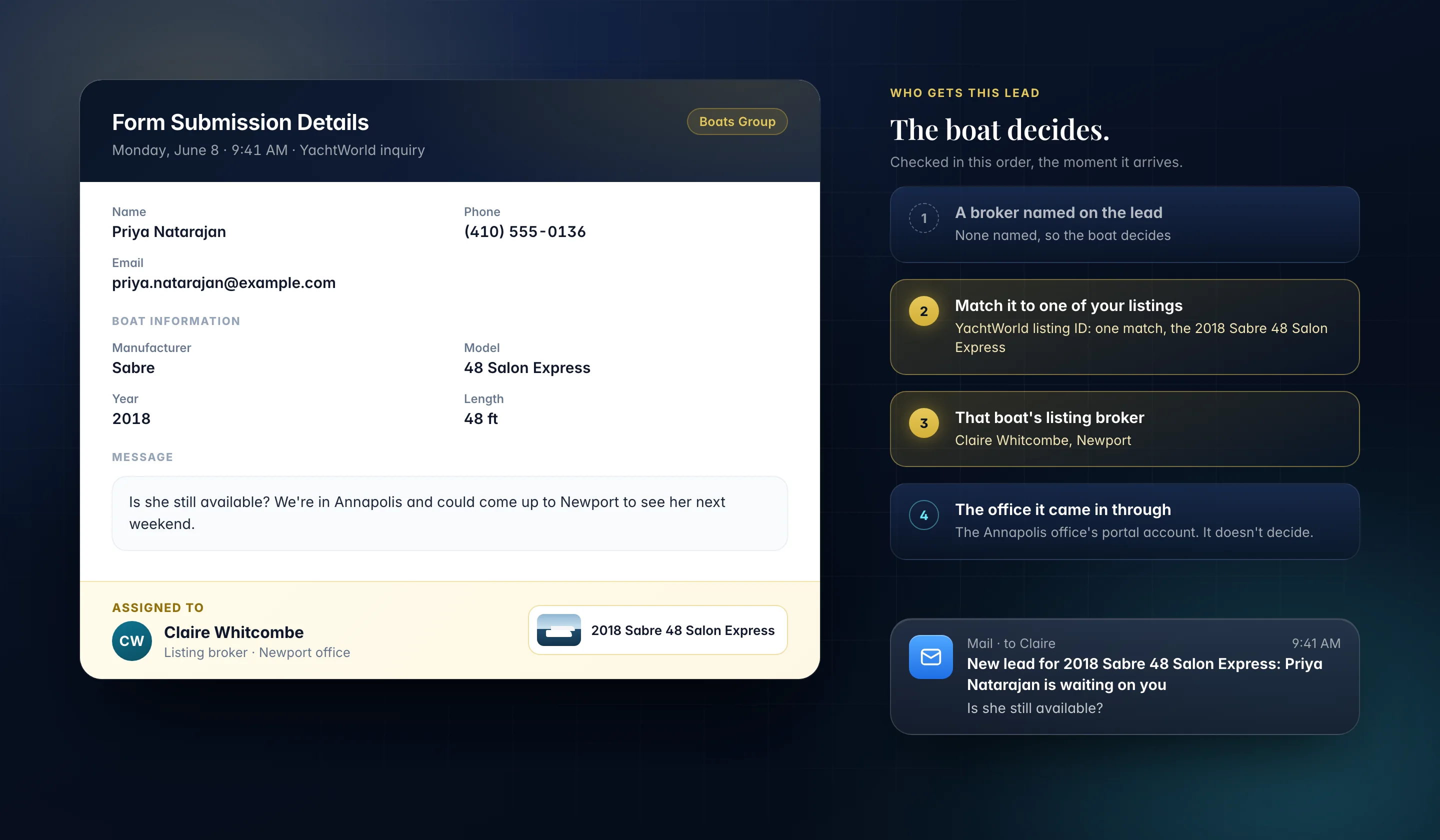
The boat decides, in this order.
Most fights over leads are fights over an unwritten rule. YachtOne applies one written rule, the same way every time, the moment an inquiry arrives.
It starts from the boat because the listing broker is the one person who knows her: the survey history, the owner’s bottom line, when she can be shown.
- 1
A broker named on the lead
Some portals name the broker an inquiry is for. If that name matches exactly one of your brokers, they get it.
- 2
Otherwise, the boat
The inquiry is matched to one of your own listings: by the portal's listing ID, then the HIN, then year, make and model.
- 3
That boat's listing broker
Whoever holds the listing gets the lead and an email, whichever office or portal account it came in through.
- 4
No clean match, no guess
No boat named, a boat that isn't yours, two boats that fit equally well: the lead waits, unassigned, for an admin to hand out.
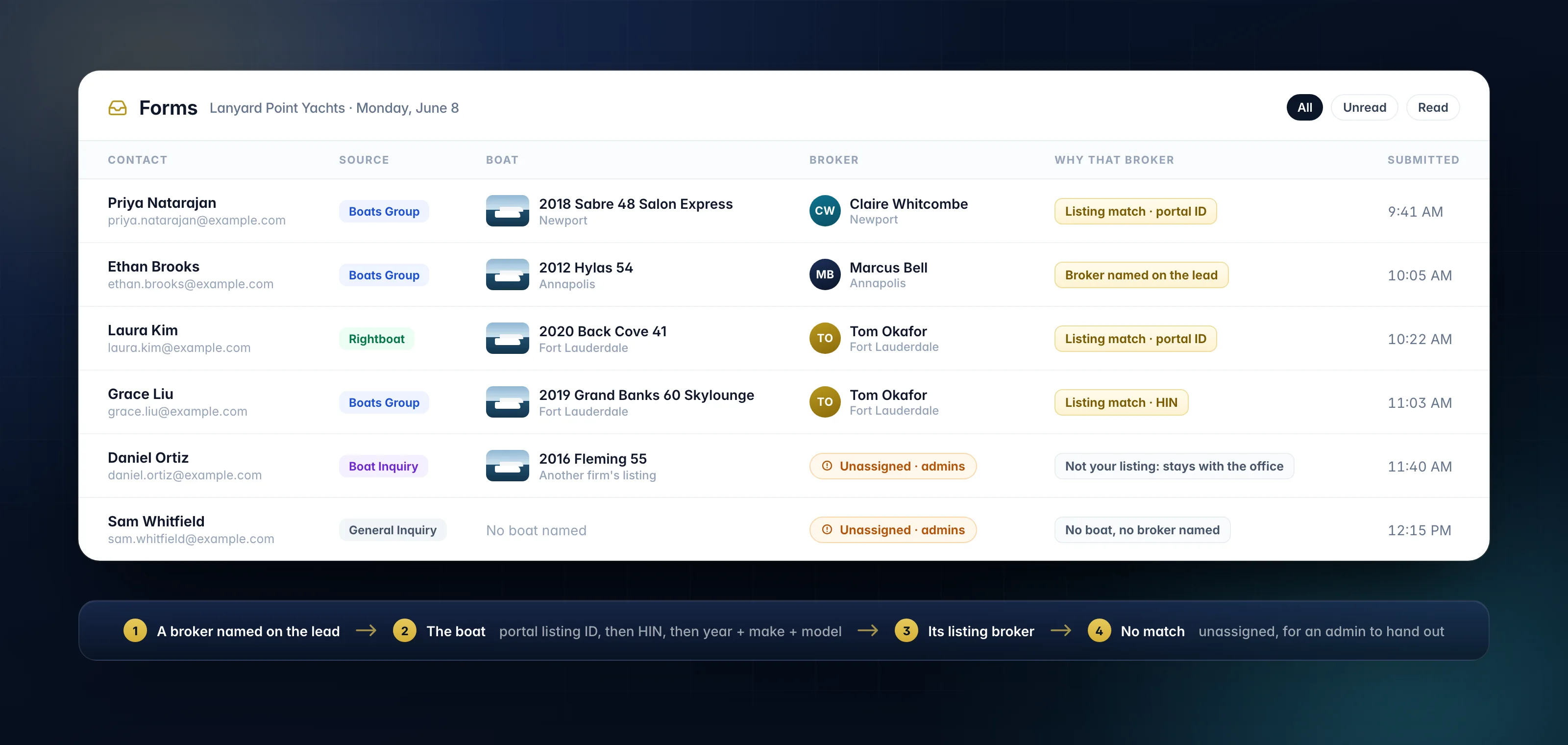
Six inquiries before lunch, and why each went where it did.
Portal leads, website inquiries and a general question, sorted by the rule above. The two that matched no listing of your own are waiting for an admin, not sitting in a broker’s inbox.
Five situations every sales manager has had to rule on.
The boat is listed in another office
The listing broker gets it. The office whose portal account it came through is recorded and changes nothing, so offices stop competing over whose account a lead arrived on.
The buyer already works with a broker here
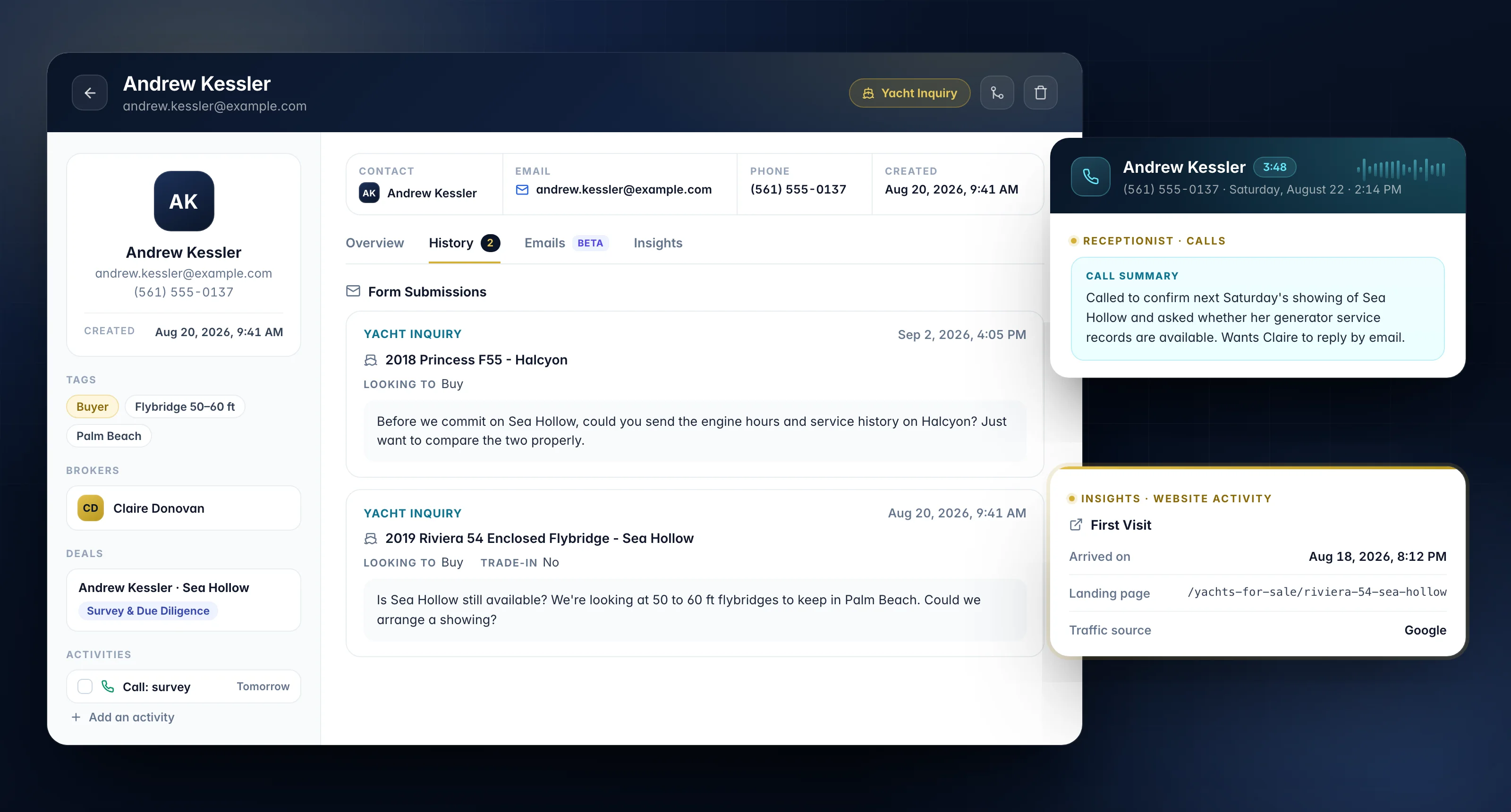
Matched by email, they stay one contact. The listing broker is added beside the broker who already knows them; nobody is removed, and each keeps their private notes.
One buyer emails three of your brokers
All three inquiries land on the same contact, each with its date, source and boat. You see it is one person before two brokers call them back.
The inquiry is about another firm's boat
A co-brokerage listing on your website brings the lead to your brokerage, never to the other firm's broker. It waits for an admin to choose who works it.
A general “do you have…” inquiry
No boat, no broker named, so no rule applies. It goes to the admin-only unassigned queue rather than to whoever happened to be logged in.
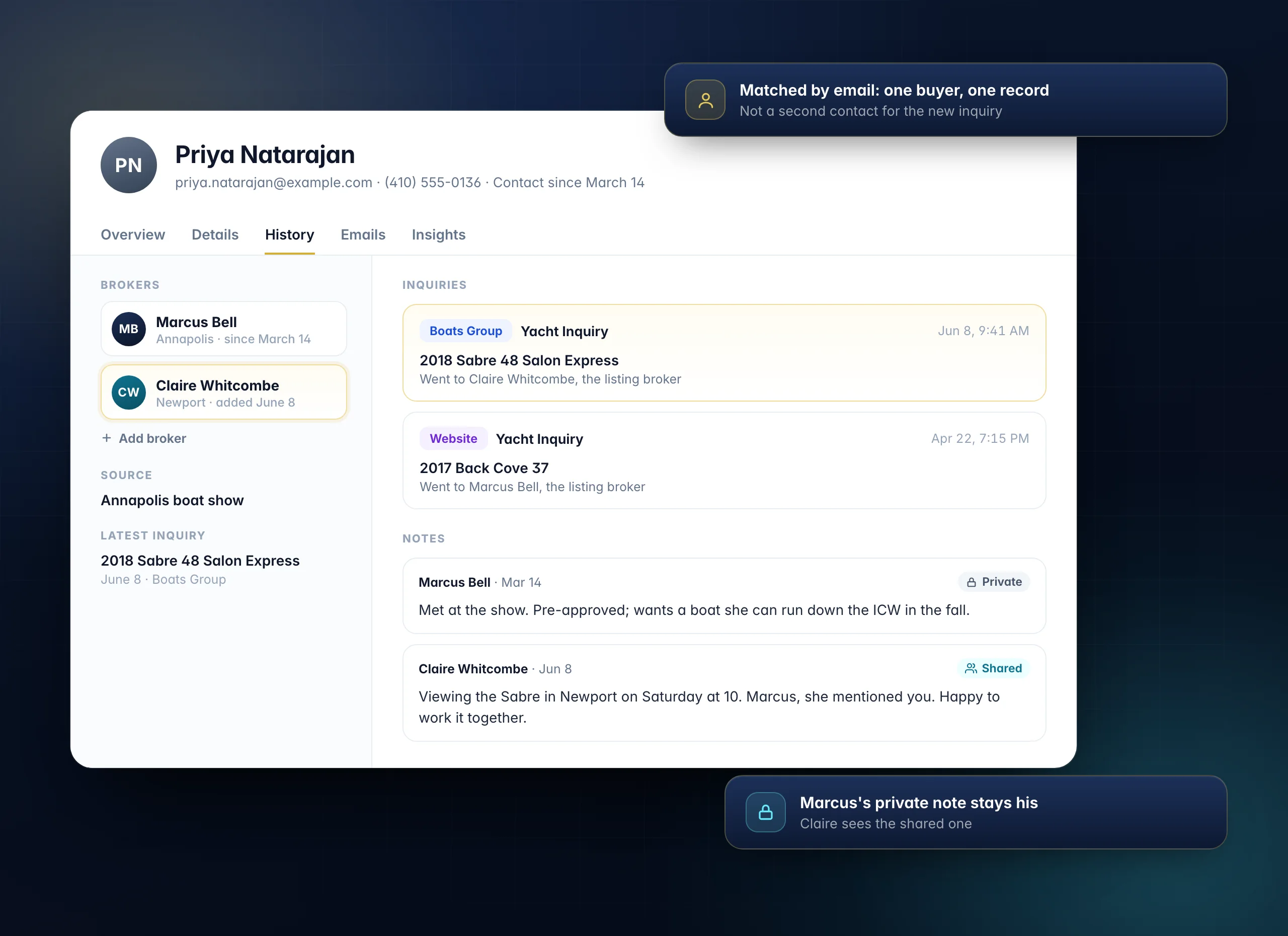
The broker who found the buyer keeps them. The listing broker gets the boat.
One record per buyer
A new inquiry from a known email address joins the existing contact. No duplicate to merge, no second broker starting from zero.
Brokers are added, not swapped
The listing broker joins the contact for their boat. The broker who brought the buyer in keeps the relationship.
Private notes stay private
Each note is Private or Shared. The other broker sees only what is shared; admins see both.
Who leads the deal, and how the commission is shared, stays your call. Every inquiry on the contact carries its date, source and boat, so the call is made on facts.
The words a lead policy has to get right.
Most advice on lead routing is written for real estate agents. Yacht brokerage has its own vocabulary, and a fair policy uses it.
- Listing broker
- The broker who holds the seller's listing agreement and markets the boat. In YachtOne, the person every inquiry about that boat goes to.
- Selling broker, or buyer's broker
- The broker who brings the buyer. When that broker is at another firm the sale is a co-brokerage, and the two firms split the commission on terms they agree between them.
- Co-brokerage
- Two brokerages on one sale: one represents the seller, the other brings the buyer.
- Central agent
- The one brokerage an owner appoints under an exclusive (central agency) agreement. Other brokers sell the boat through the central agent rather than listing it themselves.
- Open listing
- The owner lists with several brokers at once and pays whoever sells. It is the usual reason one boat appears several times at different prices.
- Procuring cause
- The broker whose work started the unbroken chain of events that ended in the sale. Not automatically whoever showed the boat or took the first call; it is argued on agreements and records.
General information, not legal advice. Your listing and co-brokerage agreements, and the law where you sell, decide any dispute.
The right person knows the moment it’s theirs.
The listing broker
An email the moment the lead is theirs (“New lead for 2018 Sabre 48 Salon Express: Priya Natarajan is waiting on you”) and a notification in the admin. Instant by default.
The brokerage's admins
“New leads for the brokerage”: every new lead, whoever it lands with. Off by default; switch it on to watch the floor.
Your office inbox
The addresses you list as notification emails receive each website inquiry in full, the way the front desk is used to.
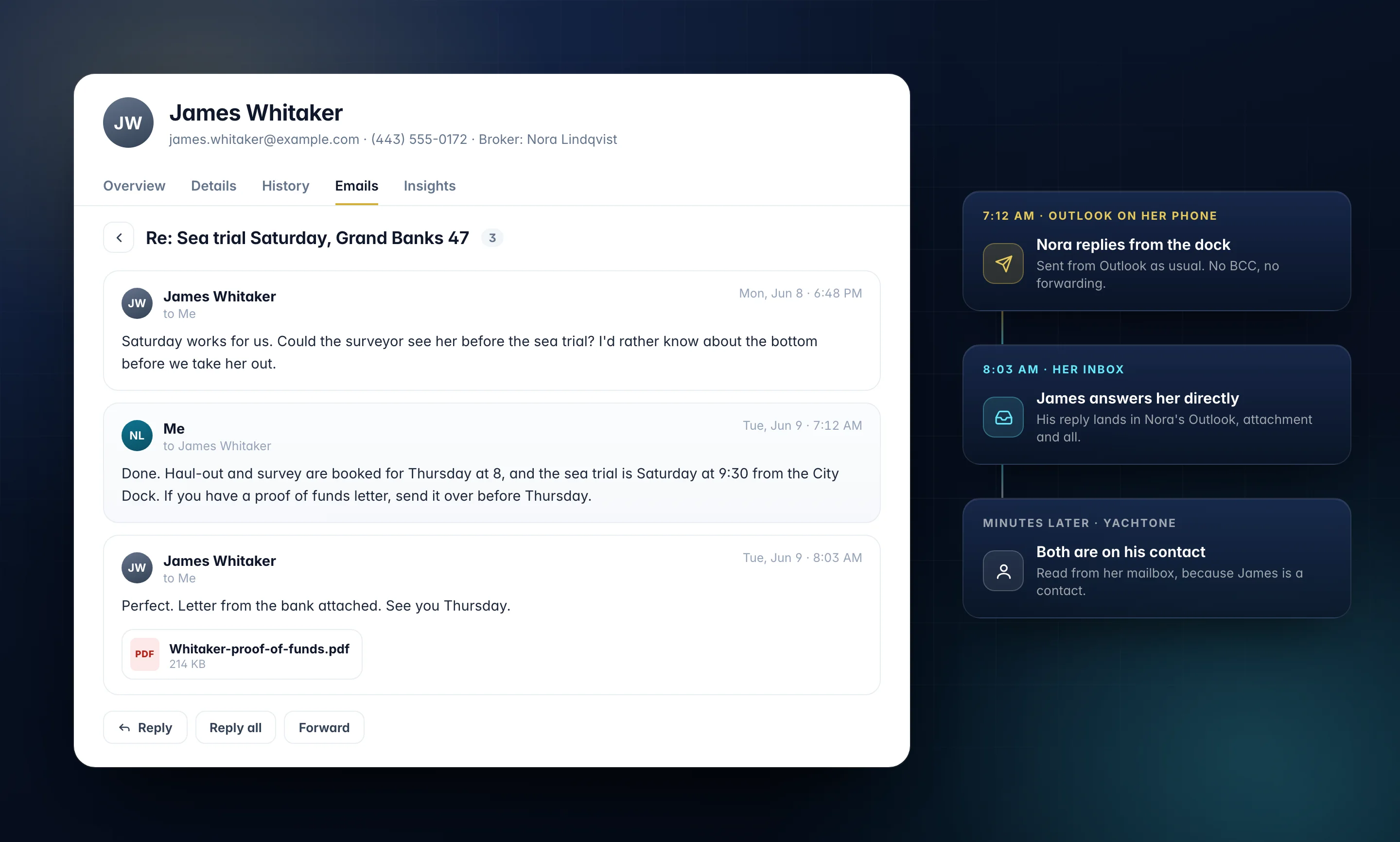
Each person chooses for themselves under Settings: in-app on or off, email Instant, Daily or Off. Calls the answering service for yacht brokers takes follow the same idea: the broker who owns the boat gets the email.
What it won’t do
No round robin
Leads are not rotated. If your house rule is rotation or territory, an admin applies it from the unassigned queue.
No guessing
If two boats fit an inquiry equally well, or a named broker matches two people, the lead waits for a person.
No open pool
Brokers only see contacts they are attached to. Unassigned leads are visible to admins alone.
Everything Else You Might Ask.
How does YachtOne decide which broker gets a lead?
It follows the boat. When an inquiry arrives, YachtOne first checks whether the portal named a broker on the lead; if that name matches exactly one of your brokers, that broker gets it. If not, it matches the inquiry to one of your own listings: by the portal's listing ID, then the HIN, then year, make and model. The lead goes to that boat's listing broker.
Inquiries from your own website's boat pages carry the boat and its listing broker with them, so they land with the right person directly.
If nothing matches cleanly (no boat named, or two boats that fit equally well), YachtOne does not guess. The lead arrives unassigned and an admin decides.
Who gets a buyer inquiry when the boat is listed in another office?
The listing broker, wherever they sit. A buyer who finds a Newport boat through the Annapolis office's portal account is asking about the Newport broker's listing, and that is who gets the lead.
The office the inquiry came through is recorded, but it never decides who gets it. That removes the most common multi-office argument: offices competing for portal accounts instead of selling boats.
What happens when the buyer is already working with another broker here?
YachtOne matches inquiries to contacts by email address, so the buyer stays one contact, not two. The listing broker is added to that contact for the new inquiry, and the broker who already works with the buyer stays on it.
Each broker's notes are private unless they choose to share them, so neither broker sees the other's private notes. Admins see everything. Every inquiry is listed on the contact with its date, source and boat, which is the record you need when the two brokers sit down to agree who leads.
Who leads the deal and how any commission is shared stays your brokerage's decision. The software makes sure the facts are in one place when you make it.
What is procuring cause in a yacht sale?
Procuring cause is the term used when brokers disagree over who earned the commission. It generally points to the broker whose work started an unbroken chain of events that ended in the sale. Being the first to show the boat, or the first to take a phone call, does not settle it on its own.
Disputes are decided on the listing and co-brokerage agreements and on the record of who introduced the buyer, when, and what followed. Superyacht legal commentary calls it a frequent source of litigation for exactly that reason. This is general information, not legal advice; your agreements and local law govern.
Does YachtOne do round-robin or territory-based lead assignment?
No. There is no automatic rotation and no territory rule. Leads with a listing broker go to that broker. Leads without one (a general inquiry, a boat that is not yours, a lead that could match two boats) arrive unassigned and are visible only to admins.
Whoever runs the floor then hands them out by your own policy, whether that is by territory, in turn, or to whoever is on duty, by adding a broker to the contact. We would rather show you that queue than invent a rotation that quietly breaks your house rules.
What happens to an inquiry about another brokerage's boat?
If your website shows co-brokerage listings, an inquiry about one of those boats comes to your brokerage, not to the other firm's broker. It arrives unassigned so an admin can give it to one of your own brokers, who then works the deal as the buyer's broker.
Can brokers see each other's leads?
No. A broker sees only the contacts they are attached to. Unassigned leads are visible to admins only, and admins see every contact in the brokerage.
A broker can only see a buyer once an inquiry or an admin has attached them, so there is no open pool for anyone to help themselves from.
How does the listing broker find out about a new lead?
Straight away, by email and in the YachtOne admin. The email's subject reads, for example, “New lead for 2018 Sabre 48 Salon Express: Priya Natarajan is waiting on you”, with the first line of the buyer's message and a link to the contact.
Each person chooses how they hear about it under Settings: in-app on or off, and email set to Instant, Daily or Off. Admins can switch on “New leads for the brokerage” to hear about every new lead whoever it lands with, and your office's notification addresses receive each website inquiry by email too.
Which lead sources does the routing cover?
Your YachtOne website's forms, and leads from Boats Group (YachtWorld and Boat Trader), Rightboat and MarineSource. Calls taken by the AI receptionist follow the same idea: the broker who owns the boat gets an email after the call.
For the receptionist side of this, see the answering service for yacht brokers.
Which plan includes lead routing to individual brokers?
The Full Platform plan, at $850 a month, which gives every broker their own login. The Website + CRM plan ($500 a month) captures and matches every lead too, but it has one admin login, so everything lands with that one person.
More problems we solve
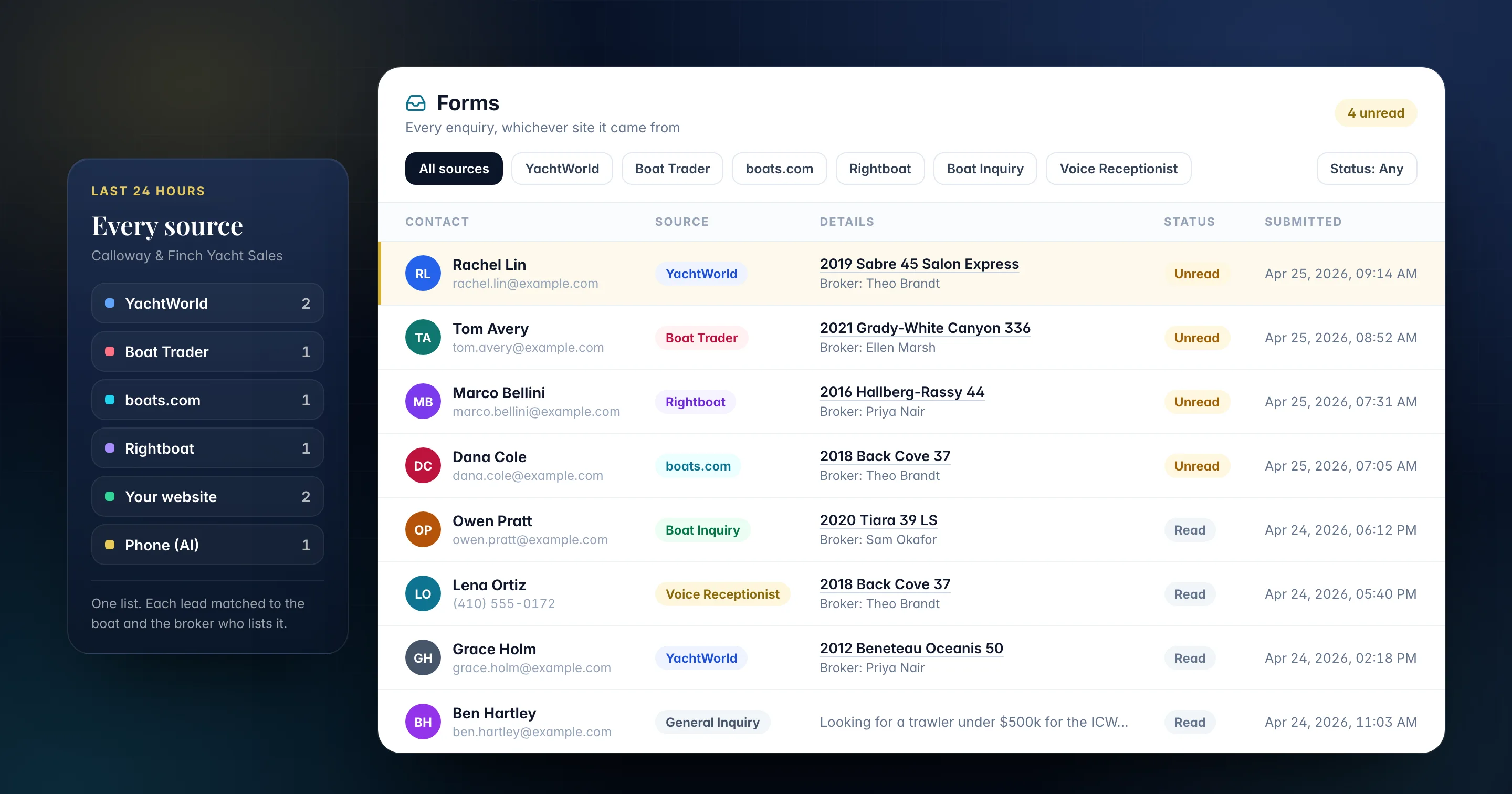
Welcome to the First End-to-End Yacht Sales Operating System
We've built the only platform designed specifically for how yacht sales actually happen. From the moment a visitor lands on your site—they never leave your ecosystem.