A Yacht Deal Pipeline Built Around the Dates That Sink Deals.
The offer the seller has to answer, the survey window, the buyer’s written acceptance, the closing. Separate buyer and seller boards with the stages a yacht deal actually goes through, every deadline on the deal as a task, and each broker’s list of what is due waiting for them in the morning.
- Buyer and seller pipelines, kept apart
- Your own stages and deal fields
- Full Platform · $850 a month
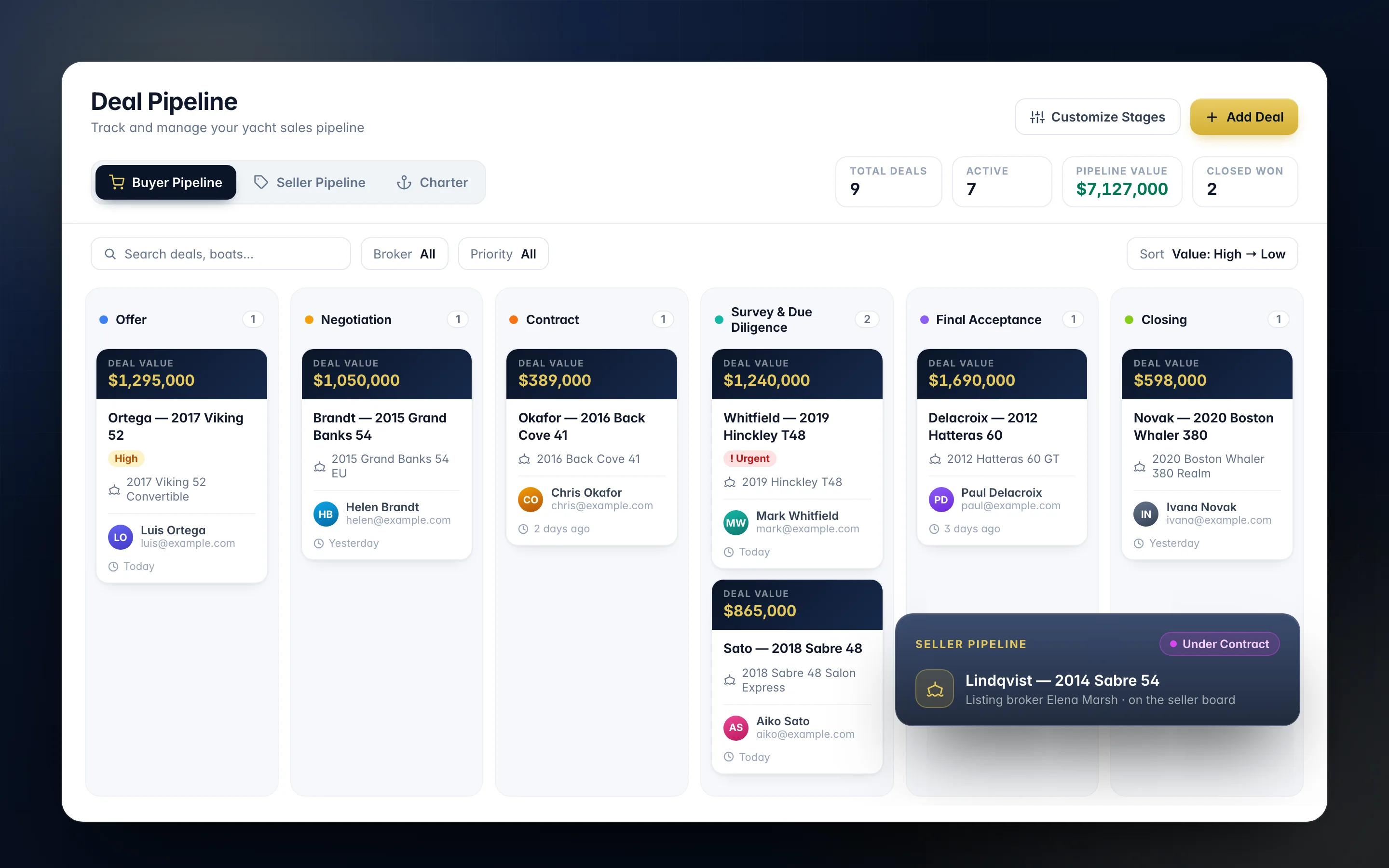
Four dates. Miss one and the deal is in trouble.
A brokerage deal is a run of deadlines set by the purchase agreement, with a deposit riding on them. Here they are in order, with the stage each one belongs to on the buyer board.
Purchase agreement forms word these differently. The dates in your signed agreement are the ones that count.
- 1Offer · Negotiation · Contract
The offer and the deposit
The buyer signs an offer and puts down a deposit, and the offer gives the seller a date to answer by. A counter that nobody answers in time is a deal that quietly lapses.
- 2Survey & Due Diligence
Sea trial and survey
The agreement gives the buyer a window to sea trial and survey the boat. The surveyor, the haul-out and the sea trial all have to line up inside it, and in spring and summer they book up.
- 3Final Acceptance
The buyer's acceptance of the vessel
By a set date the buyer accepts the boat, rejects it, or accepts it subject to repairs or a new price, in writing. What happens to the deposit if that date passes in silence is set by the agreement, which makes it the date to watch.
- 4Closing · Sold
Closing
Funds, the bill of sale, the release of any mortgage, the documentation or registration transfer and delivery, all against an agreed closing date.
Two sides of a deal, two separate boards.
List a boat and bring the buyer too, and you have two deals: a seller deal for the listing and a buyer deal for your buyer. Each has its own stage, broker and dates, and moving one never moves the other. These are the stages every brokerage starts with.
Buyer Pipeline
From first inquiry to a sold boat
- Lead
- Qualification
- Showing/Sea Trial
- Offer
- Negotiation
- Contract
- Survey & Due Diligence
- Final Acceptance
- Closing
- Sold
Seller Pipeline
From first call to a sold listing
- Lead
- Seller Qualified
- Vessel Evaluation & Pricing
- Listing Agreement Sent
- Listing Agreement Signed
- Listing Prep
- Photos & Specs
- Marketing Live
- Active Listing
- Under Contract
- Closing
- Sold
Rename, recolour, reorder or add stages to match your office. You can also switch on Charter, Service & Refit and Slips & Dockage pipelines, plus up to three you name yourself.
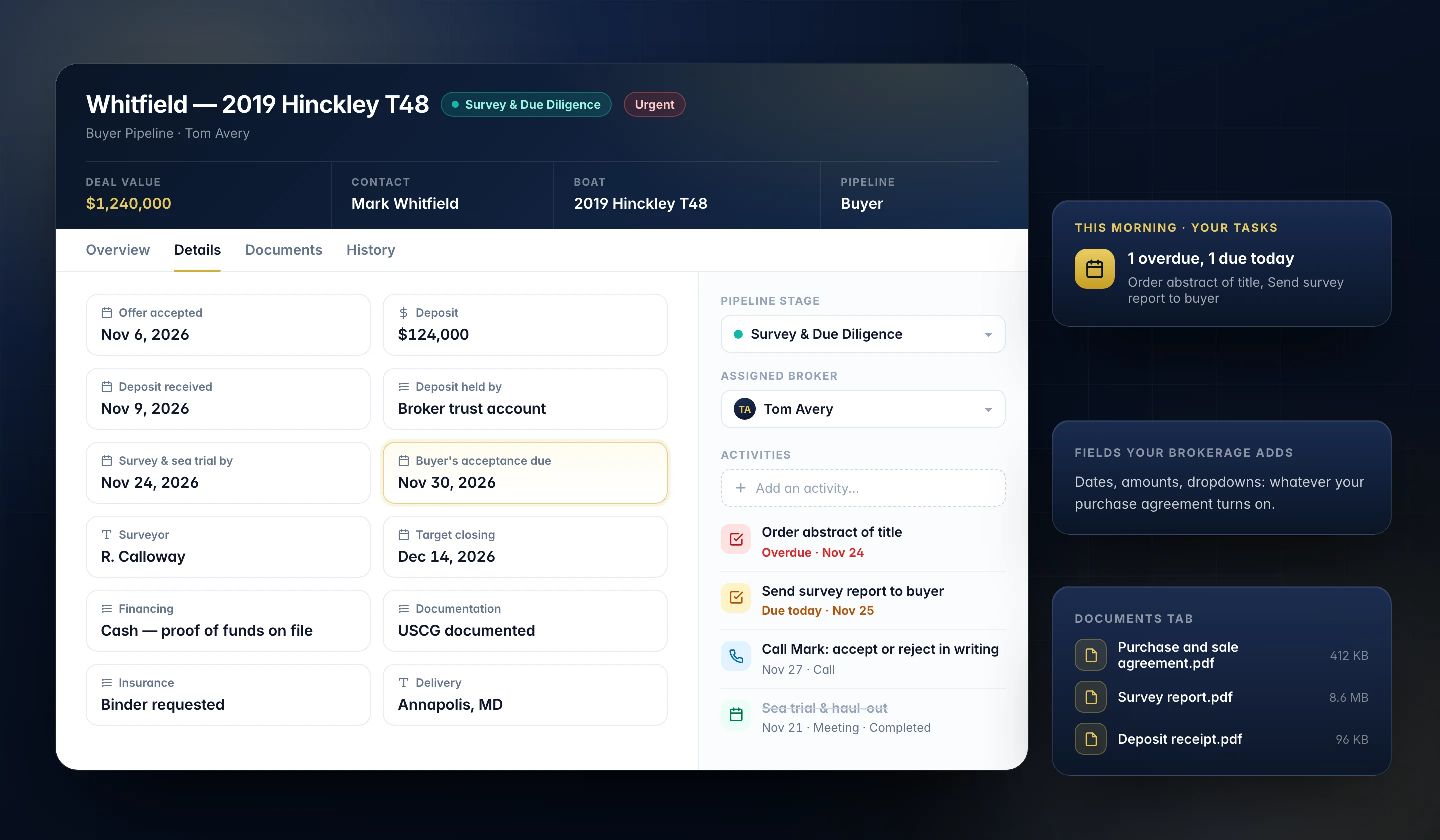
Every deal carries its own deadlines.
The contract dates, on the deal
Add your own deal fields (offer accepted, deposit, survey by, acceptance due, target closing) and every deal carries them on its Details tab.
A task for every deadline
Each date becomes a task with a due date, assigned to the broker. Calls, emails and meetings sit in the same list, against the same deal.
The paperwork in one place
The signed agreement, the survey report and the deposit receipt go in the deal's Documents tab, with notes and the full history alongside.
Every morning, each broker gets their tasks for the day in the app and by email: what is due today, and what has already slipped past its date.
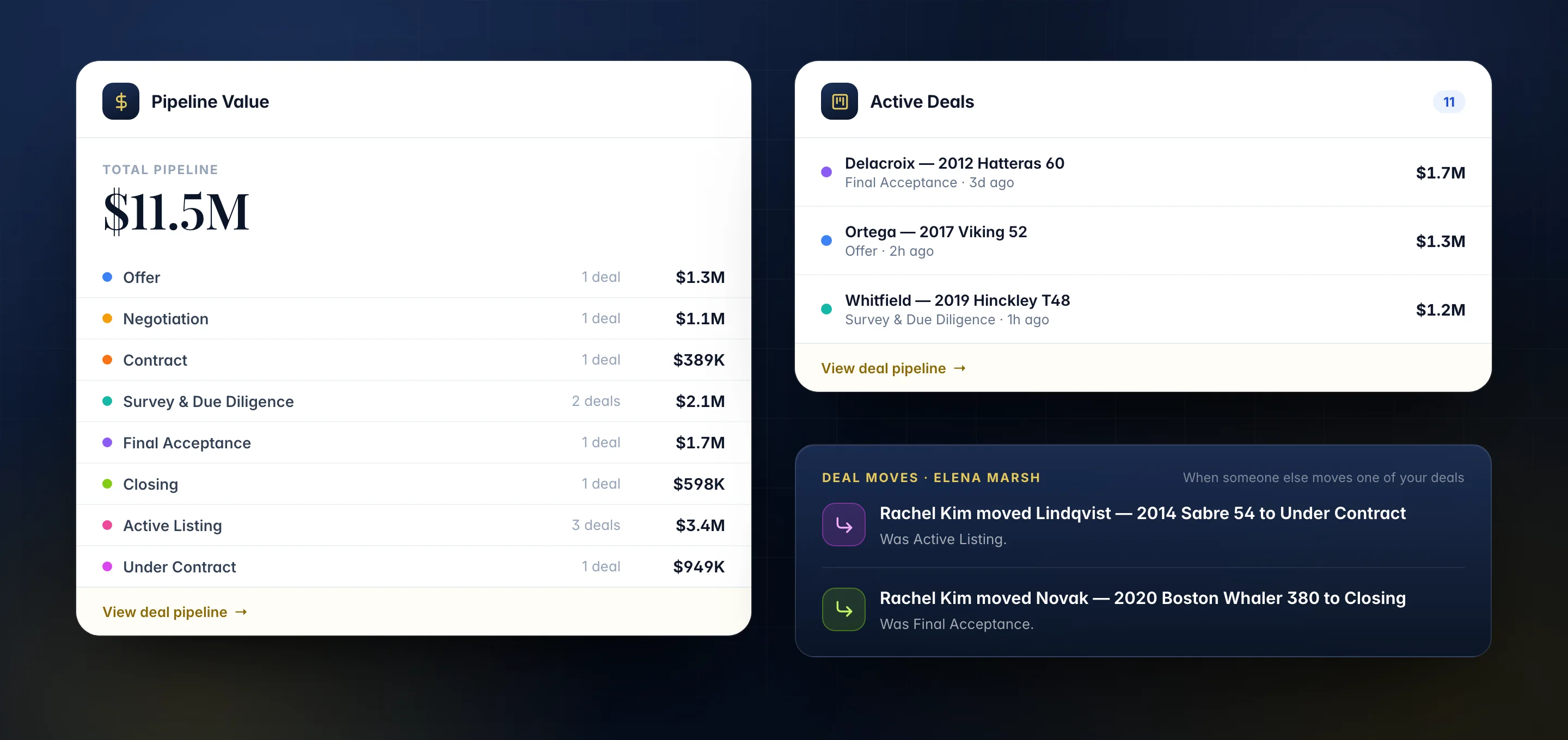
The whole pipeline, before the first coffee.
The admin home page opens on what is in play across both boards. Brokers see their own deals; admins see every deal in the brokerage.
- 01
Pipeline Value
The total of every open deal, then broken down stage by stage with the count and value in each.
- 02
Active Deals
How many deals are open, and the three biggest with their stage and when each last moved.
- 03
Deal moves
When a colleague moves one of your deals, you are told who moved it, to which stage and from where.
Everything Else You Might Ask.
What stages should a yacht deal pipeline have?
YachtOne starts every brokerage with two pipelines. Buyer: Lead, Qualification, Showing/Sea Trial, Offer, Negotiation, Contract, Survey & Due Diligence, Final Acceptance, Closing, Sold. Seller: Lead, Seller Qualified, Vessel Evaluation & Pricing, Listing Agreement Sent, Listing Agreement Signed, Listing Prep, Photos & Specs, Marketing Live, Active Listing, Under Contract, Closing, Sold.
They are a starting point, not a rule. You can rename, recolour, reorder and add stages so the board matches the way your office actually works.
How do I keep the buyer side and the seller side of a boat apart?
They live on separate boards. When you list a boat and also bring the buyer, that is two deals: a seller deal for your listing and a buyer deal for your buyer, each with its own stage, its own broker and its own dates.
Moving one never moves the other. The seller deal can sit in Under Contract while the buyer deal works through Survey & Due Diligence and Final Acceptance.
Will it remind me about the survey and acceptance deadlines?
Yes, if you put them on the deal as tasks with due dates. Add one for each date in the agreement (survey and sea trial, the buyer's written acceptance, closing) and assign it to the broker handling the deal.
Each morning that broker is sent their tasks for the day, in the app and by email: what is due today and what has gone past its date. You can also record the contract dates themselves on the deal as date fields your brokerage defines. Those fields are a record; the tasks are what send the reminder.
Where do I record the deposit?
On the deal. Add your own deal fields for it (an amount, the date it was received, where it is held) and they appear on every deal's Details tab. The deposit receipt itself can go in the deal's Documents tab.
YachtOne keeps the record. It does not hold or move money. In Florida, section 326.005 of the Florida Statutes requires a licensed yacht broker to place funds received in a transaction in a trust account at a Florida financial institution with a net worth over $5 million until they are disbursed, to keep a separate record of those funds, and to give the buyer and seller an itemized closing statement at closing. This is general information, not legal advice.
What happens when someone else moves one of my deals?
You are told. If a colleague drags your deal to a new stage, you get a notification that says who moved it, where to, and where it was before, in the app and in your daily email. Moving your own deals does not notify you.
Can my brokers see each other's deals?
No. Brokers see their own deals, and admins see every deal in the brokerage. Admins can filter the board by broker, contact, boat and priority.
Does a deal start on its own when an inquiry comes in?
It can. Website forms can open a deal as soon as they are submitted (a list-your-boat form opens a seller deal, for example), and inquiries taken by the AI Chat Concierge open a buyer deal. You can also add a deal by hand from the board.
Can we track charters, refits or slips in the same place?
Yes. Alongside buyer and seller you can switch on a Charter pipeline, a Service & Refit pipeline and a Slips & Dockage pipeline, each with its own starting stages, plus up to three more pipelines you name yourself.
What does it cost?
Buyer and seller deal pipelines come with the Full Platform plan at $850 a month, along with private logins for every broker. There is no build cost and no minimum term.
The Website + CRM plan at $500 a month includes the contacts CRM, tasks and activities, but not the deal pipelines.
More problems we solve
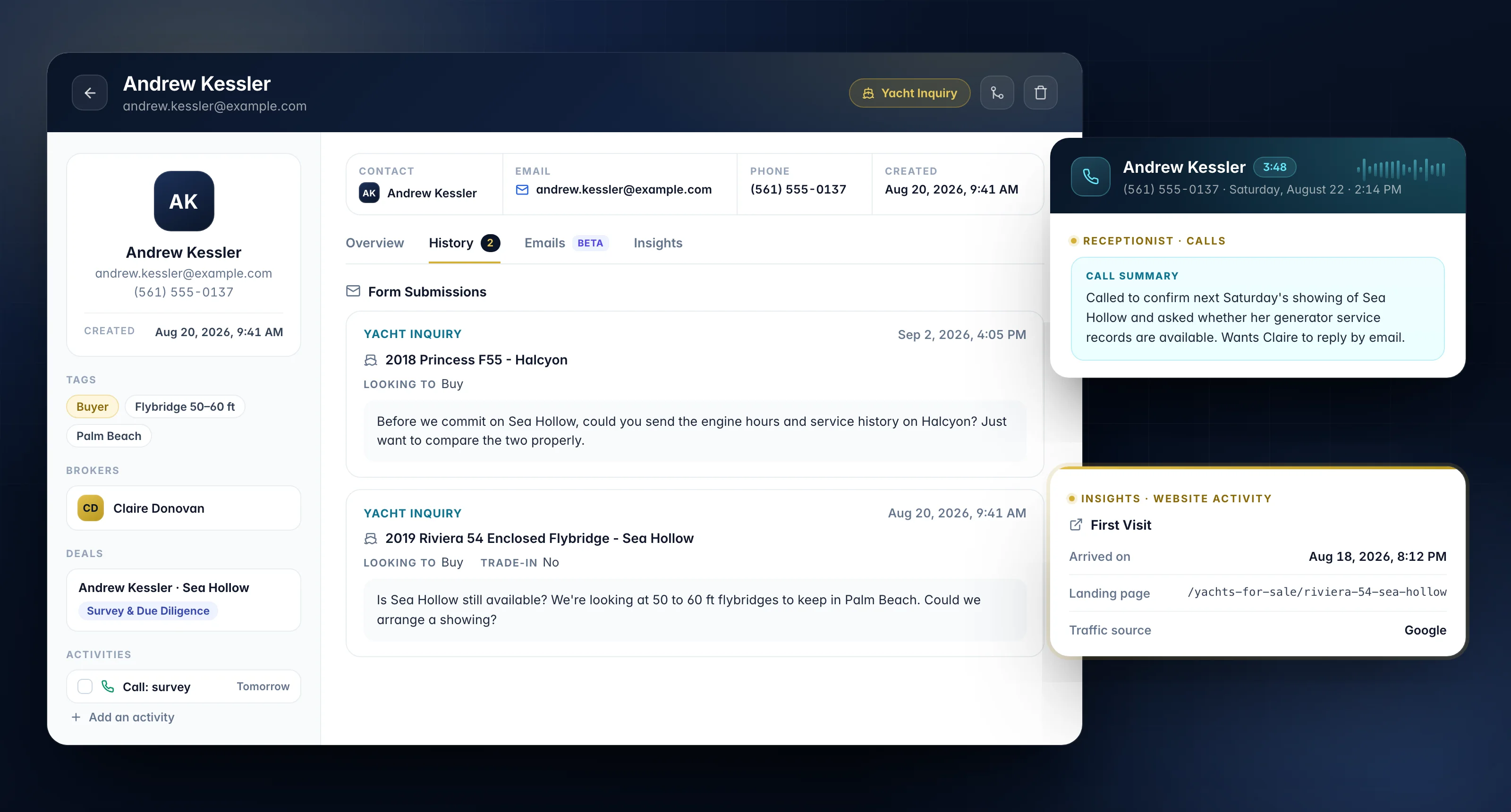
Welcome to the First End-to-End Yacht Sales Operating System
We've built the only platform designed specifically for how yacht sales actually happen. From the moment a visitor lands on your site—they never leave your ecosystem.