Yacht Inventory SEO Pages: A Page for Every Boat Type and Builder You Sell.
Buyers search for “used trawlers for sale” and “Kadey-Krogen for sale”, not for your home page. We build a page for each boat type and builder you sell, a sold archive and a yacht map, all filled from your live inventory, and keep filter combinations from turning into pages Google has to sort through.
- /trawlers-for-sale
- /builders/kadey-krogen
- /sold-boats
- /yacht-map
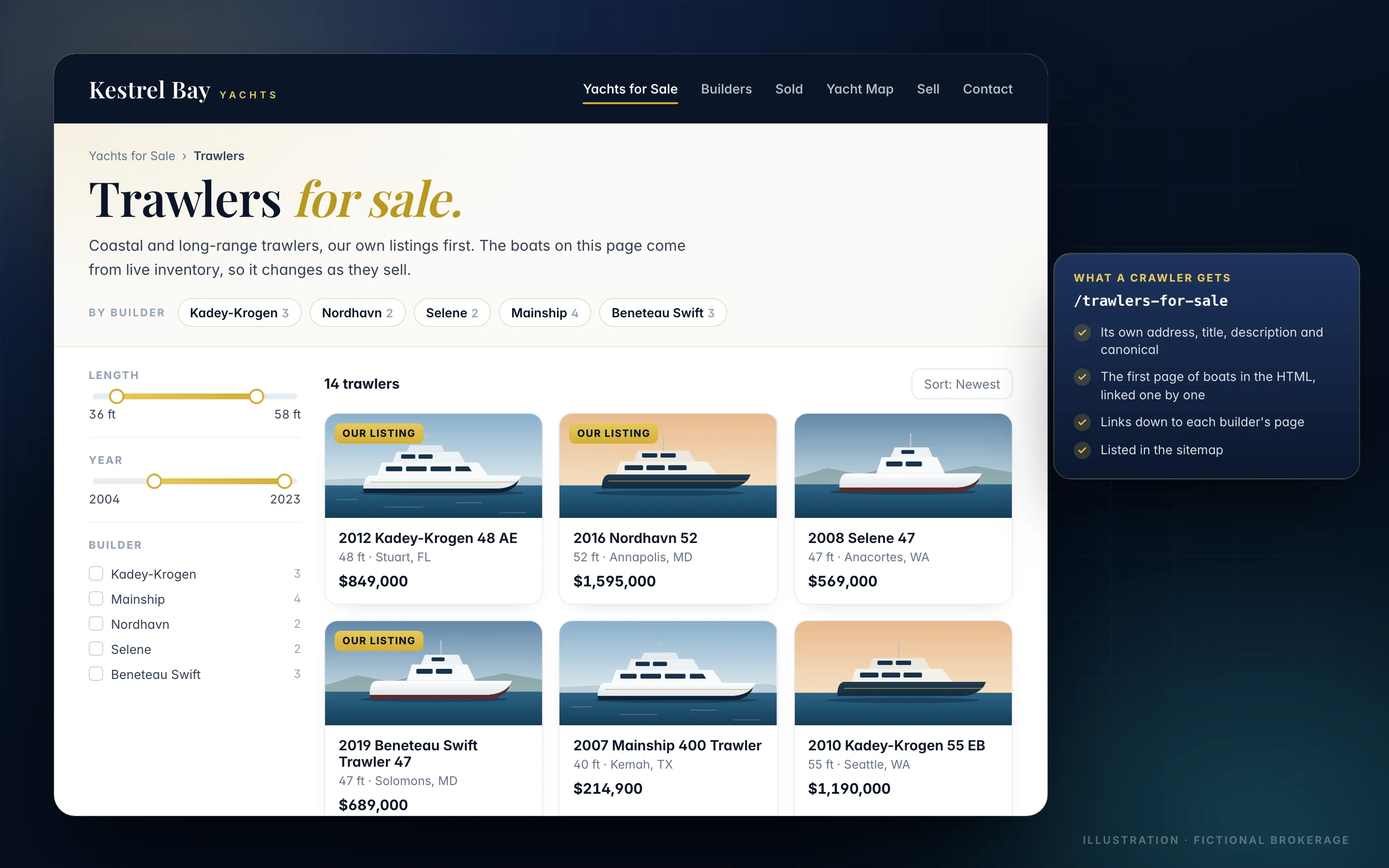
Four searches, four kinds of page.
A buyer starts wide and gets specific. Each step is a search someone types, and each deserves a page at its own address that answers it. A listings page with a filter applied is not that page: it has one address, one title and one canonical however it is filtered.
The last rung, the boat’s own page, is covered in SEO for yacht brokerages.
- used trawlers for sale
/trawlers-for-saleBoat-type page - kadey-krogen for sale
/builders/kadey-krogenBuilder page - new beneteau oceanis
/new-beneteauNew-model page, for dealers - 2012 kadey-krogen 48 ae
/listings/2012-kadey-krogen-48-ae-…The boat's own page
Five kinds of page, filled from your stock.
Your site can have whichever fit the boats you sell. The boats on each come from your inventory feed or the built-in admin, and the pages refresh as listings come in, change and sell.
Boat-type pages
/trawlers-for-sale · /sailboats-for-sale · /center-consoles-for-sale · /sportfish-boats-for-saleOne per type you sell: trawlers, sailboats, center consoles, sportfish, express cruisers, motor yachts, catamarans, Great Loop boats. Each has its own title, description and introduction, with the type locked so filters narrow it but never widen it.
Builder pages
/builders/kadey-krogen · /sailboats-for-sale/beneteauA chapter about the builder in your words, then its boats with the make pinned. The head photo can be the first boat on the page, so it changes as listings do. With nothing listed, the page says so plainly.
New-model pages
/new-boats · /new-beneteauFor dealers: each new model is kept in the admin like a listing and grouped by builder and range. Add, remove or re-range a model and the menu and brand page follow.
A sold archive
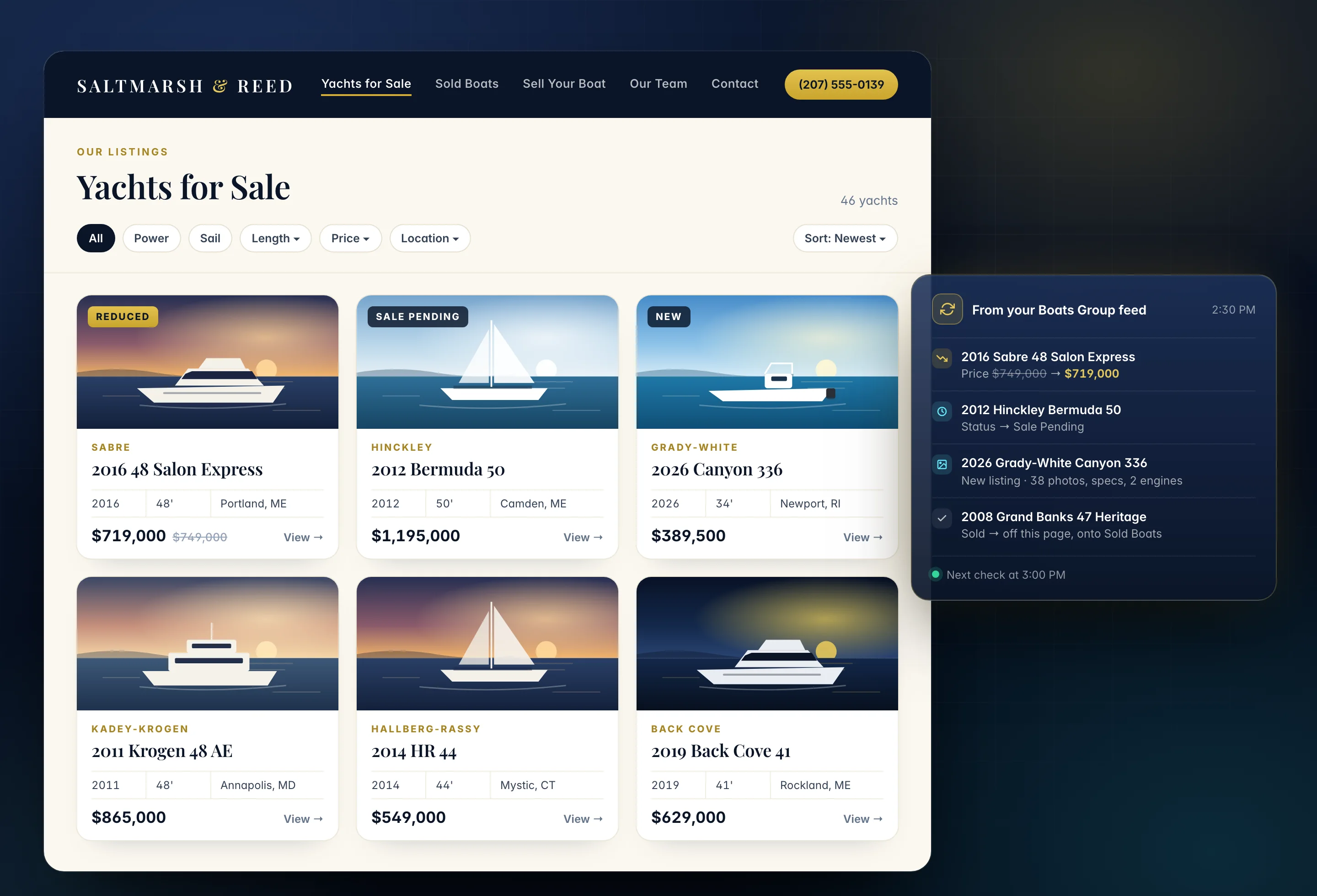
/sold-boatsYour own closed sales, never co-brokered boats from the wider pool. Sold prices can stay private. A boat moves here when she sells, and her page stays live.
A yacht map
/yacht-mapEvery one of your listings where she lies, with a search for boats within a chosen distance of a ZIP code. Boats the map can't place are listed under it, not dropped.
Landing pages, not doorway pages.
Pages generated from a feed can drift into what Google’s spam policies describe. Here is what those policies say, in Google’s words.
“Doorway abuse is when sites or pages are created to rank for specific, similar search queries. They lead users to intermediate pages that aren’t as useful as the final destination.”
- “Having multiple domain names or pages targeted at specific regions or cities that funnel users to one page”
- “Creating substantially similar pages that are closer to search results than a clearly defined, browseable hierarchy”
Among Google’s examples: “Scraping feeds, search results, or other content to generate many pages” where little value is provided to users.
Source: Google Search spam policies
How we build them
- A page for a type or builder you really sell, not every name in the feed
- Words of its own on every page: an introduction, a chapter about the builder
- Linked from the menus, so the pages form a hierarchy a visitor can browse
- No town-by-town copies of the same page
- Filter combinations stay views of one page, never pages of their own
Endless ways to filter. A handful of pages to rank.
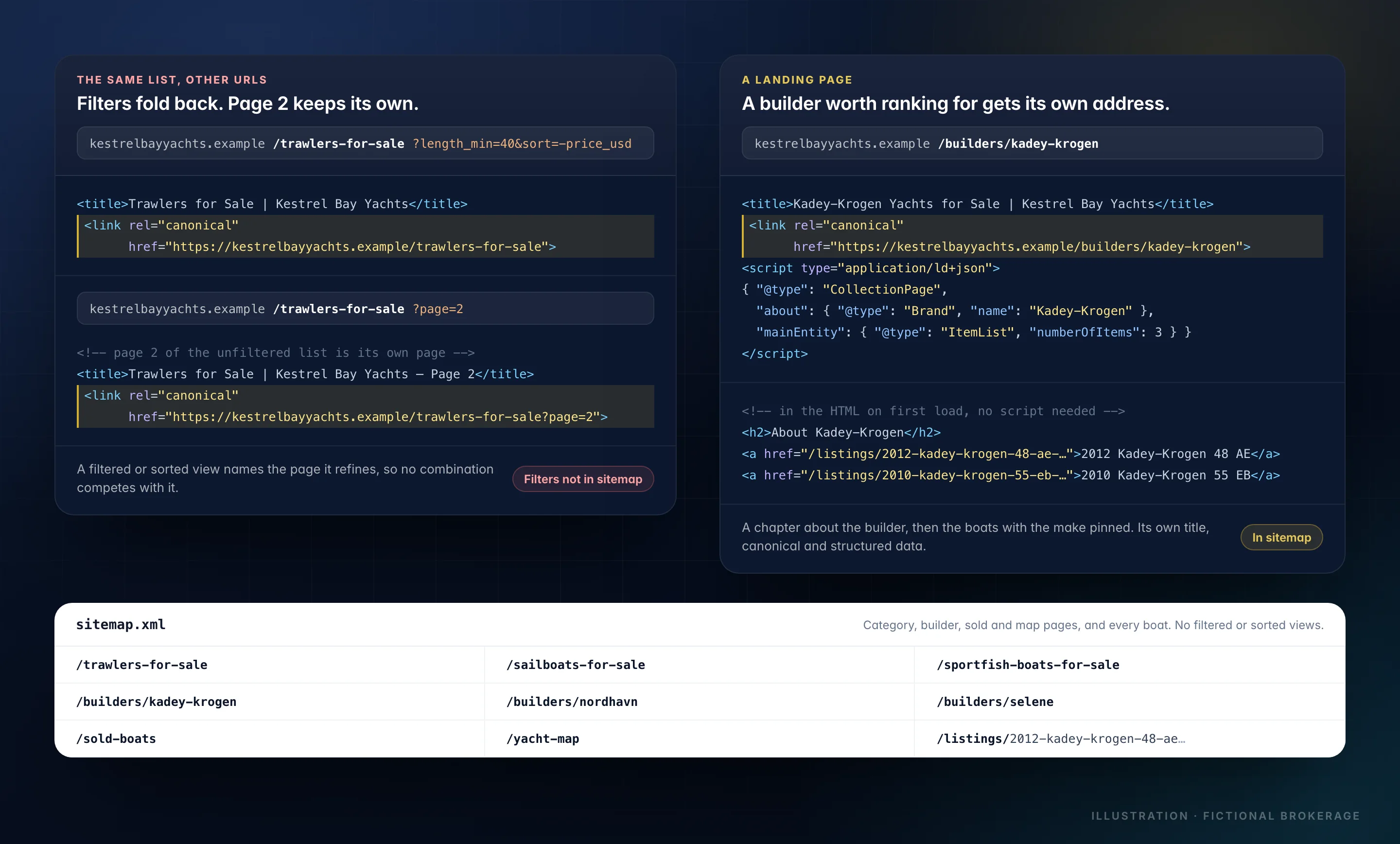
Length, year, price, builder and sort order multiply into more URLs than any brokerage has boats. Google calls this faceted navigation, and the job is to keep those URLs out of the way of the pages that matter.
| Topic | Google’s guidance | On a site we build |
|---|---|---|
| Filter and sort URLs | If you don't need faceted URLs in Search, stop them being crawled, or point rel="canonical" at the unfiltered version (which Google says is generally less effective in the long term). | Every filtered or sorted view names the unfiltered page as its canonical, and no filter URL is ever listed in the sitemap. |
| Numbered pages | Give each page of a series its own URL, and don't use the first page as the canonical for the rest. | Where a site has numbered pages, page 2 keeps its own canonical and adds “— Page 2” to its title. |
| Site structure | Link from menus to category pages, from category pages to sub-categories, and from those to all product pages. | Yachts for sale, then the type, then the builder, then the boat, with breadcrumbs back up each step. |
Sources: Google’s guides to faceted navigation, pagination and ecommerce site structure.
A sold archive and a yacht map that keep themselves.
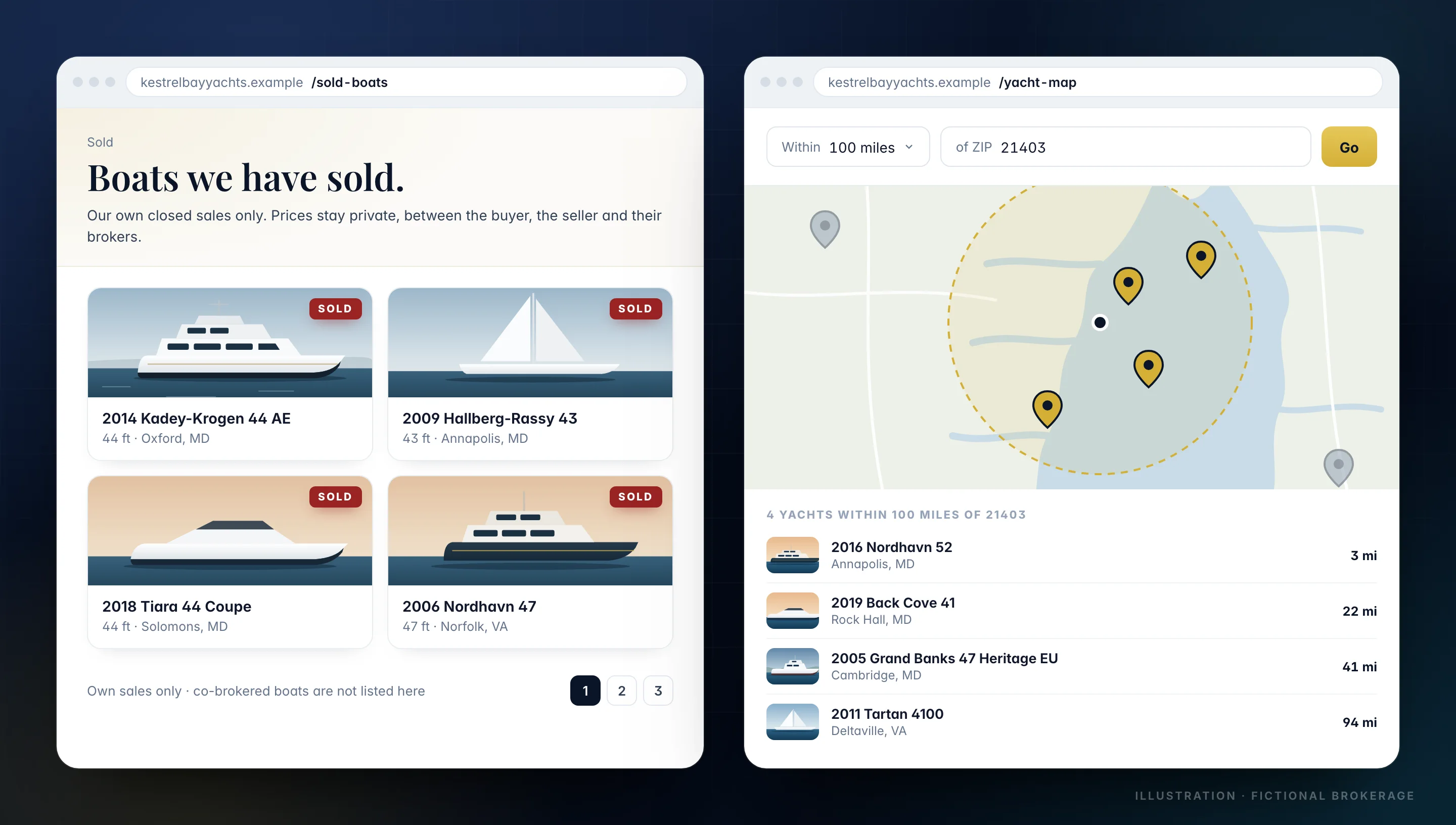
The sold archive
When a boat sells, she leaves the for-sale pages and joins the archive, and her own page stays live for anyone still searching for her. Sold boats are listed in the sitemap only on sites that have a sold page. For an owner deciding who to list with, it is the proof of what you have closed: see seller pages that win listings.
The yacht map
Each boat is placed from the town, state and country on its listing, using a place table that ships with the site, so no paid geocoder is involved. The ZIP-code search runs on the site itself, and a new listing reaches the map when the page next refreshes.
Included in the Website plan at $350 a month, with no build fee. Getting the inventory onto the site in the first place is covered in YachtWorld listings on your website; being quoted in AI answers in getting your brokerage into ChatGPT.
How YachtOne websites are builtEverything Else You Might Ask.
Should a yacht brokerage website have separate pages for trawlers, sailboats and center consoles?
Yes, for the types you actually sell. Buyers search by type (“used trawlers for sale”, “center consoles for sale”), and a page at its own address, with its own title and description, gives that search somewhere to land. A filter on your main listings page doesn't: its address carries a query string, and it names the main page as its canonical.
Google's ecommerce guidance describes the shape to aim for: links from menus to category pages, from category pages to sub-categories, and from there to every product. For a brokerage that is yachts for sale, then the type, then the builder, then the boat.
Is a builder page worth it with only one or two of that builder listed?
It can be, if the page has something to say beyond the grid. The builder pages we build open with a chapter about the builder in the brokerage's own words (its history, what its boats are known for, what to look for), then show the boats with the make pinned, so a visitor can narrow by length, year or price without filtering their way out of the builder.
A page that is only a list of one boat adds little. Build pages for the builders you know and sell regularly, not for every name in the feed.
What does a builder page show when nothing from that builder is listed?
On the sites we build, it says so plainly. The chapter about the builder stays, the grid shows an honest empty state, and the introduction points the visitor to the brokers rather than promising listings that aren't there. When a boat of that make comes in, it appears on the page at the next refresh, with no one editing anything.
Are boat-type and builder pages doorway pages?
Not when they are part of a site people can browse and each one is useful on its own. Google describes doorway abuse as pages created to rank for specific, similar search queries that lead users to intermediate pages less useful than the final destination. Its examples include pages targeted at specific regions or cities that funnel users to one page, and substantially similar pages that are closer to search results than a clearly defined, browseable hierarchy.
Separately, its scaled content abuse policy names scraping feeds to generate many pages where little value is provided to users. Inventory pages sit close to that line by nature, which is why each one we build has its own words, links into the site's menus, and exists only for a type or builder you really sell.
Do filtered URLs like ?length_min=40 get indexed?
They aren't offered as pages. On a site we build, a filtered or sorted view of a listing page names the unfiltered page as its canonical, and filter URLs are never listed in the sitemap. A link someone shares with filters in it still opens on the right boats.
Google's faceted-navigation guide says pointing rel="canonical" at the unfiltered version may, over time, reduce crawling of the filtered ones, and that it is generally less effective in the long term than stopping crawlers reaching them at all. Where a site has numbered pages, page 2 of the unfiltered list keeps its own canonical, as Google's pagination guidance asks.
Is a sold-boats archive good for SEO?
Google has no special rule for sold boats; a sold archive earns its place by being useful. For a brokerage it is the record of what it has closed, which is exactly what an owner choosing a broker wants to see, and it keeps a sold boat's page alive for anyone still searching for that boat.
The sold pages we build show the brokerage's own sales only, never co-brokered boats from the wider pool, and can hide sold prices. Sold boat pages are listed in the sitemap only on sites that have a sold-boats page.
Should a dealer's new models and used boats share a brand page?
They can live side by side without competing. On the dealer sites we build, each new model is kept in the admin like any listing and grouped by builder and range on the brand's new-boat page, which updates as models are added or re-ranged. Used boats of the same make stay on the brokerage builder page, so “new Beneteau” and “used Beneteau sailboats for sale” each have a page of their own.
How does the yacht map know where each boat is?
From the town, state and country on the listing itself, matched against a place table that ships with the site, so no paid geocoding service is involved. Boats it can't place honestly are listed under the map rather than dropped. The ZIP-code radius search runs on the site, so a visitor's search never goes to a third party. New listings reach the map as the page refreshes.
What do these pages cost?
They are part of the website: the Website plan is $350 a month with no build fee and includes unlimited yacht search pages (featured, sold, brand and category pages) built from your live inventory feed or the built-in admin.
More problems we solve
Welcome to the First End-to-End Yacht Sales Operating System
We've built the only platform designed specifically for how yacht sales actually happen. From the moment a visitor lands on your site—they never leave your ecosystem.