Get More Yacht Listings: Give Owners a Reason to Ask You First.
Owners decide who to list with long before they pick up the phone. We build the pages they start on — “what is my yacht worth?”, sell your boat, trade in — into your own site, and every request reaches you with the boat already described. A listing enquiry opens a seller deal on its own.
- Built into your site, no build fee
- From $350 a month
- No instant-price widget
“Getting more boat listings.”
The answer a yacht-sales trainer says his students “always come back with” when he asks for their main challenge. His advice is to turn it round: why would a seller want to list with you?
- Used boats, North America, 2025
- 139 daysaverage time to sell, up 16 days on 2024
- New boats, North America, 2025
- 279 daysaverage time to sell, up 50 days
Selling times: Boats Group 2025 Year-End Market Index, as published by Denison Yacht Sales. When boats take longer to sell, every new listing, and every well-priced one, is worth more.
Three doors, one for each kind of owner.
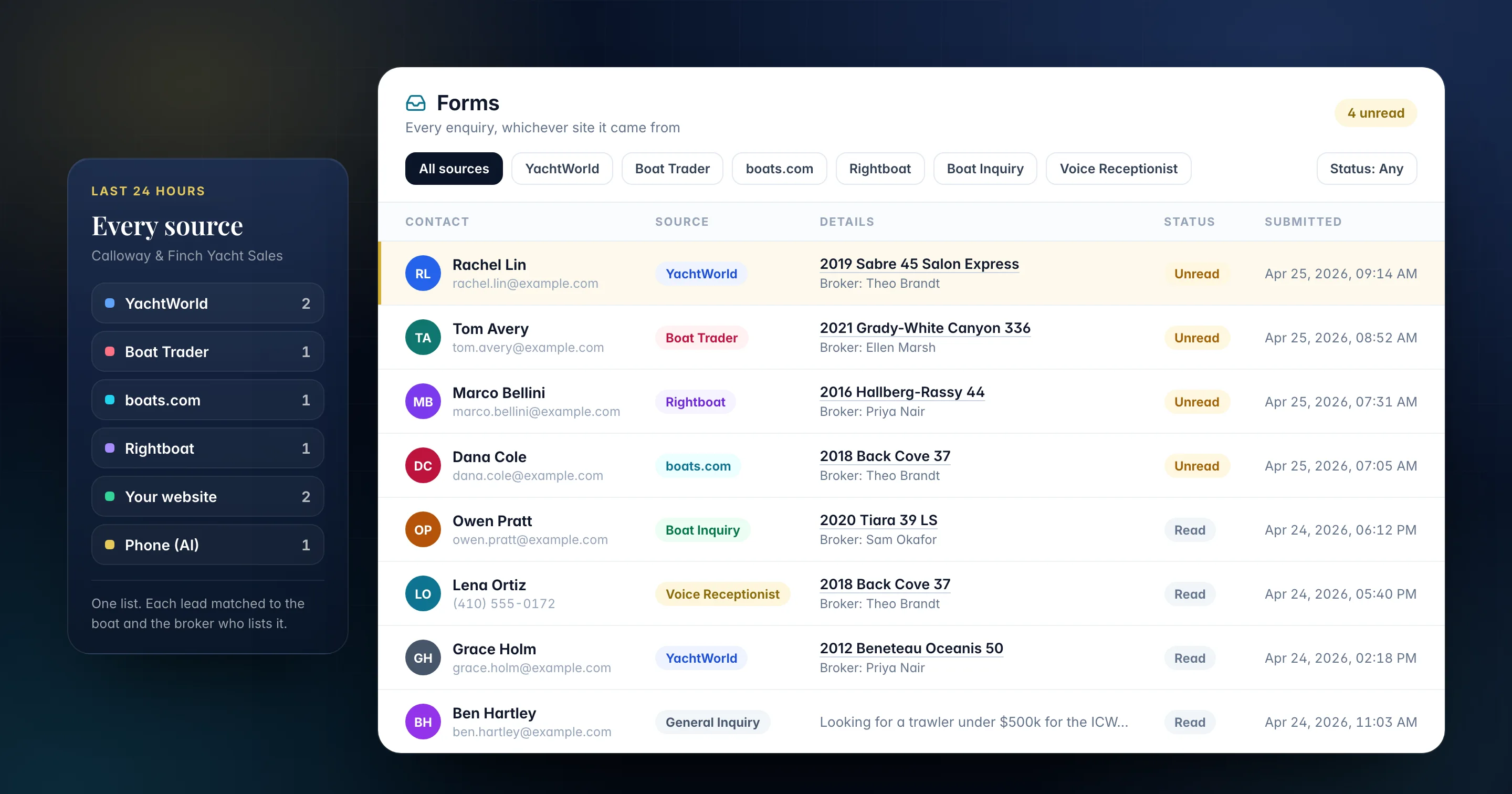
Your site can have any of them, at the addresses owners already type, written in your brokerage’s words. Each form asks what a broker needs and files the answer where it belongs.
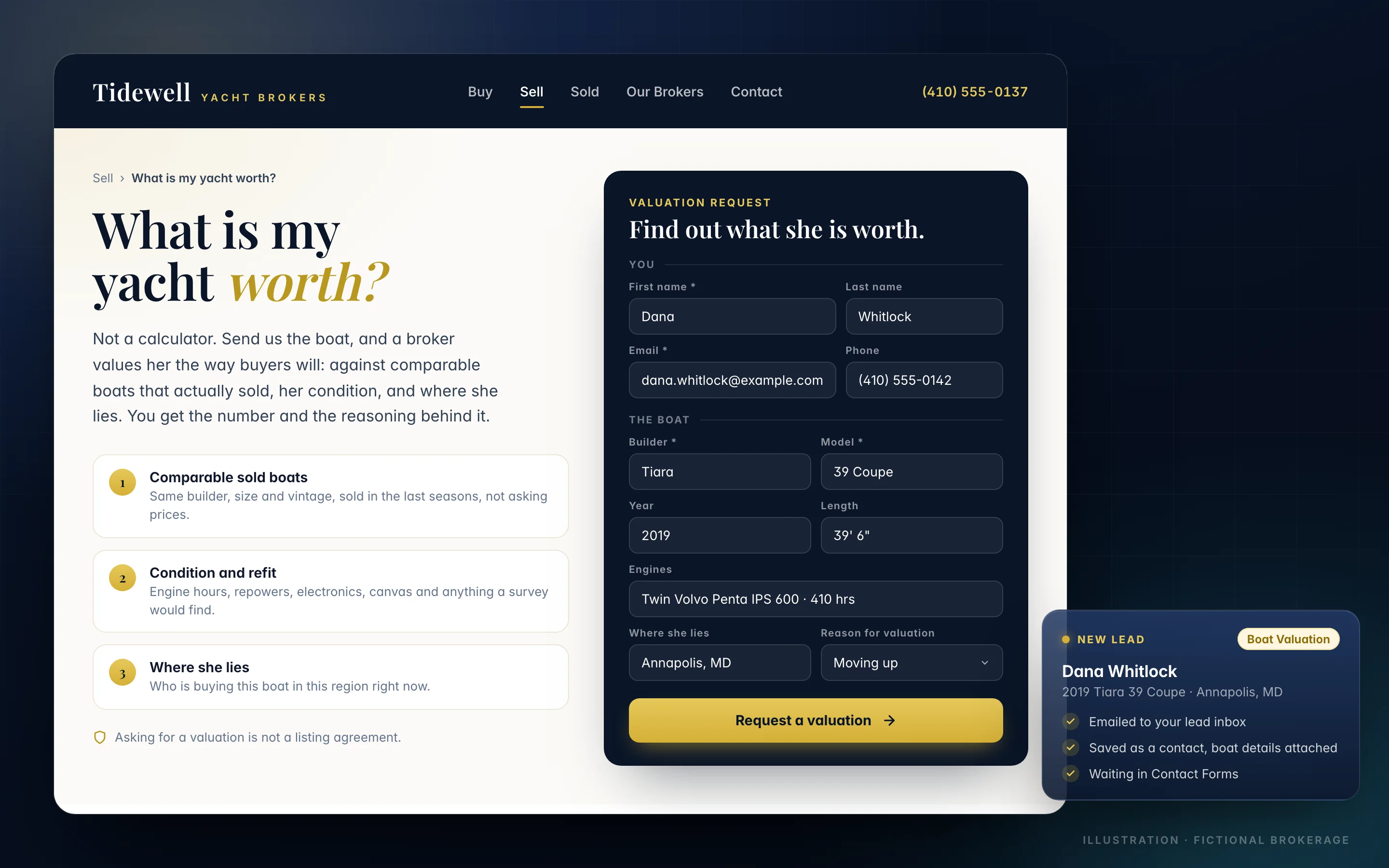
/what-is-my-yacht-worthWhat is my yacht worth?
The owner who is only thinking about it
- It asks
- Builder, model, year, length, engines and hours, where she lies, and why they want a valuation.
- It lands as
- A Boat Valuation lead. You decide whether it opens a seller deal or waits for a broker.
/sell-your-boatSell your boat
The owner who has decided
- It asks
- The same boat details, plus the asking price they have in mind and her condition.
- It lands as
- A List Vessel lead, and a seller deal in the first stage of the pipeline.
/trade-in-your-boatTrade in your boat
The dealer customer moving up
- It asks
- The boat they own now, and what they would like to move into.
- It lands as
- A Trade In lead, kept apart from valuations and listing enquiries.
And a seller’s guide to lead into them
Chapters an owner can read before they call: plan and prepare, set your price, preparing the boat, presentation, showings, surveys and negotiation, closing. Each one ends at the form. Next to it, a sold-boats page shows what your brokerage has already closed (see sold archives and other pages built from your inventory).
A valuation page that says it isn’t a calculator.
The obvious build is four fields and a number. We don’t build it. The page explains how your brokerage values a boat (comparable boats that actually sold, her condition, where she lies, who is buying) and asks for what a broker needs to do that. The owner gets a real figure and the reasoning, from a person.
- Condition, engine hours and a repower don't show up in builder, model and year
- Two boats of the same model can be a season apart in where they lie and who is buying
- A widget's number and the broker's number, a few days apart, leave the owner trusting neither
What the valuation form collects instead
- The owner: name, email, phone
- The boat: builder, model, year, length
- Engines and hours
- Where she lies
- Why they want a valuation
- Their own notes on refits and equipment
Free text where owners need it: a length of 45′ 6″ stays 45 feet 6 inches, and a builder that isn’t in a dropdown is never turned away.
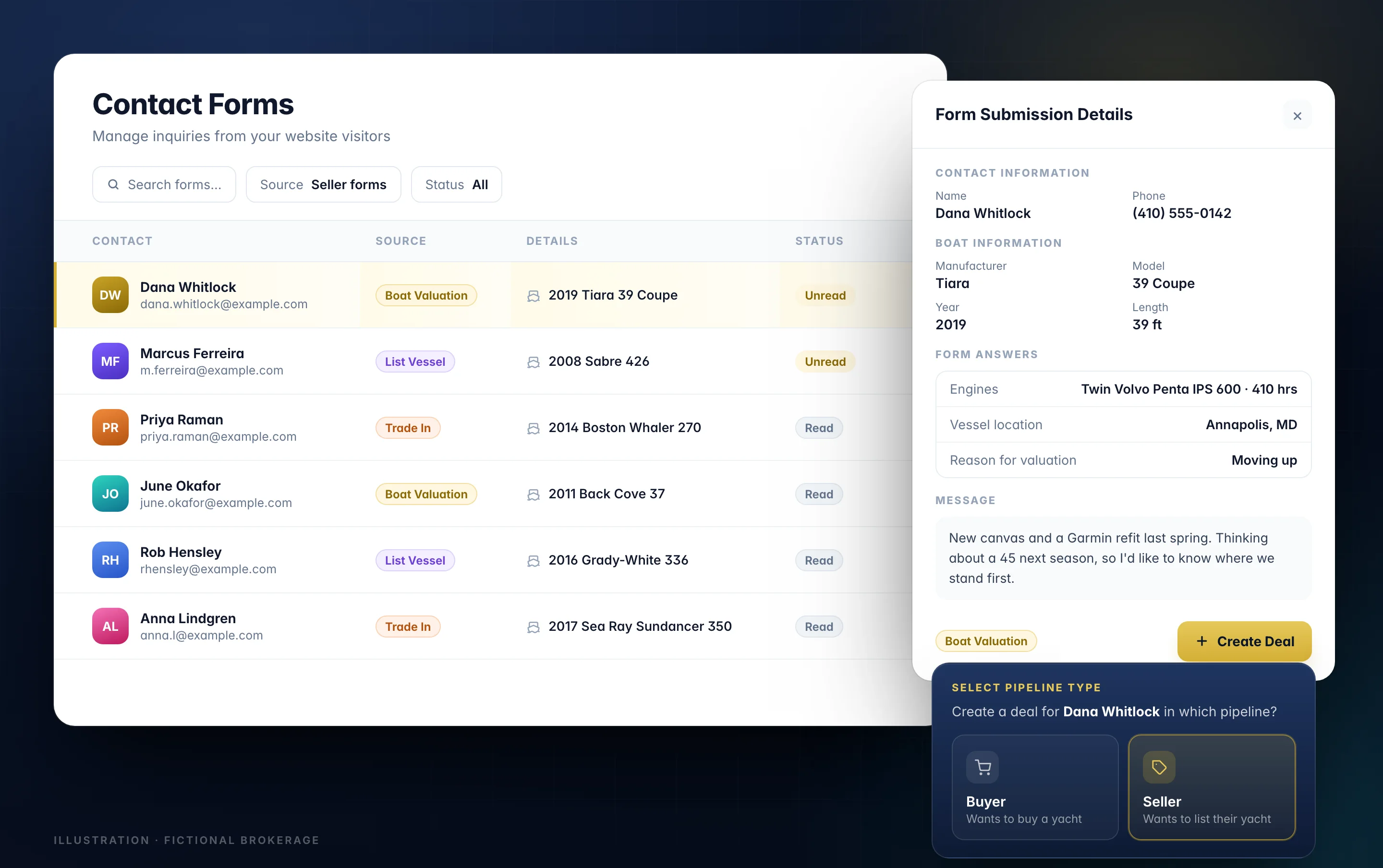
Every seller request, labelled and complete.
- 01
An email to your lead inbox
The owner's details and the boat, sent to the addresses you choose for leads. A form can copy one extra inbox of its own, such as a valuations address.
- 02
A contact, with the boat attached
Builder, model, year and length in their own fields; engines, location and the owner's reason as labelled answers. Nothing is buried in one long message.
- 03
Labelled by what the owner asked for
Boat Valuation, List Vessel or Trade In, so seller requests never hide among buyer enquiries. Open one and choose Create Deal, then Seller.
- 04
Ready to take elsewhere
Export to CSV with a column per answer, or let it reach HubSpot with the boat details when HubSpot is connected.
The owner who asked becomes a card on the seller board.
A listing enquiry opens a seller deal in the first stage, titled boat first (“2008 Sabre 426 - Marcus Ferreira”) with the vessel details filled in. The deal’s History tab keeps the original submission and the owner’s own words. Rename the stages to fit how you work.
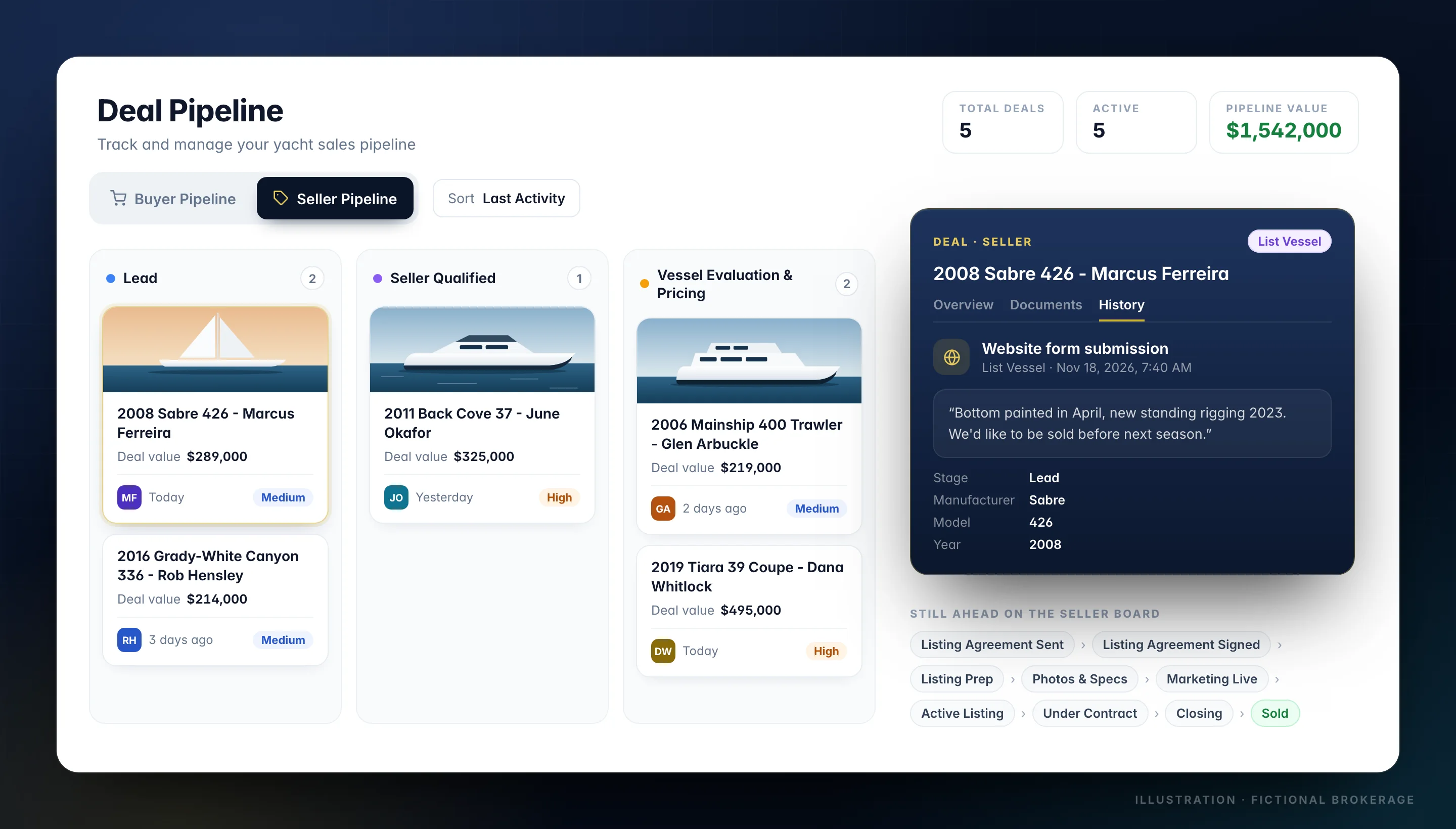
- 01Lead
- 02Seller Qualified
- 03Vessel Evaluation & Pricing
- 04Listing Agreement Sent
- 05Listing Agreement Signed
- 06Listing Prep
- 07Photos & Specs
- 08Marketing Live
- 09Active Listing
- 10Under Contract
- 11Closing
- 12Sold
Seller pages come with the website.
Monthly, no build fee and no minimum term. Each plan adds what happens after the owner presses send.
Website
$350/month
- Seller pages written for your brokerage
- Valuation, listing and trade-in forms
- Every request emailed to your lead inbox
- A sold-boats page to show what you have closed
Website + CRM
$500/month
- Everything in Website
- Owners saved as contacts, the boat attached
- Lead Analytics: the boats they viewed before asking
- HubSpot, Mailchimp and Constant Contact sync
Full Platform
$850/month
- Everything in Website + CRM
- The seller pipeline, from Lead to Sold
- Listing enquiries open a seller deal on their own
- Broker logins for the whole team
Full plan details are on the pricing page. Portal enquiries from buyers are a different job, covered in YachtWorld & Boat Trader lead management.
Everything Else You Might Ask.
Should a yacht brokerage offer free boat valuations on its website?
A valuation request is the most natural first step an owner can take, because it asks nothing of them: no listing agreement, no commitment, just a question they already have. That makes it a good front door for listing leads.
What matters is what happens next. On a site we build, the request reaches the brokerage's lead inbox straight away, with the boat's builder, model, year, length, engines and location already filled in, so a broker can reply with a real answer instead of a list of questions.
Can the website give an owner an instant price for their boat?
We don't build one, and the valuation pages we build say so. A number generated from builder, model, year and length can't see condition, engine hours, a repower, electronics or where the boat lies, and an owner given one figure by a widget and a lower one by a broker a few days later trusts neither.
Instead the page explains how the brokerage values a boat (comparable boats that sold, condition, location and who is buying) and the form collects what a broker needs to apply that method.
What should a boat valuation form ask the owner?
Enough to value the boat without a phone call first: name, email and phone; builder, model, year and length; engines and hours; where she lies; and why they want a valuation. A listing form usually adds the asking price they have in mind and the condition. Some brokerages also ask for the hull identification number; it can be optional so it doesn't put owners off.
Each answer is saved as its own field, not pasted into one message, so it can be filtered, exported to CSV and sent to HubSpot as the boat details.
Does a valuation request open a deal in the seller pipeline?
That is the brokerage's choice, made per form. A listing enquiry opens a seller deal in the first stage of the pipeline automatically. A valuation request can do the same, or it can wait in Contact Forms as a Boat Valuation lead, because some brokerages promise that asking for a valuation is not a listing agreement.
Either way, a broker can open the submission and choose Create Deal, then Seller, the moment the conversation turns into a listing. The contact and the boat details carry across.
Who is told when an owner fills in a seller form?
The addresses your brokerage has set to receive lead notifications get an email with the owner's details and the boat. A form can also copy one extra inbox of its own, for example a valuations address, on top of those. The request is saved as a contact with the boat attached, and on the Full Platform a listing enquiry appears on the seller board.
Can a boat dealer take trade-in requests the same way?
Yes. A trade-in form collects the boat the customer owns now (builder, model, year, length) and what they would like to move into. It arrives labelled Trade In, separate from valuation requests and listing enquiries, so a sales manager can see the trades waiting without reading every message.
Do seller leads reach HubSpot?
Yes, if HubSpot is connected (included from the Website + CRM plan). Seller forms are forwarded with the boat's year, make, model and length as well as the owner's details, so a valuation request doesn't arrive in HubSpot as a blank contact.
How long are boats taking to sell right now?
According to the Boats Group 2025 Year-End Market Index, as published by Denison Yacht Sales, used boats in North America averaged 139 days to sell in 2025, 16 days more than in 2024. New boats averaged 279 days, up 50.
Longer selling times make every new listing, and every well-priced one, worth more to a brokerage. That is the argument for making it easy for an owner to start the conversation with you.
What do the seller pages cost?
Seller pages and their forms are built into the website, with no build fee: the Website plan is $350 a month and includes unlimited forms with email submissions. The contacts CRM, Lead Analytics and HubSpot sync come with Website + CRM at $500 a month. The seller pipeline, with deals opened automatically from listing enquiries, is in the Full Platform at $850 a month.
More problems we solve
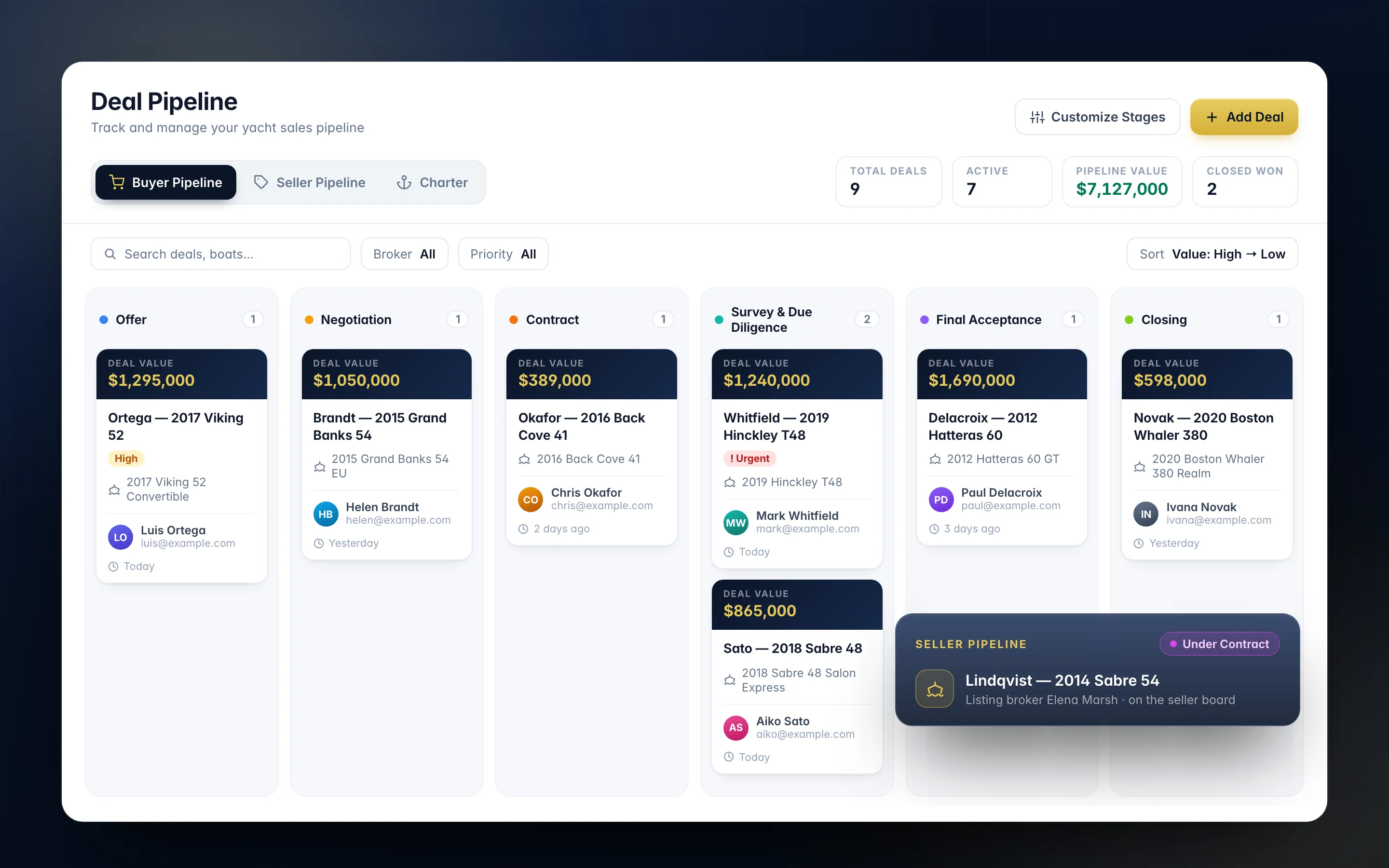
Welcome to the First End-to-End Yacht Sales Operating System
We've built the only platform designed specifically for how yacht sales actually happen. From the moment a visitor lands on your site—they never leave your ecosystem.