A Website for International Yacht Buyers, in English and Spanish.
The buyer in Monterrey, Bogotá or Madrid reads your site in Spanish: menus, listings, filters, the contact form and your own pages, each at its own /es address with the hreflang tags Google asks for. Prices show in the currency each boat is listed in. We build the Spanish version into your site.
| English | Español |
|---|---|
| Yachts for sale | Yates en venta |
| Price on request | Precio a consultar |
| Sale pending | Venta pendiente |
| Send message | Enviar mensaje |
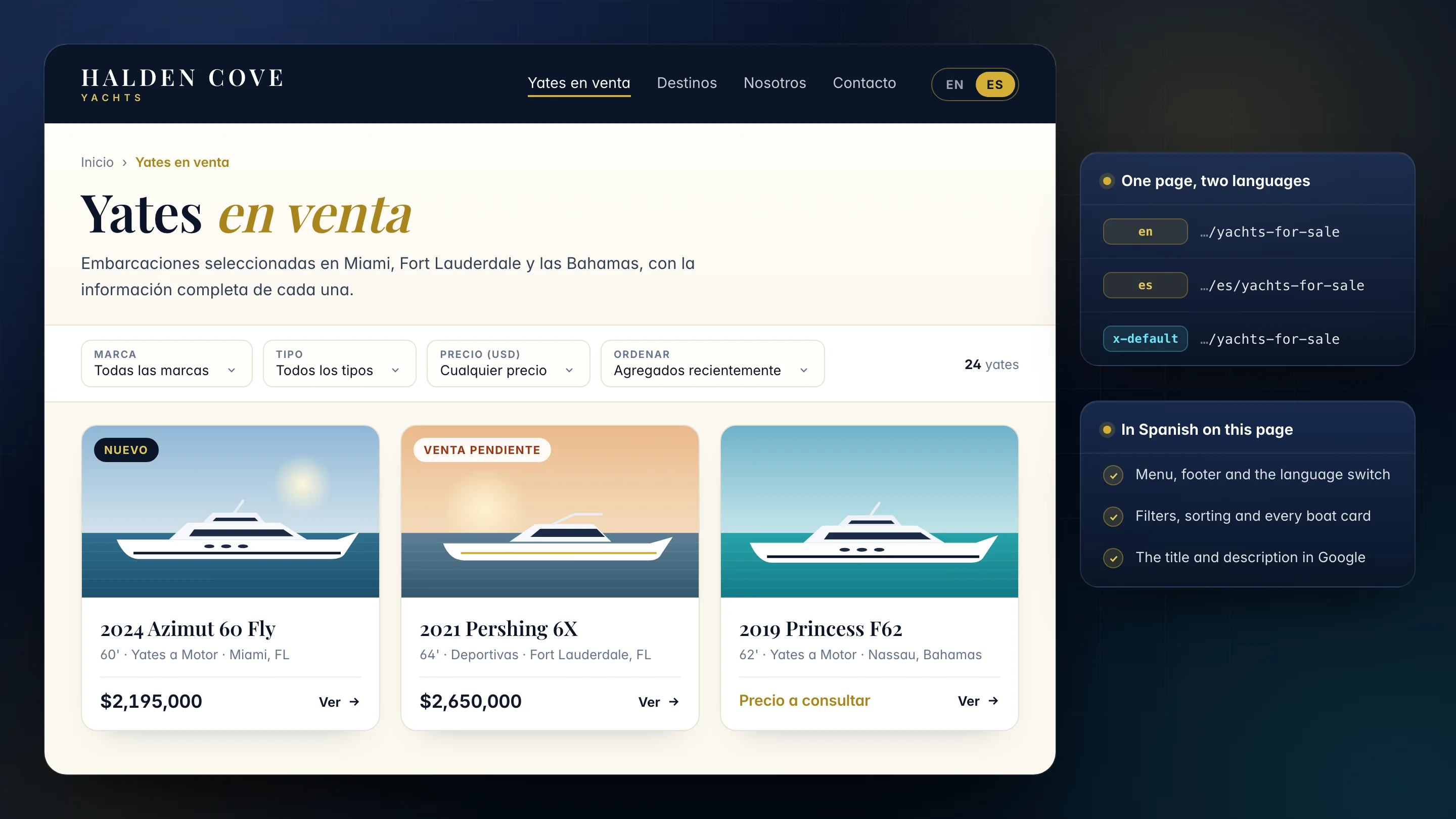
What reads in Spanish, and what stays English.
A Spanish site that switches back to English two clicks in loses the buyer and confuses Google. Here is exactly where the line falls.
En español
- The menu, the footer and a language switch that opens the same page in the other language
- Your home page, about page and the pages you write about your boats and waters
- Destination and boat-type pages
- The listings page: filters, sorting and every boat card
- The contact form, its errors and its thank-you message
- The title and description Google shows for each page
Stays in English
- Each boat's description and specs, which come from your listing feed
- Charter yacht details from your charter feed
- News articles you have written in English
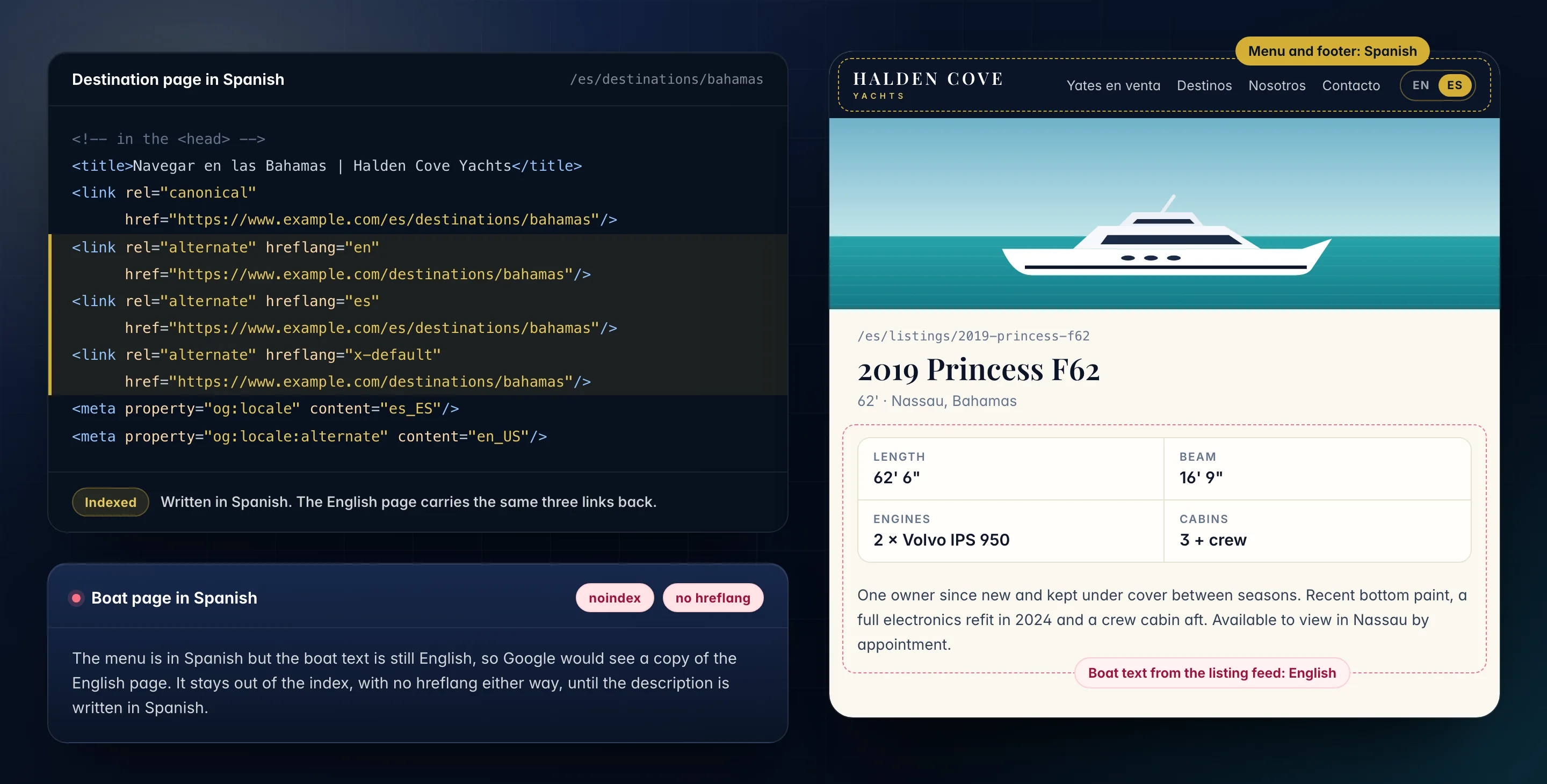
Those pages still get Spanish menus, so a buyer never lands back in English navigation. They are kept out of Google until the text itself is written in Spanish.
The four rules Google sets, and what your site does about each.
- 01
“Each language version must list itself as well as all other language versions.”
Every indexed Spanish page lists itself, its English twin and an x-default. The English page lists the same three.
- 02
“If two pages don't both point to each other, the tags will be ignored.”
Both sides are written from the same list of pages, so a link is never one-way.
- 03
“Localized versions of a page are only considered duplicates if the main content of the page remains untranslated.”
A boat page with Spanish menus over English feed text is kept out of the index, with no hreflang, until the boat text is Spanish.
- 04
“Google recommends using different URLs for each language version of a page.”
Spanish lives at /es addresses, listed in your sitemap. Nobody is redirected by browser language.
Quoted from Google Search Central: Tell Google about localized versions of your page and Managing multi-regional and multilingual sites.
The asking price, in the currency it was listed in.
Buyers abroad compare boats across portals and brokerages. The price that holds up is the seller’s own number in the seller’s own currency, not a converted figure that moves with the market.
Listed in euros, shown in euros
A boat priced in euros by its listing keeps that price and that currency on the page. Nothing is rounded into dollars.
Listed in dollars, shown in dollars
The asking price is the listing's own number, in the currency it was entered in, on every page and every language.
US and Canadian dollars side by side
A second price in USD or CAD can sit beside the first, converted at the day's published exchange rate and refreshed daily.
Not built
Conversion into pesos, reais or any other currency, and a currency picker for the visitor.
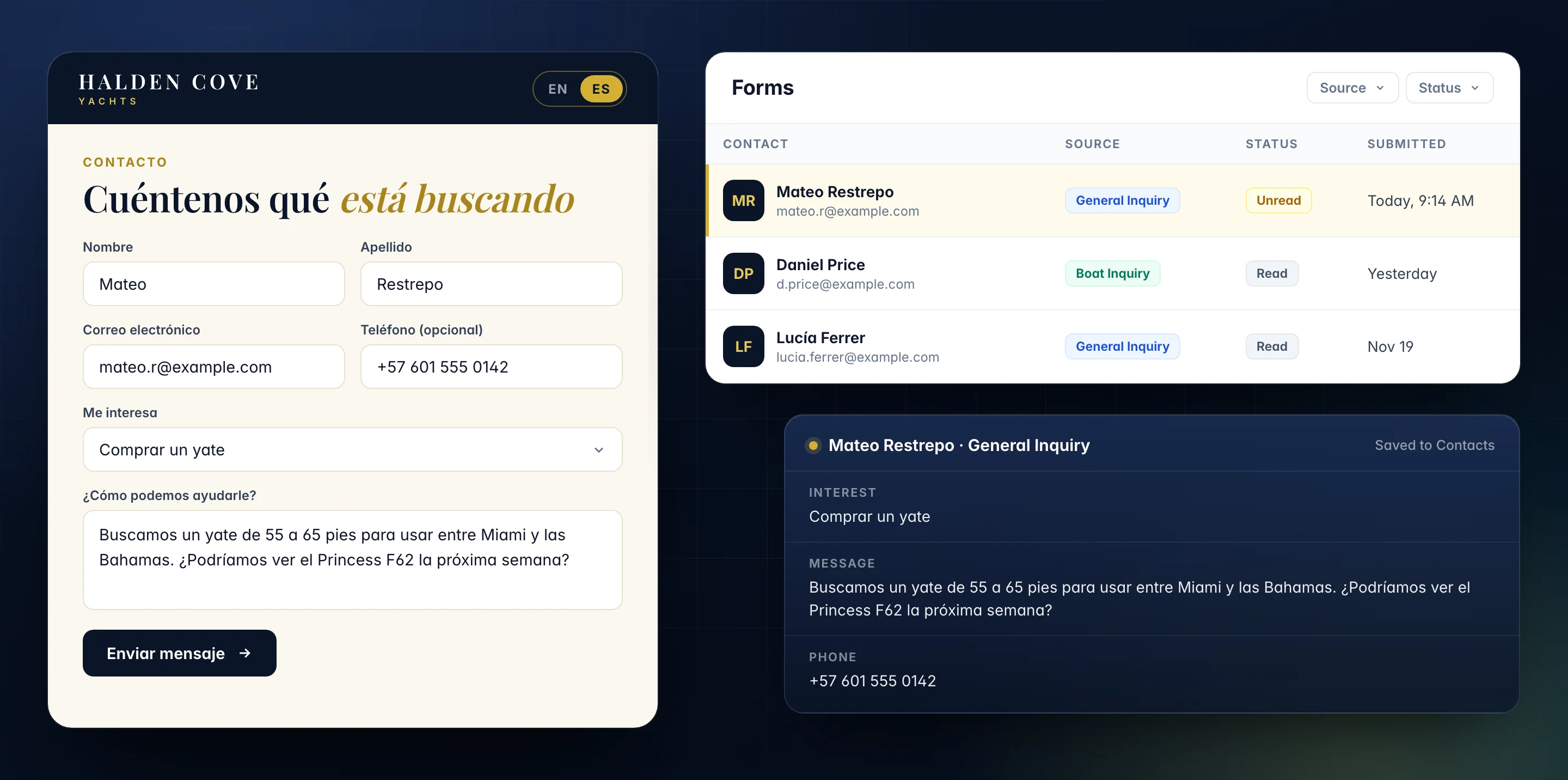
A Spanish enquiry, in the same inbox as the rest.
- The form, its labels and its thank-you message are in Spanish
- The enquiry lands in the same Forms list as every other one, in the buyer's words
- What they chose under “Me interesa” files with the English answers, so the two sort together
On Website + CRM the buyer is saved as a contact, ready for the follow-up. Leads from YachtWorld and Boat Trader land in the same place: see YachtWorld & Boat Trader lead management.
Built into your site, page by page.
Spanish runs on one YachtOne site today. Yours is set up the same way. For the rest of the search side, see SEO for yacht brokerages.
- 01
Choose the pages
Home, about, destinations, boat types, the listings page, contact and legal. Start with the pages Spanish-speaking buyers actually land on.
- 02
We write the Spanish
Menus, buttons, forms and your page copy, stored with your site. Someone on your team who sells in Spanish reads it before launch.
- 03
We wire it for Google
/es addresses, hreflang both ways, the Spanish title and description on each page, and the /es pages in your sitemap.
- 04
Boat pages wait for their text
They get Spanish menus straight away and stay out of the index until the description itself is in Spanish.
Everything Else You Might Ask.
Can you build a Spanish version of our yacht brokerage website?
Yes. We build it into your site: the same pages at their own /es addresses, with the menu, footer, listing filters, boat cards, contact form and your own pages written in Spanish, and a language switch that opens the same page in the other language.
It is built per site rather than switched on. One YachtOne site runs a Spanish version today, and the next one is set up the same way.
Is the Spanish machine-translated?
No. Nothing is translated on the fly. The Spanish for your menu, buttons, forms and pages is written once, stored with your site, and served as ordinary pages.
Have someone on your team who sells in Spanish read it before it goes live. Words like eslora, chárter or embarcaciones are trade vocabulary your buyers know, and the register (usted or tú) should be your call.
Will each boat's page be in Spanish too?
Partly. On the Spanish listings page the filters, sorting and boat cards are in Spanish. On a single boat's page the menu and footer switch to Spanish, but the description and specs are the text from your listing feed, which is in English.
Because that page's main content is English, it is kept out of Google's index and carries no hreflang link until the boat text itself is in Spanish. Google's own guidance is that a localized page whose main content is untranslated counts as a duplicate.
Will Spanish pages compete with our English pages in Google?
Not when they are linked properly. Every Spanish page we index lists itself, its English twin and an x-default in hreflang tags, and the English page lists the same three back.
Google's documentation is specific: “Each language version must list itself as well as all other language versions,” and “If two pages don't both point to each other, the tags will be ignored.” The /es pages are also listed in your sitemap.
Does the site send Spanish speakers to the Spanish version automatically?
No, and that is deliberate. The visitor chooses the language and the choice is a different URL, so a buyer, a broker sharing a link and Googlebot all see the same page.
Google recommends “using different URLs for each language version of a page” and says to “Avoid automatically redirecting users from one language version of a site to a different language version of a site.”
Can buyers see prices in euros, pesos or their own currency?
Each boat shows its asking price in the currency it is listed in, so a boat listed in euros shows in euros and a boat listed in dollars shows in dollars.
A second price in US or Canadian dollars, converted at the day's published exchange rate and refreshed daily, can sit beside the first. There is no conversion into pesos, reais or other currencies, and no currency picker for the visitor.
What about Portuguese, French or Italian?
Not today. The sites support English and Spanish. If your buyers are mostly in Brazil or the Mediterranean, tell us; we would rather say no than publish a half-built version.
Where do enquiries from the Spanish pages go?
To the same Forms list as every other enquiry, in the buyer's own words, and by email like any other submission. With Website + CRM the buyer is saved as a contact too, and your team works the lead from there.
What the buyer chose under “Me interesa” (buying, chartering, selling) is stored in the same field as the English form’s “I’m interested in”, so Spanish and English enquiries sort and filter together.
What does a Spanish version of our website cost?
The Website plan is $350 a month with no build cost (the first month covers it), and Website + CRM is $500. The Spanish version depends on how many of your pages need writing in Spanish, so it is scoped with your site rather than listed on the pricing page.
More problems we solve
Welcome to the First End-to-End Yacht Sales Operating System
We've built the only platform designed specifically for how yacht sales actually happen. From the moment a visitor lands on your site—they never leave your ecosystem.